
The United States celebrates its 250th birthday on July 4, 2026, and instead of a unified national celebration, the country is getting exactly what you would expect from this political era: two competing parties, a controversy over who is paying, and a growing list of artists who have decided they would rather not be involved at all.
Two Commissions, One Birthday, Zero Cooperation
The original plan was straightforward. In 2016, Congress created the bipartisan United States Semiquincentennial Commission, known as America250, to plan the nation’s 250th anniversary. The commission was congressionally chartered, independently funded, and designed to operate above partisan politics.
Then the Trump administration created Freedom 250, a White House-controlled task force that effectively sidelined the congressional commission. Federal resources that were supposed to flow to America250 got redirected. the Washington Times reported that America250 received only $25 million of its congressionally appropriated $150 million, with the rest reallocated to the administration’s preferred events.
This is the structural story that the parade coverage will miss. The fight is not about party planning aesthetics. It is about whether a congressionally chartered, bipartisan institution gets to function as designed or gets overridden by executive branch preferences. That pattern shows up in everything from the January 6 committee records to judicial appointments to agency staffing, and the semiquincentennial is just the latest and most symbolic instance.
The Great American State Fair and Its Problems
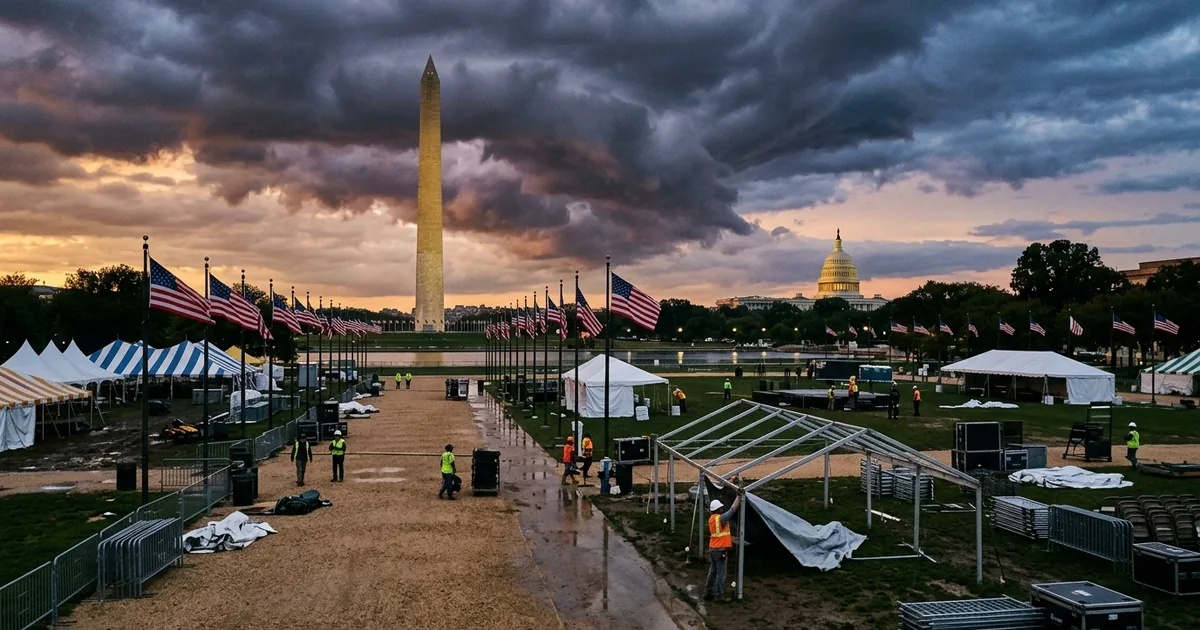
Freedom 250’s centerpiece event is the Great American State Fair on the National Mall, featuring food, games, and what the White House has described as a celebration of American ingenuity. The event has drawn criticism from multiple directions. NPR reported that several states have declined to participate, performers have pulled out over concerns about political association, and a June 2026 Reuters/Ipsos poll found that a majority of Americans, including half of Republicans and three-quarters of Democrats, believe the anniversary events have become too political.
Meanwhile, America250 is hosting its own events, including “America’s Block Party” at the Los Angeles Memorial Coliseum with Chris Stapleton, The Smashing Pumpkins, Chaka Khan, and Anthony Ramos, hosted by Queen Latifah. The parallel programming underscores the split: one celebration in Washington controlled by the White House, another in LA run by the commission Congress actually authorized.
The Artist Exodus Tells the Real Story
Multiple performers who were initially invited to participate in Freedom 250’s Washington events publicly declined, citing concerns that what was presented as a nonpartisan celebration had gradually become associated with the president personally. The pattern is familiar: the same dynamic played out with the UFC Freedom 250 event at the White House earlier this year, which drew more attention for its political optics than for the fights themselves.
The artists who are staying away are making a calculated choice. Performing at a politically branded event carries association costs that outlast a single news cycle, and in an era where social media amplifies every booking decision, the downside risk is real.
What the 250th Should Have Been
Compare this to the Bicentennial in 1976. President Ford presided over national celebrations that included tall ships sailing into New York Harbor, community events in every state, and a unifying tone that cut across Watergate fatigue and Vietnam-era divisions. The celebrations were not apolitical, nothing involving a sitting president ever is, but they were designed to belong to the country rather than to a political brand.
The 250th had the same potential. A quarter-millennium of American independence is worth celebrating regardless of who occupies the White House. Instead, the event has become another front in the culture war, with the structural cause being the administration’s decision to create a parallel planning apparatus rather than work through the bipartisan commission that Congress built specifically for this purpose.
Friday’s fireworks will still be spectacular. The hot dogs will still be eaten. But the story of America’s 250th is not the celebration itself. It is the fight over who controls the narrative, and what that fight reveals about the health of the institutions that are supposed to hold the center.