
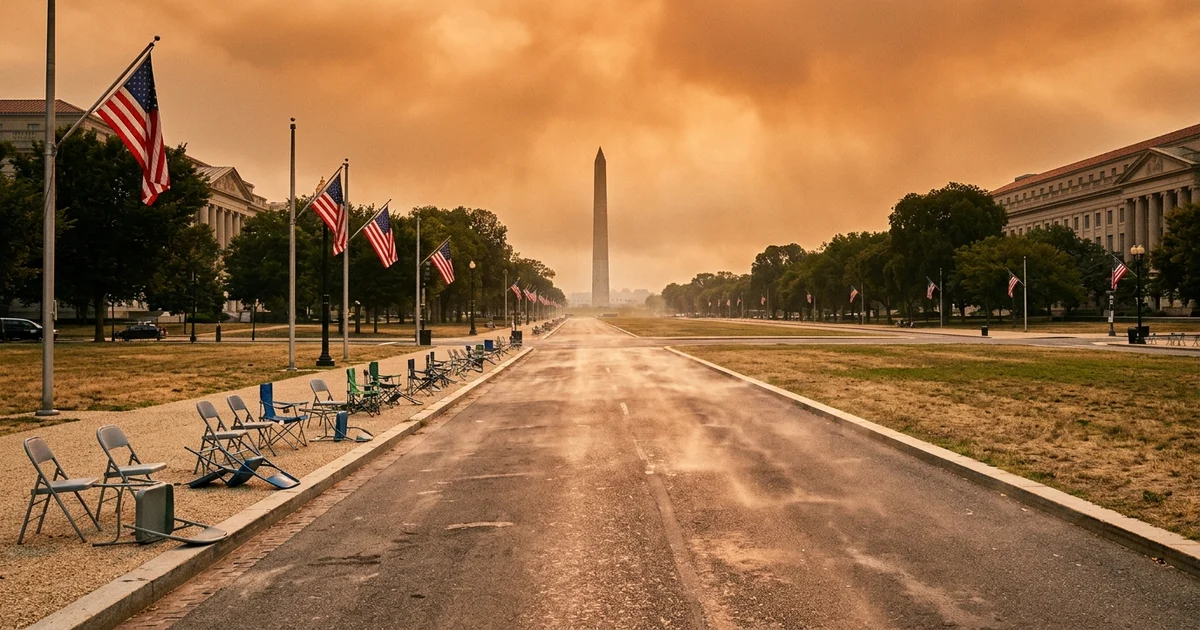
The nation’s capital cancelled its Independence Day parade on Friday as a punishing heat dome pushed heat index values toward 115 degrees Fahrenheit, marking one of the most dramatic disruptions to July Fourth celebrations in modern American history.
More than 185 million people across the central and eastern United States woke up under heat alerts on the holiday itself, and the CDC is already reporting “extremely high” rates of heat-related emergency room visits.
Washington Hit 102 Degrees and Shattered a Record From 1872
The cancellation came after DC recorded 102 degrees on Friday, surpassing a daily high that had stood since 1872. Todd Marcocci, president of Under the Sun Productions, the company that organizes the National Independence Day Parade, said the decision was made “after extensive and careful consideration of the safety of our participants, spectators, and staff.”
He is not the only one scrambling. The Great American State Fair on the National Mall temporarily shut down Friday afternoon, and parades, concerts, and fireworks across the Mid-Atlantic and Northeast were either cancelled or pushed to later in the evening when temperatures were expected to drop. This is not a localized inconvenience. This is a national public health emergency reshaping how Americans celebrate their own founding.
The Numbers Are Getting Worse, Not Better
More than 20 cities broke temperature records on Thursday alone. Several of those cities were hotter than Phoenix, the desert benchmark Americans use as shorthand for unbearable heat. Philadelphia and New York City hovered near 100 degrees with heat indices around 105. Boston, a city whose infrastructure was designed for cold winters, not triple-digit summers, also cracked the century mark.
The CDC flagged the situation as urgent: heat-related ER visits hit “extremely high” levels across the Northeast, and the agency warned that Saturday would be worse. Washington, Boston, New York, Philadelphia, and Raleigh all expanded cooling center hours and deployed extra public health resources. Federal agencies coordinated with the Secret Service and FEMA to add water stations and medical tents across the National Mall, where the fireworks show and evening concert went forward after organizers shifted timing and expanded shade areas.
The structural question here is not whether one parade gets cancelled. It is whether America’s July Fourth tradition, as currently designed, can survive in a climate where triple-digit heat on the East Coast is no longer an anomaly but a recurring feature of early summer. Last month, LNC covered the same heat dome pattern baking 200 million Americans across the Midwest and East Coast. That was June. This is worse.
Air Quality Adds a Second Layer of Risk
The heat alone would be dangerous enough, but the combination of extreme temperatures and massive fireworks displays creates what meteorologists call a “double dose” of unhealthy air. CNN reported that the oppressive heat dome traps pollution at ground level, and the particulate matter from fireworks lingers far longer than it would under normal atmospheric conditions. For people with asthma, heart disease, or other respiratory conditions, the Fourth of July weekend is not a celebration. It is a health hazard.
Colorado took a different approach entirely, with communities across the state cancelling fireworks shows due to ongoing wildfires. The western fire risk and the eastern heat dome are two expressions of the same underlying reality: the calendar of American public life was built for a climate that no longer exists.
Cities that built their entire identity around outdoor Fourth of July traditions are now confronting a question they have been deferring for years. Do you move the parade indoors? Start it at 6 a.m. before the heat peaks? Cancel it permanently and replace it with an evening-only format? None of those options feel like American independence. All of them may be necessary.
What Comes Next
The National Weather Service expects the heat wave to begin loosening its grip by Sunday, but the damage to this weekend’s celebrations is already done. Dozens of events across the DMV, Pennsylvania, and New York were moved, shortened, or scrapped entirely.
The real question is whether event organizers, city governments, and federal agencies will treat this as a one-off disruption or the beginning of a permanent planning challenge. Climate attribution studies have already linked heat waves of this magnitude to fossil fuel emissions, and the frequency of triple-digit days in the eastern United States has roughly doubled over the past two decades. The pattern is not ambiguous.
When the nation’s capital cannot safely hold a parade on its most important civic holiday, that is not a weather story. That is an infrastructure story, a public health story, and, increasingly, a story about what kind of country adapts and what kind pretends the problem is temporary.