
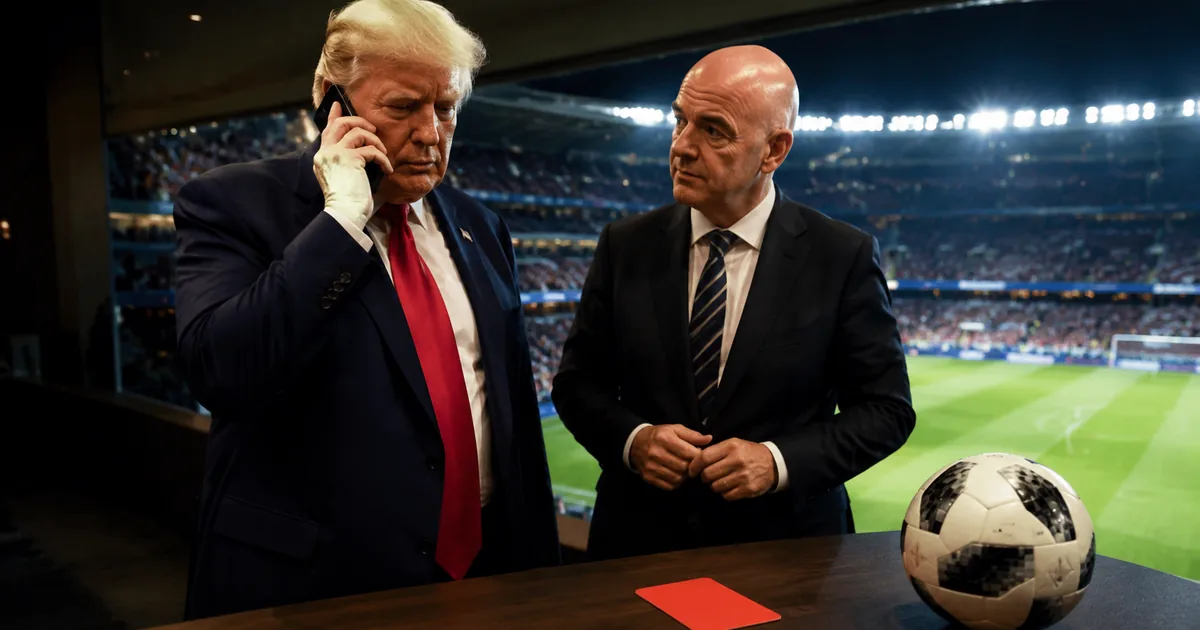
President Donald Trump personally phoned FIFA chief Gianni Infantino to challenge a red card, and days later the suspension vanished.
For the first time in more than sixty years of World Cup play, a sending-off carried no consequence, and the reason was a phone call from the host nation’s head of state.
What Actually Happened
Folarin Balogun, the United States’ 25-year-old lead scorer, was shown a straight red in the round of 32 against Bosnia and Herzegovina on July 1 for stepping on the ankle of defender Tarik Muharemovic. The card triggered the automatic one-match ban that every World Cup player has served since 1962. Under the rulebook, Balogun sits out the next game. Full stop.
Except he didn’t. Trump called Infantino on Wednesday to ask why the card was issued, the U.S. government forwarded what it described as “additional evidence” to FIFA, and the Disciplinary Committee then reached for Article 27 of its disciplinary code, the clause that lets a judicial body “fully or partially suspend the implementation of a disciplinary measure.” FIFA converted the ban into a one-year probation. Balogun took the field against Belgium in the round of 16. CBS News confirmed with multiple sources that the reversal followed Trump’s call, and an administration official told Axios the president had intervened directly.
The mechanics matter less than the sequence. A player got a competitive advantage back because a president wanted it back.
The Why Nobody at FIFA Will Say Out Loud
The interesting question is not whether Article 27 technically exists. It does, and FIFA used a version of it last year to trim two games off Cristiano Ronaldo’s qualifying ban. The question is why the guardian of the sport’s rulebook was willing to deploy it, mid-tournament, for the host nation, at the specific request of that nation’s president.
The answer runs through the relationship Infantino has spent years building. FIFA has opened office space inside Trump Tower. As CNBC reported, Infantino handed Trump ten tickets worth roughly $15,000 to last summer’s Club World Cup final, where the two stood together on the MetLife pitch to present the trophy. Infantino invented a “FIFA Peace Prize” and gave Trump the inaugural award at the World Cup draw after the president failed to land the Nobel. When the head of a governing body has this much personal and institutional exposure to a political leader, “cordial ties with the host nation,” as Infantino likes to frame it, stops being diplomacy and starts looking like dependency. A regulator that cannot say no to the government it is supposed to be independent of is not regulating anything.
That is the structural failure here, and it is bigger than one match. Sport works only because the referee’s authority is insulated from the powerful. Strip that insulation out, and every call becomes negotiable for whoever has the biggest phone.
Europe Saw a Red Line, Not a Red Card
The reaction from the game’s European core was immediate and unusually blunt. UEFA said FIFA had “crossed a red line,” calling the decision “unprecedented, incomprehensible and unjustifiable,” and warning in a Monday statement that “when the certainty of rules is no longer guaranteed by its guardians, the integrity of the game is at stake.” The Royal Belgian Football Association said it was “astonished,” arguing the move stood in direct contradiction to the tournament’s own rules, and signaled it would appeal.
UEFA also flagged the part that should worry every remaining team: precedent. If Balogun’s ban can be suspended, then the next player sent off has a claim to identical treatment, and FIFA has handed itself a mid-tournament crisis in which every disciplinary decision is now contestable. The certainty that made the automatic ban automatic is gone. As European officials noted, there is no known case of a political leader pressuring FIFA over who plays, which is precisely why the rules never imagined needing to stop one.
The Precedent That Outlives the Tournament
The damage is not confined to a single knockout round on home soil. The 2026 World Cup is a joint North American tournament that the United States was already hosting from a position of enormous logistical and commercial advantage, the same edge that will carry into the USA’s round-of-16 clash with Belgium. Layering direct presidential influence over match officiating on top of that home-field edge tells every visiting federation that the field was never quite level to begin with.
There is a version of this story where it reads as a proud president going to bat for his country’s striker. That framing is the trap. The moment a head of state can reach into an independent disciplinary process and pull a result out, the process was never independent, and the outcome of the tournament carries an asterisk that no trophy ceremony erases. Trump has said he will help present the World Cup trophy in the final. The question hanging over the rest of the tournament is whether anyone will fully trust how the winner got there.
FIFA spent decades insisting it stands above politics. It took one phone call to show how quickly it kneels.