
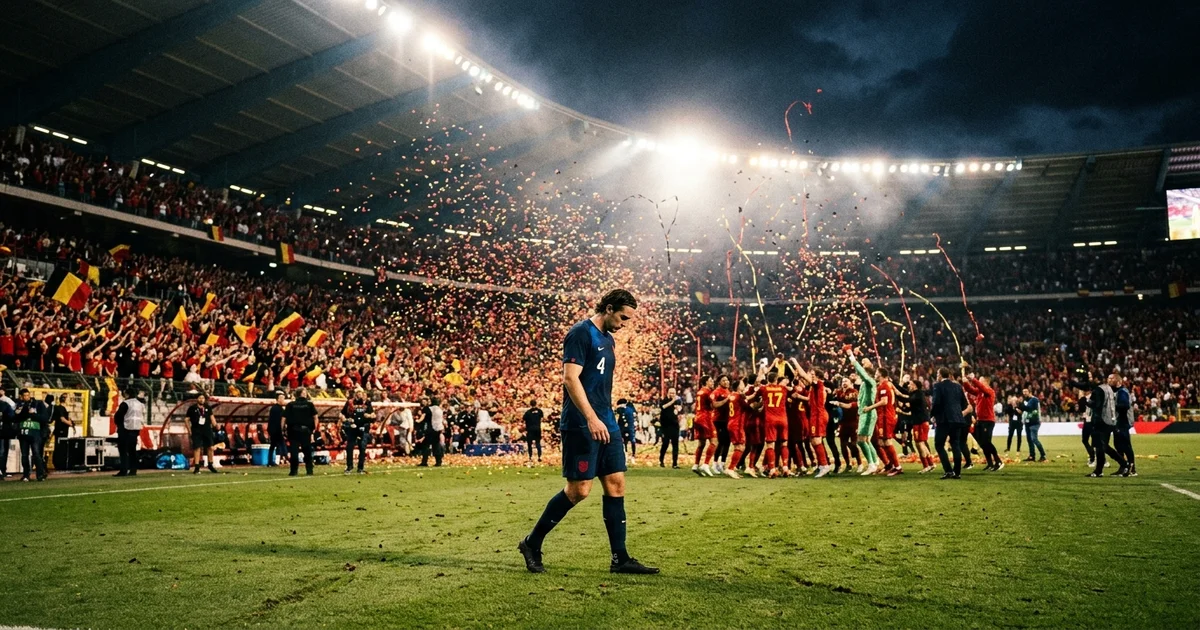
The United States men’s national team came into Monday night’s Round of 16 match in Seattle with belief, home-crowd energy, and a controversial roster boost.
They left with a 4-1 demolition at the hands of Belgium that was not close at any point that mattered, a scoreline that flatters the Americans only because Romelu Lukaku’s stoppage-time finish came with the outcome already decided.
Belgium’s Charles De Ketelaere needed barely 10 minutes to find the net, capitalizing on a defensive clearance the Americans should have handled. He would score again before halftime, and by the time U.S. goalkeeper Matt Freese gifted Belgium their third with a catastrophic error in the 57th minute, the atmosphere at Seattle Stadium had turned from fevered belief to something closer to a funeral. Malik Tillman’s free-kick goal was the lone bright spot in a match where Belgium generated 2.15 expected goals to the Americans’ 0.67, as CNN documented in their live coverage.
The Balogun Controversy Loomed Over Everything
The match was played under a cloud that had nothing to do with Seattle’s weather. Folarin Balogun, the USMNT’s star striker, had been red-carded in the group-stage match against Bosnia and Herzegovina, triggering an automatic one-match suspension that should have kept him out of the Belgium game. That suspension was reversed after President Trump placed a private call to FIFA President Gianni Infantino asking for a review.
FIFA complied, overturning a red-card suspension mid-tournament for the first time in more than 60 years of World Cup history. UEFA’s response was scathing, calling the reversal “unprecedented, incomprehensible and unjustifiable” and accusing FIFA of crossing a red line. Belgium coach Rudi Garcia said it was “the first time in the history of the World Cup that there is this kind of decision.” LNC previously covered how the intervention unfolded and why it matters for competitive integrity.
Balogun played. It did not help. The Americans were outclassed in every phase, and the striker’s return could not compensate for a defensive structure that Belgium dismantled with surgical efficiency.
What Actually Went Wrong on the Pitch
Strip away the politics and the loss tells a straightforward tactical story. Belgium’s press suffocated the American midfield from the opening whistle, forcing turnovers in dangerous areas and exposing the lack of quality depth behind the starting XI. The defensive line, never this team’s strength, was caught flat-footed repeatedly by De Ketelaere’s runs.
Christian Pulisic, the team’s most dangerous creative player, was substituted out with an apparent injury in the 59th minute, which effectively ended any slim hope of a comeback. Without Pulisic orchestrating the attack, the USMNT had no mechanism to break down Belgium’s defensive shape.
Then came the goalkeeper error. Freese, who had been solid in the group stage, made a handling mistake under minimal pressure that handed Belgium their third. It was the kind of individual error that ends a tournament run, and it shifted the question from “can the U.S. get back in this?” to “how many more will Belgium score?” Lukaku answered that question in the 90th minute.
A Reckoning for the U.S. Soccer Project
The 4-1 loss raises uncomfortable questions that the post-match press conference will not answer. The United States spent years and billions preparing to host a World Cup that was supposed to showcase how far American soccer had come. Reaching the Round of 16 was the minimum expectation for a host nation. Getting blown out in front of a home crowd is a result that will define Mauricio Pochettino’s tenure as manager, fairly or not.
The structural problem is not coaching. The USMNT’s talent pool remains thin compared to European powers, and the gap between the squad’s Premier League and Bundesliga starters and its backup options is enormous. Belgium exposed that gap without needing to play particularly well themselves. De Ketelaere and Lukaku did their jobs. The Americans simply could not match them at any level.
Where This Leaves the World Cup and U.S. Soccer
Belgium advances to a quarterfinal against Spain at Los Angeles Stadium on Thursday, carrying the confidence of a team that just dismantled the host nation with efficiency rather than brilliance. For the tournament itself, the Balogun affair has opened a wound that will not close easily. If a phone call from a head of state can override on-field officiating, the precedent applies to every nation with political leverage, and FIFA has handed future leaders a playbook.
For the USMNT, the road forward is longer than the federation would like to admit. The 2026 cycle was supposed to be the culmination of a talent wave that included Pulisic, Weston McKennie, Tyler Adams, and a new generation of European-based players. That wave crested in the group stage and broke against the first serious opponent. The next World Cup is in 2030, co-hosted by Spain, Portugal, and Morocco. The Americans will need to qualify the traditional way, without home-field advantage, and the lesson of Seattle is that qualifying is only the beginning.
The USMNT goes home with a controversy they did not create and a result they thoroughly earned.