
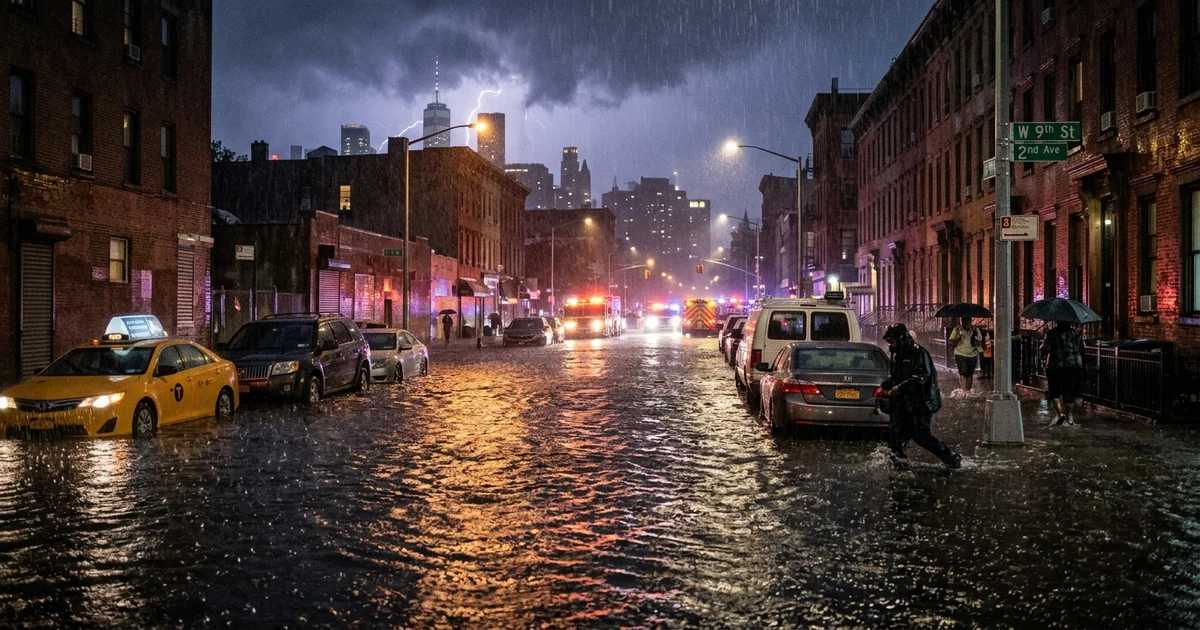
Flash flooding tore through Brooklyn and Queens on Monday night, turning streets into waist-deep rivers, shutting down the Belt Parkway, knocking out power to tens of thousands, and forcing Mayor Zohran Mamdani to issue urgent warnings for residents of basement apartments to evacuate.
The storms dumped two to three inches of rain per hour on neighborhoods that have flooded repeatedly in recent years, and once again the city’s drainage infrastructure could not keep up.
Neptune Avenue in Coney Island became impassable. East 28th Street in Sheepshead Bay looked like a canal. Dozens of trees came down across Queens, blocking roads and damaging vehicles. And Con Edison asked roughly 163,000 customers in southeastern Queens to conserve electricity after reducing voltage by 8% across Jamaica, Hollis, Queens Village, Springfield Gardens, St. Albans, and Laurelton, as ABC7 New York reported from the hardest-hit areas.
The Basement Apartment Problem Has Not Gone Away
The most chilling aspect of Monday’s flooding was not the dramatic footage of submerged cars. It was the speed at which water reached basement-level dwellings, renewing a crisis that has already killed New Yorkers. Two men died in flooded basement apartments in Manhattan and Brooklyn during a record-breaking rainstorm less than a year ago. Those deaths prompted promises of reform, tighter enforcement of building codes, and better early-warning systems for the roughly 10% of low-income and immigrant New Yorkers who live in basement units at high flood risk.
Monday’s storms tested whether any of that translated into action. Mayor Mamdani urged residents to leave basement apartments immediately if they saw water rising, a warning that assumes people have somewhere else to go. For many basement tenants, particularly undocumented immigrants who rent illegally converted units, the life-threatening conditions that officials have warned about are inseparable from the housing crisis that put them underground in the first place.
Four Record Storms in Four Years Is Not a Coincidence
City officials have acknowledged what the data makes obvious: the four most intense storms in New York City’s history have occurred in the last four years. The drainage systems beneath Brooklyn and Queens were designed for a climate that no longer exists. Rainfall rates of two inches per hour overwhelm century-old sewer systems built for a city that expected gradual, moderate rain, not the concentrated downpours that warming oceans are producing with increasing regularity.
The infrastructure gap is not a surprise. Engineers and climate scientists have been warning about it for more than a decade. The question is not whether New York will flood again but whether the city will spend the money to prevent the flooding from being deadly. That means upgrading stormwater capacity, enforcing building codes on basement apartments, expanding green infrastructure to absorb runoff, and building real-time alert systems that reach communities in languages other than English.
The Belt Parkway Closure Shows How Fragile the System Is
The Belt Parkway, one of Brooklyn’s most critical arterial highways, had to be completely shut down near Cropsey Avenue after standing water made it impassable. That single closure rippled through Monday evening’s commute, stranding drivers on surface streets that were themselves flooding. City workers had been out over the weekend clearing catch basins and preparing historically flood-prone neighborhoods, but preparation counts for little when the rain falls faster than the drains can handle.
Con Edison’s decision to reduce voltage across a wide swath of southeastern Queens added a secondary crisis. Asking 163,000 customers to limit air conditioning use during a summer week when temperatures had been punishing days earlier put the utility in the position of choosing between electrical safety and heat-related health risks. The infrastructure is not failing in one dimension. It is failing across multiple systems simultaneously, which is what happens when extreme weather events compound rather than arriving one at a time.
What Comes Next
The flash flood watch remained in effect through 6 a.m. Tuesday, with the National Weather Service forecasting additional rounds of heavy rain. The storms followed a brutal heat wave that buckled pavement on highways across the eastern U.S. last week, a one-two punch of extreme heat followed by extreme rain that climate models have long predicted would become the summer norm.
New York has spent billions on resiliency projects since Hurricane Sandy in 2012, but much of that investment went to coastal surge protection, not the inland stormwater systems that fail during intense downpours. Monday’s flooding is a reminder that the city’s climate vulnerability is not limited to its coastline. The neighborhoods that flood worst are often the ones with the oldest pipes, the least green space, and the most residents who cannot afford to move.
For the residents of Coney Island, Sheepshead Bay, and southeastern Queens, the forecast is a familiar one: more rain, more flooding, more promises, and the same basements filling with water.