
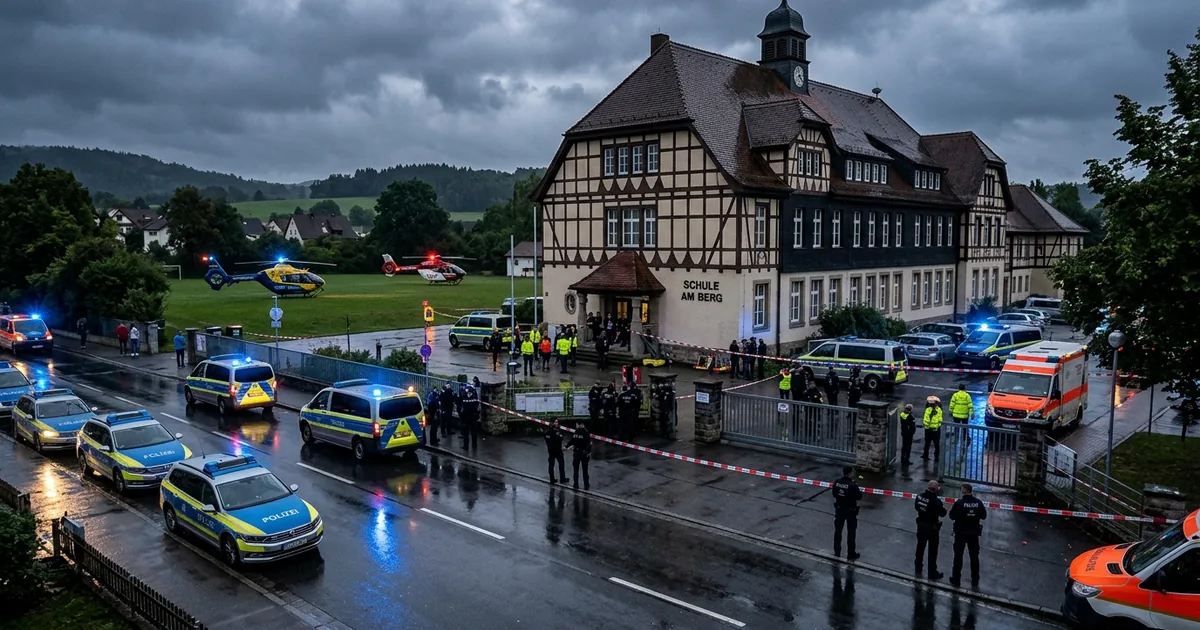
A 16-year-old boy was arrested Wednesday after attacking multiple people at a grammar school in the Bavarian town of Schongau, seriously wounding at least four, including two 13-year-old girls whose injuries initially prompted fears they might not survive.
Bavarian police said the suspect acted alone, but declined to confirm the weapon used or disclose a motive, leaving a town of 12,000 people 90 minutes southwest of Munich grappling with the kind of violence Germany has been confronting with alarming frequency.
What Happened at Welfen Gymnasium
The alarm sounded at approximately 12:50 p.m. local time at Welfen Gymnasium, a grammar school with roughly 800 students and more than 80 teachers, The Local Germany reported. Some victims were attacked inside the building, others on the school grounds outside, suggesting the assailant moved through the campus before fleeing.
Police characterized the incident as a suspected “Amoklauf,” the German term for a rampage-style attack. More than 15 police vehicles converged on the school within minutes. At least six helicopters were dispatched to airlift the wounded to regional hospitals. A reception center was established at a nearby fire station for students and staff evacuated from the building.
The suspect fled the scene initially but was apprehended shortly afterward with the help of a police helicopter deployed during the search, the Irish Times reported from Berlin. Police confirmed that no other suspects were being sought: “We are currently assuming that the perpetrator acted alone.”
Two Girls in Serious Condition
Four people were seriously injured in the attack. Two 13-year-old girls sustained the gravest wounds, according to BBC News, though authorities later said their lives were not believed to be in danger. It remains unclear whether all the victims were students or whether teachers were among the wounded.
Press reports widely described stab wounds among the injured, but the police spokeswoman declined to confirm the weapon type. Several international outlets flagged that investigators had not ruled out the possibility of a firearm being involved, a detail that underscores how early and uncertain the investigative picture remains.
A Pattern Germany Cannot Ignore
The attack at Welfen Gymnasium lands barely ten days after a shooting at a youth center in Stade, northern Germany, killed five people on June 29. That incident, which police linked to a domestic dispute that escalated into a public mass shooting, reignited debate over Germany’s gun laws and security protocols at public venues.
Wednesday’s attack shifts that conversation directly into schools. Germany has experienced several high-profile school attacks over the past two decades, from the 2002 Erfurt massacre to the 2009 Winnenden shooting, both of which prompted legislative action on firearms access and school security. The Schongau attack raises the question of whether those reforms have been sufficient, particularly if the weapon turns out to be a knife rather than a firearm. Blade attacks are harder to legislate against, and they expose a different vulnerability: that a determined attacker inside a school building needs only seconds to inflict serious harm before anyone can respond.
The why here is structural. Germany’s school security model relies primarily on open campuses with minimal physical barriers, a design philosophy rooted in the belief that schools should be welcoming community spaces rather than fortified compounds. Each new attack tests whether that model can survive the reality that some fraction of teenagers will attempt mass violence regardless of the security environment they encounter.
Investigation Still in Its Earliest Hours
Bavarian police have released no information about the suspect’s identity beyond his age and gender. They have not confirmed whether he was a student at Welfen Gymnasium, whether he had any prior contact with law enforcement, or what motivated the attack. The investigation is being led by the Upper Bavarian police and the local prosecutor’s office.
The school, located near Schongau’s historic town center, was evacuated following the attack. Parents were directed to the reception center at the fire station to reunite with their children.
Germany’s interior minister has not yet issued a public statement on the attack. Given the severity of the injuries and the target, a federal-level response is likely within hours, particularly as the Stade shooting is still raw in public consciousness.
What Comes Next
The immediate questions are whether the weapon was a knife, a firearm, or something else, and whether the suspect had any connection to the school. Those answers will shape both the criminal prosecution and the policy debate that follows. If this was a knife attack by a student, Germany faces a different kind of reckoning than a firearm brought from outside: one that no metal detector or access-control system would have prevented.
For now, four families in a small Bavarian town are waiting for updates from hospital wards, and a school community of nearly 900 is trying to process the fact that their campus became a crime scene on a Wednesday afternoon.