
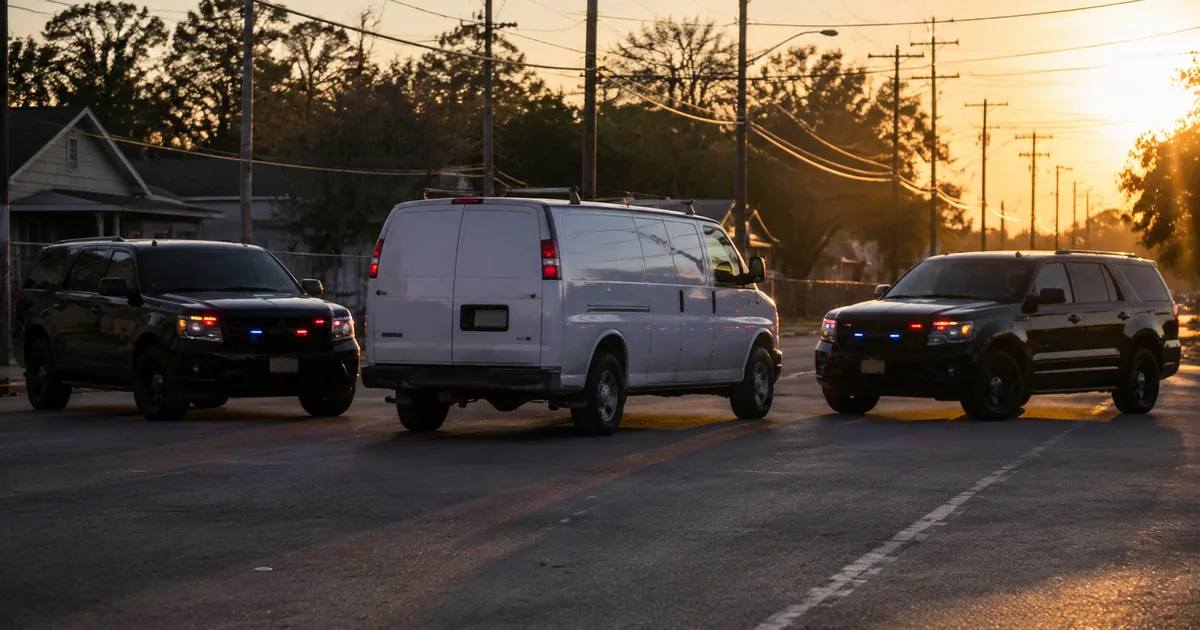
Three men who watched Lorenzo Salgado Araujo die on a Houston street Tuesday morning say the government’s story is wrong.
Their accounts, published by The Washington Post on Thursday, dispute nearly every load-bearing element of the Department of Homeland Security’s claim that the 52-year-old construction worker “weaponized” his white work van against an ICE officer: no agent stood in front of the vehicle, no one was about to be run over, and the shot came almost immediately.
That matters, because right now those three passengers are the only independent record of what happened. The agents involved wore no body cameras. Their vehicles carried no dash cameras. Four days after the shooting, federal officials have released no video and no physical evidence, and the men who contradict the official story are sitting in an ICE detention center awaiting deportation processing.
What the Passengers Say Happened on Canal Street
The shooting unfolded around 6:30 a.m. on July 7 in Magnolia Park, a predominantly Mexican American neighborhood in Houston’s East End. Salgado Araujo was doing what he did most mornings: driving his van to pick up his crew for a homebuilding job, work he had done for roughly 35 years.
According to the passengers, the van’s occupants noticed an unmarked vehicle tailing them. At a stoplight, Salgado Araujo pulled away when the light turned green, and the unmarked car cut in front of him. He made a U-turn. Only then did the agents activate their lights, and the passengers say the van was rolling at roughly 5 miles per hour when government vehicles rammed it, not the other way around. An officer then ran at the van from the passenger side, yelled “Stop!” and opened fire, hitting Salgado Araujo in the abdomen.
One of the passengers, 51-year-old Jose Trinidad Rojas, put the physics problem plainly in a written account: it is impossible to claim anyone was about to be run over when no officer was positioned in front of or behind the vehicle. Hugo Balderas Ibarra, an attorney representing two of the men, told reporters that at no point was an agent ever placed in the line of danger. One of the other passengers was Victor Salgado, the dying man’s own brother, who watched agents pull him from the van as he called for help.
DHS told a different story within hours of the shooting. In its telling, Salgado Araujo attempted to evade arrest, rammed an ICE vehicle, ignored commands, and tried to run over an officer, who fired in self-defense. The agency has declined to comment on the witnesses’ accounts.
The Government Got to Tell Its Story First, With No Footage to Check It
There is a structural reason these two versions can coexist for days without resolution: the government built an enforcement operation with no independent evidence trail, then made itself the sole narrator.
The absence of cameras was not bad luck. Representative Sylvia Garcia, whose district includes the East End, confirmed that the agents involved wore no body cameras and had no dashboard cameras, standard accountability equipment for virtually every major American police department. ICE operates under no such default, and the Trump administration shelved the body-camera expansion that had begun under its predecessor. When the only recording devices at a fatal shooting belong to bystanders, the official account becomes unfalsifiable by design.
Then there is the question of who ICE was even there for. Acting ICE Director David Venturella told Garcia the operation targeted one of the other men in the van, not Salgado Araujo. The New York Times reported something more damning: none of the operation’s intended targets were in the van at all. The Texas Tribune’s reporting captures both claims, and they cannot both be true. Either the tip was wrong, or the targeting was, and a man with no criminal convictions is dead in either case.
Salgado Araujo was, by his family’s account, close to the finish line of the legal process his killing is now being processed through. His son Ronaldo told reporters his father had completed biometrics earlier this year and was nearing legal status, PBS NewsHour reported. All three of his sons are U.S. citizens. “He did not deserve to be reduced to a headline,” Ronaldo said.
The Only Witnesses Are in the Government’s Custody
Consider the position of the three men whose testimony now challenges DHS. They witnessed a federal officer kill their friend, brother, and boss. They were handcuffed at the scene, and they are now detained by the same agency whose account they contradict, facing deportation proceedings that the agency controls. The League of United Latin American Citizens is offering a $5,000 reward for bystander video precisely because the institutional evidence either does not exist or has not been released.
The investigation architecture inspires no more confidence. DHS’s own Office of Inspector General is leading the federal probe, while the FBI’s Houston field office investigates the alleged assault on the officer, an inquiry premised on the very claim the witnesses dispute. Harris County District Attorney Sean Teare has opened a local investigation, and he has already flagged the obvious obstacle: federal investigators can simply withhold the evidence. The shooting has also become a diplomatic problem. Mexican President Claudia Sheinbaum said she is weighing legal measures and may ask the United Nations to intervene over violence against Mexican nationals in U.S. enforcement operations.
A Quota Machine Was Always Going to Produce This
Zoom out and the Houston shooting stops looking like an aberration. At least 10 people have been killed by federal immigration agents nationwide since January 2025, the Texas Tribune reported, alongside at least 14 deaths in Texas federal detention centers. The administration has set ICE a goal of 2,000 arrests per day, and Congress supercharged that mandate with the $70 billion Secure America Act, whose ICE and border funding surge we covered when the House passed it in June.
That is the why beneath this story. When you give an agency arrest quotas, historic funding, plainclothes teams in unmarked cars, and no camera requirement, you get exactly this: high-speed, low-information street confrontations with day laborers at 6:30 in the morning, narrated afterward exclusively by the agency that pulled the trigger. Civil rights groups note that initial official descriptions of these encounters have repeatedly been contradicted when video later surfaced. The incentives all point one direction, and none of them point toward restraint.
The test now is simple and public. If the government’s account is true, the evidence that supports it, scene reconstruction, vehicle damage, ballistics, any surveillance footage from Canal Street, should be released to Harris County investigators and the public. If three detained witnesses with everything to lose are telling the truth, then a federal officer shot a man through the passenger window of a van that was barely moving, and the paper trail of who authorized what will matter enormously. Watch whether that evidence ever sees daylight. The answer will tell you whether anyone in this system still believes it can be checked.