
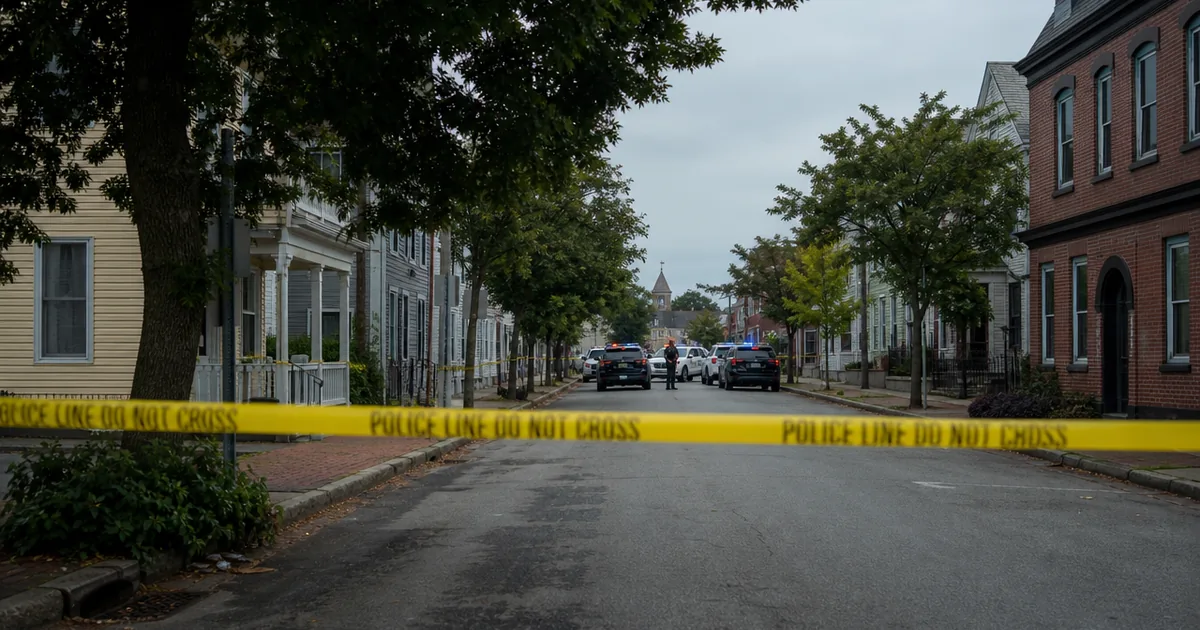
A person was shot and killed Monday morning in Biddeford, Maine, in a shooting that Maine House Speaker Ryan Fecteau said involved federal immigration agents.
It is the second fatal ICE-involved shooting in the country in under a week, and the question it forces is no longer about one street corner in southern Maine.
What Happened on Pool Street
Police closed Pool Street near Hill Street early Monday and flooded the block with a heavy law-enforcement presence, according to local outlets on the scene. Fecteau, the top Democrat in the Maine House, was among the first officials to confirm any details, announcing on Facebook, in a post CBS News reported Monday, that state police and the Maine Department of Public Safety were “on the scene gathering details.” As Bangor Daily News reported, the FBI was expected to take over the investigation. “These are the details that I have at this time,” Fecteau wrote. “I will provide further updates, as they are relayed to me.”
That a state House speaker was relaying the basic facts through a social-media post tells you how little the federal agencies at the center of this have said. As of Monday afternoon, U.S. Immigration and Customs Enforcement (ICE) and the Department of Homeland Security had not put out a detailed account of what happened, who fired, or who died. The person killed has not been publicly identified.
The early version of events is contested. A witness described to reporters seeing a car put into drive in what looked like an attempt to hit an ICE officer, after which the agent fired roughly four shots. That account is unverified, it comes from a single bystander, and it maps neatly onto the justification federal agencies typically offer after a roadside shooting. It may hold up. It may not. The Maine State Police, the state Department of Public Safety, and the FBI are the ones who will reconstruct the sequence, and until they do, the “he drove at the officer” framing deserves the same skepticism as any other early claim from an interested party.
A Pattern, Not an Accident
Strip away the specifics of this one shooting and a harder fact remains. Monday’s death was at least the 11th fatal shooting involving ICE or U.S. Border Patrol agents since the start of the second Trump administration, and the second in less than a week. Days earlier in Houston, a federal immigration officer fatally shot 52-year-old Lorenzo Araujo, a construction worker, during a traffic stop, as CNN reported in its running tally of enforcement killings.
Eleven fatal shootings by a single set of federal agencies in a matter of months is not a run of bad luck. It is a rate. And a rate is a policy outcome, the visible result of decisions made far from Pool Street about how many agents to put on the street, how fast, with what rules of engagement, and under whose supervision. When the number climbs this steadily, the individual circumstances of each stop start to matter less than the machine producing them.
A Machine Built to Escalate
The machine got a lot bigger this year. Congress routed tens of billions of dollars into immigration enforcement, a spending surge captured in the $70 billion the House approved for ICE and border operations under the Secure America Act. Money at that scale buys rapid hiring, aggressive arrest quotas, and a mandate to run high-tempo operations in places that had seen relatively little of ICE before. Maine, a state whose leaders have spent years limiting local cooperation with federal immigration enforcement, was always going to feel that expansion eventually.
Here is the mechanism nobody in Washington wants to name out loud. You cannot scale an armed federal force this quickly, push it into unfamiliar neighborhoods, reward volume, and thin out supervision without raising the odds that a routine encounter ends with someone dead. Roadside stops are the most volatile thing armed agents do. Multiply the number of stops, compress the timelines, and add officers who are newer and operating far from their usual turf, and the death toll does not spike by accident. It rises because the system was tuned to make more contact, faster, with less friction. Biddeford is what that tuning looks like on a Monday morning.
The Accountability Vacuum
The response to each of these killings follows the same script, and the script is the problem. A federal agency shoots someone, says almost nothing, and the investigation is handed to other federal actors while the family and the public wait. There is no national requirement that ICE agents wear body cameras, no consistent public release of use-of-force records, and no independent civilian oversight with teeth over how these operations are run. When the FBI investigates a shooting by fellow federal agents, the inquiry may be rigorous, but it is federal law enforcement examining federal law enforcement, and that structure asks the public to extend a trust the agencies have not earned by being transparent.
That vacuum is why a Facebook post from a state legislator became the primary public record of a killing on American soil. It is why the “the car lunged at the officer” account arrives with no dashcam, no body camera, and no contemporaneous federal statement to confirm or contradict it. Accountability is not a favor you grant after the cameras leave. It is supposed to be built into how an armed arm of the government operates, and on the evidence of eleven deaths, it has been engineered out.
What Comes Next
By Monday afternoon, the community was already moving faster than the agencies. Biddeford Saco for Racial Justice called a protest for noon at Mechanics Park, and local reporters were still parked outside the tape while ICE said nothing. The immediate questions are narrow and answerable: Who died. Who fired. What the investigation finds. The larger one is harder, and it will outlast this news cycle. If a rate of fatal shootings this high, spread across this many states in this short a window, is not enough to force body cameras, public use-of-force data, and real independent oversight onto federal immigration enforcement, then what number would be?