
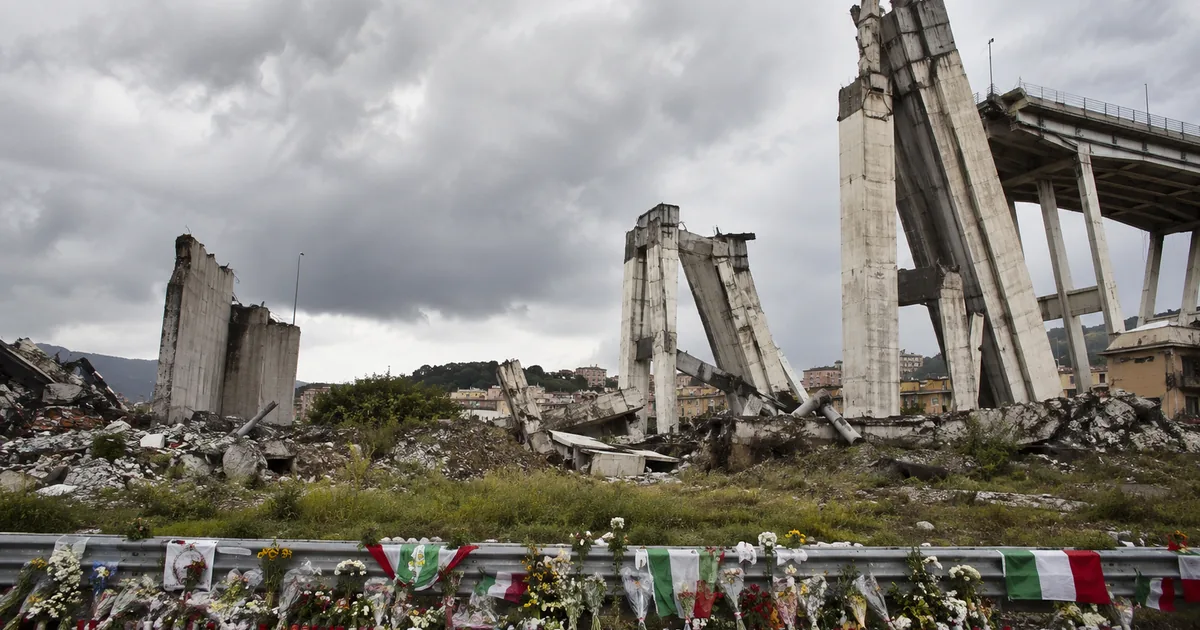
A Genoa court on Wednesday sentenced Giovanni Castellucci, the former CEO of Autostrade per l’Italia, to 12 years in prison for his role in the 2018 Morandi Bridge collapse that killed 43 people.
The verdict caps a nearly four-year trial that laid bare how institutional neglect and corporate cost-cutting turned one of Italy’s busiest highways into a death trap.
The Verdicts Landed in Under 20 Minutes
Family members of the 43 victims packed the courtroom as judges read out sentences in less than 20 minutes, a starkly brisk conclusion to a trial that spanned more than 280 hearings across four years. Castellucci, who ran Autostrade per l’Italia from 2005 to 2019, received 12 years, well short of the 18 and a half years prosecutors had sought. He was not present to hear it. He is already behind bars, serving a six-year sentence for a separate fatal viaduct incident in southern Italy in 2013.
Michele Donferri Mitelli, the former number-three executive at Autostrade, received 11 years. Carmine Testa, the former director of the Infrastructure Ministry’s regional inspection office in Genoa, was sentenced to four years and two months. Two former senior ministry officials, Giovanni Proietti and Bruno Santoro, were acquitted outright.
Of the 57 defendants facing charges of manslaughter, endangering transport safety, and falsifying official documents, prosecutors had sought sentences totaling more than 400 years. Under Italy’s legal system, this first-instance ruling can be appealed at least twice, meaning the case is far from closed.
Why This Happened: The Maintenance Deficit That Cost 43 Lives
On the morning of August 14, 2018, a 200-meter section of the Morandi Bridge gave way during a rainstorm, sending dozens of vehicles plunging from a highway that connected northern Italy to the French Riviera. The bridge, inaugurated in 1967, had been a known structural concern for decades.
The trial’s central finding was that this was not an act of nature but an act of negligence. The prosecution built its case around systemic failures in maintenance and inspection by Autostrade, the private concessionaire responsible for the bridge’s upkeep, and by the ministry officials charged with overseeing them. The structural concerns around the Morandi Bridge had been documented for years before the collapse, yet the critical maintenance work never happened.
This is the pattern that makes infrastructure disasters preventable and therefore damning: the warning signs existed, the institutional knowledge existed, and the people with the authority to act chose not to. The bridge did not fail because engineering could not save it. It failed because the incentive structure rewarded deferring maintenance costs over protecting the public.
A Reckoning That Extends Beyond the Courtroom
Castellucci’s conviction carries an added weight that the sentence itself does not fully convey. He is already imprisoned for a 2013 incident on a separate viaduct in southern Italy that also proved fatal, making him a repeat offender in the most literal sense: two deadly infrastructure failures, both under his corporate watch. That pattern transforms this from an isolated tragedy into evidence of a systemic corporate culture that treated public safety as a cost center.
Atlantia, the holding company that controlled Autostrade at the time, eventually lost its motorway concession in a political fallout that reshaped Italy’s approach to infrastructure privatization. The company sent a formal apology letter to victims’ families eight years after the disaster, a gesture that arrived the same week as the verdict.
The Morandi collapse also triggered a broader European conversation about aging infrastructure and the risks of privatized maintenance. Italy had outsourced highway management to private concessionaires who operated under long-term contracts with limited oversight, a model that several other European nations also use. The structural concerns about deferred maintenance on major transport routes are not unique to Italy.
What Comes Next
The appeals process will likely extend this case for years. Under Italian law, defendants are not required to begin serving their sentences until all appeals are exhausted, meaning Castellucci’s 12-year term may be reduced or overturned before he ever serves a day specifically for the Morandi collapse.
For the families of the 43 people who died on that August morning, Wednesday’s verdict is a marker, not an endpoint. The question the Italian legal system still has to answer is whether accountability for infrastructure negligence at this scale will actually stick, or whether the appeals process will quietly sand down the sentences until the corporate and institutional failures that killed their loved ones carry no real consequence at all.