
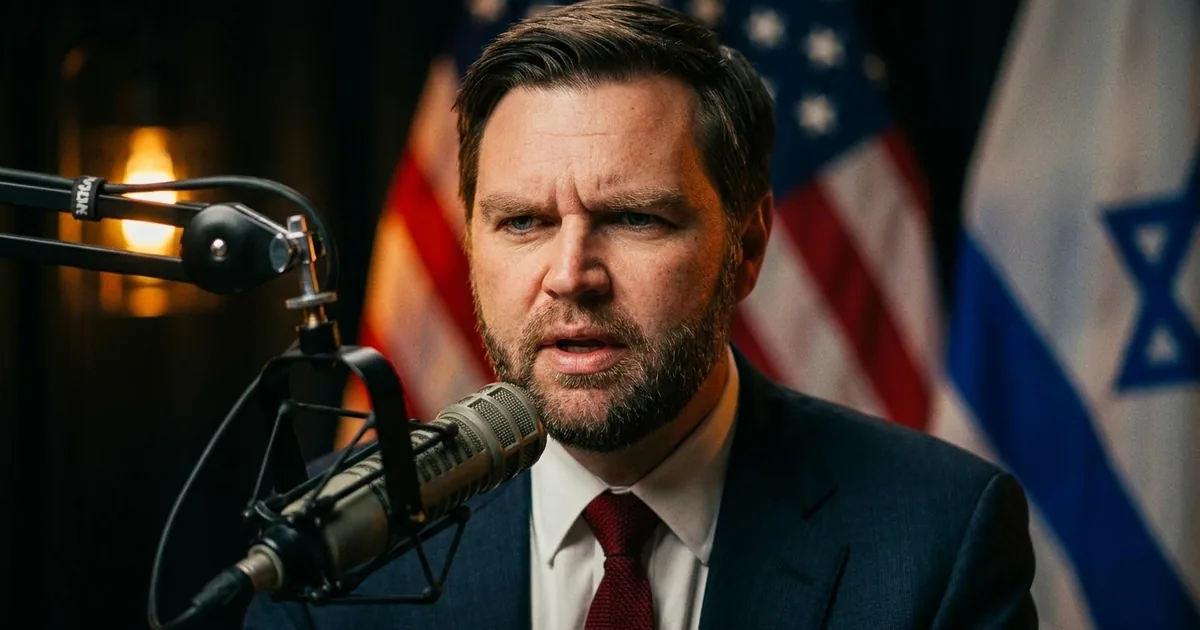
Vice President JD Vance just accused elements of the Israeli government of orchestrating a well-funded, covert influence operation designed to manipulate American public opinion and keep the war with Iran going indefinitely.
Speaking on Joe Rogan’s podcast in an episode that aired Wednesday, Vance delivered what may be the most extraordinary public rebuke of Israel by a sitting senior US official in modern memory.
The Accusation: ‘Beyond a Shadow of a Doubt’
Vance told Rogan he knows “beyond a shadow of a doubt” that people within the Israeli government system have been “manipulating and trying to change American public opinion to keep the war going on indefinitely.” He described a “very discreet, extremely well-funded campaign to try to derail the negotiation and try to derail the deal,” as Al Jazeera reported Wednesday.
The campaign, Vance said, involved leaks to journalists and coordinated social media attacks aimed at undermining his personal diplomatic efforts to secure the US-Iran memorandum of understanding. When asked about the people behind it, Vance did not mince words: “Go to hell.”
That is not diplomatic language. That is a vice president publicly telling operatives linked to a treaty ally to back off, on the most-watched podcast in the country.
The $45 Million Brad Parscale Connection
Vance pointed to a Time magazine investigation that revealed former Trump campaign manager Brad Parscale received $45 million from an Israeli government-funded operation. The money paid for a content factory producing 100 original pieces per month, all targeting young conservative audiences with messaging designed to turn them against any diplomatic resolution with Iran.
The structure is worth understanding. This was not a traditional lobbying campaign registered under FARA. It was an influence operation routed through a political operative with deep access to the MAGA media ecosystem, producing content designed to look organic while carrying a foreign government’s preferred narrative. The scale, $45 million and 100 pieces of content monthly, puts it in the territory of a state-run information campaign, not a think tank white paper.
Parscale denied the allegations, telling The Jerusalem Post he had “never funded, organized, or participated in any effort to undermine President Trump, ever, including his MOU or ceasefire proposal.” He called the claims “completely false.”
Why Vance Is Saying This Now
The timing is not accidental. The US-Iran memorandum of understanding that Vance helped negotiate has been under sustained pressure since it was announced, with hawkish voices in Congress and in allied capitals pushing to collapse it before implementation milestones lock in. Vance’s decision to go public on Rogan, rather than through diplomatic channels or a Sunday show, is itself a strategic choice: Rogan’s audience skews young, male, and right-of-center, exactly the demographic the alleged Israeli campaign was targeting.
By naming the operation on the same platform where the influence was being deployed, Vance is inoculating the audience against it. He is also doing something no vice president has done in recent memory: publicly accusing an ally’s government of running a covert campaign against US foreign policy on US soil.
The Structural Problem: Foreign Influence Without FARA
The deeper issue here is not whether Parscale took the money, which he denies, or whether Vance is exaggerating the scale. It is the structural vulnerability that allows a foreign government to fund an influence operation through a US political operative without triggering Foreign Agents Registration Act requirements.
FARA enforcement has been a persistent weak point in US counterintelligence, and the pattern Vance describes, foreign government money flowing to a domestic operative who produces content that looks like organic conservative media, is precisely the gap that existing law was supposed to close but has not. If the Time reporting holds up, this is a case study in how state-backed influence campaigns can operate in plain sight when the money moves through familiar political networks.
What This Means for the US-Israel Relationship
The US-Israel relationship has survived decades of disagreements, but those disagreements were typically managed through back channels, congressional caucuses, and carefully calibrated public statements. What Vance did on Wednesday was none of those things. He named names, cited dollar amounts, and told the people behind it to go to hell, all on a podcast that reaches tens of millions.
The Times of Israel noted that Vance’s words “will not stay on Joe Rogan’s microphone,” and that assessment captures the gravity of the moment. This is not a leaked cable or an anonymous briefing. It is the second-highest-ranking official in the US government, on the record, accusing elements of a treaty ally’s government of covert interference in American democratic discourse.
The question now is whether this remains a Vance broadside or becomes administration policy. Trump has not commented on the Rogan interview, and the White House has not issued a follow-up statement. If Vance is freelancing, the diplomatic damage is containable. If he is speaking for the president, the US-Israel relationship just entered territory it has never been in before.
Either way, the accusation is now public, sourced to investigative reporting, and sitting in the feeds of Rogan’s massive audience. The next move belongs to Jerusalem, and to the Justice Department, which now faces the question of whether a $45 million foreign-funded influence operation warrants a FARA investigation.