
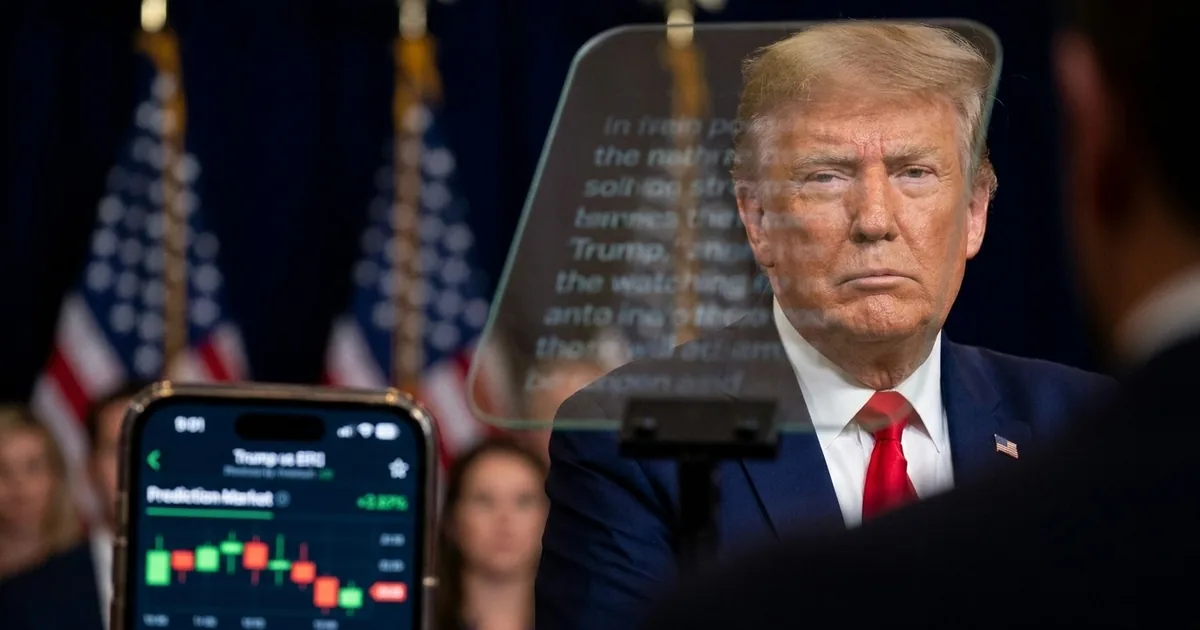
The White House aide who loads Donald Trump’s speeches into the teleprompter spent months quietly wagering on what the president would say next, and won more than $100,000 doing it.
Gabriel Perez is now on unpaid administrative leave and negotiating a settlement with federal regulators, which makes him the first person caught monetizing a presidential script in real time and the clearest test yet of whether anyone actually polices prediction markets.
The Easiest Trade in Washington
Kalshi runs what it calls mention markets: contracts that pay out based on whether Trump says a specific word or phrase during a public appearance. For an ordinary trader, that is a coin flip on the most improvisational speaker in American politics. For the man holding the script, it was free money. CBS News reported that Perez, a technical adviser who has worked Trump’s teleprompters since 2016 and took his current federal role in January 2025, is in settlement talks with the Commodity Futures Trading Commission after clearing six figures on the platform.
The scope was not subtle. Forbes reported that Perez placed bets tied to more than a dozen presidential speeches over roughly three months, including a December primetime address, Trump’s January remarks at the World Economic Forum in Davos, a March Medal of Honor ceremony, and the State of the Union. The detail that removes any ambiguity about intent: when Trump wandered off script mid-speech, Perez exited positions in real time. That is not a lucky streak. That is a man trading against his own document feed.
Kalshi’s surveillance desk spotted the pattern, froze the account with roughly $90,000 in winnings still locked inside, and referred the case to the CFTC. The company says its surveillance team flagged the trades and handed them to the regulator after an internal investigation. Perez, according to people familiar with the case, is cooperating, and regulators are weighing a trading bar plus restitution of the profits. The CFTC, as is standard, declined to confirm or deny an active investigation.
Caught by the Casino, Not by the Rules
Here is the uncomfortable part: the system that caught Perez was the betting platform’s own fraud desk, not any law written for this situation. Insider trading doctrine in the United States grew up around securities, built over decades of case law about fiduciary duty and material nonpublic information in stocks. Event contracts live under the Commodity Exchange Act, where the equivalent framework is thin, untested, and was never designed for a market where the inside information is literally a speech draft. Congress has not legislated on it. The CFTC has approved the industry’s explosive growth far faster than it has built enforcement rules for it.
The White House saw this coming, at least on paper. It circulated guidance on March 24 warning staff against betting with nonpublic information, months after Perez had allegedly started doing exactly that. Press Secretary Karoline Leavitt said the president considers the episode “deeply unfortunate and frankly a disgrace.” The stronger disgrace may be structural: an employee with access to presidential remarks faced no systemic barrier at all between the script in his hands and a regulated exchange happy to take his action.
None of this is a one-off. The pattern echoes the congressional scrutiny of suspiciously timed Polymarket bets placed ahead of the Iran ceasefire announcement, another case where traders appeared to know the outcome before the public did and investigators had to improvise a response. Prediction markets keep insisting they are serious financial infrastructure. Serious financial infrastructure comes with an insider trading regime. This industry got the volume first and is bolting on the rules after each scandal.
The Family Business Problem
The regulatory awkwardness runs deeper than missing statutes. Kalshi named Donald Trump Jr. a strategic adviser in January 2025, an arrangement that came with an equity grant now worth many multiples of its original value as the company’s valuation has climbed into the tens of billions. The CFTC dropped its long-running legal challenge to Kalshi’s election contracts in May 2025, and the administration has backed the industry in its fights with state gambling regulators. CNBC reported in April that Kalshi and Polymarket have been spending heavily to lobby Congress as insider trading concerns pile up.
So follow the chain. A White House employee allegedly trades on presidential inside information. The exchange that profited from his volume is advised by the president’s son, who holds a stake in it. The regulator handling the case answers to an administration that has been the industry’s most valuable political patron. Every actor in this story has an incentive to settle it quietly, and a quiet settlement is exactly what appears to be underway. Perez has not been charged with anything, and a negotiated resolution may genuinely be the correct legal outcome given how unsettled the law is. But the incentives here would look disqualifying in any other regulatory context, and nobody in power has an interest in saying so.
The Test Case Nobody Designed
What happens to Perez matters less than what his case forces into the open. If a teleprompter operator can quietly run a six-figure edge on a CFTC-regulated exchange for months, the exposure list writes itself: schedulers, advance staff, speechwriters, Hill aides with markup calendars, agency staff who know a decision before the press release. Mention markets turn every one of them into a potential insider, and right now the only backstop is whether the exchange’s own surveillance catches the pattern after the money has already moved.
Congress could fix this with a statute that defines insider trading for event contracts and puts real penalties behind it. The industry, valued in the tens of billions and eyeing public listings, would probably welcome the legitimacy. The open question is whether Washington writes those rules before the next Gabriel Perez, or waits until the person trading on a script is somebody whose script actually moves markets.