
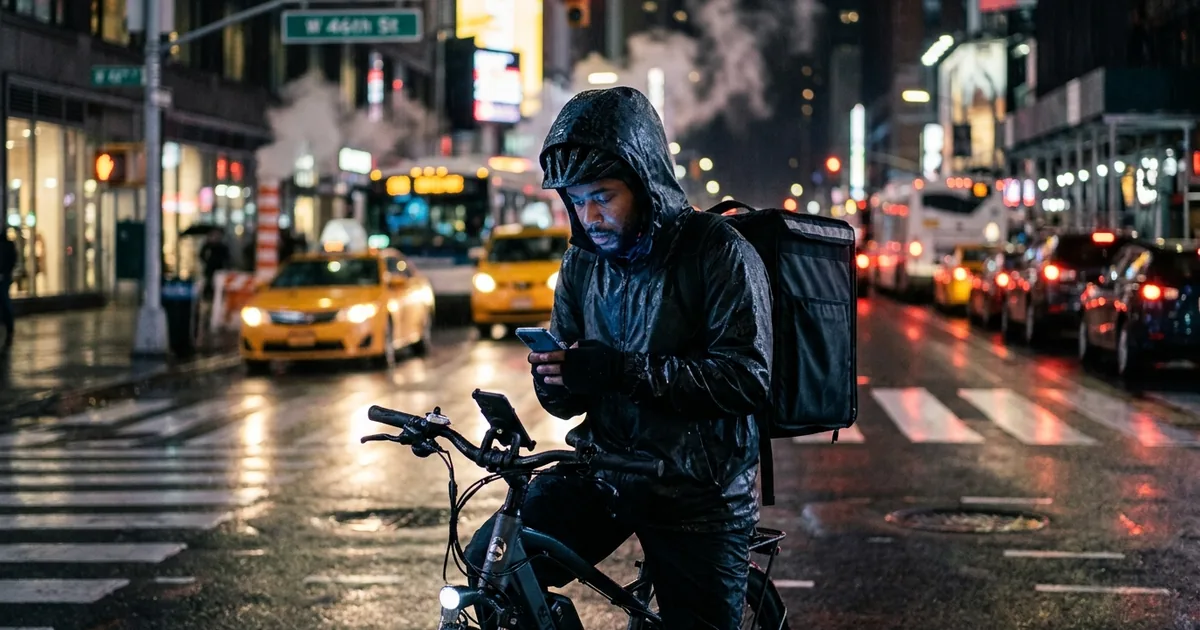
New York City’s roughly 70,000 app-based delivery workers have collected an estimated $104 million in extra tips since January, and the policy that produced that number is not a wage law.
It is a rule about where a button sits and what it says.
Mayor Zohran Mamdani and the Department of Consumer and Worker Protection released the figure on July 29, six months into enforcement of two local laws that took effect January 26. What those laws require is narrow to the point of sounding trivial: restaurant and grocery delivery apps have to show customers a clear tipping option at checkout, including a selectable 10 percent tip, a custom amount, or the choice to leave nothing. That is the entire intervention. No new wage floor. No new licensing regime. A screen, and what has to appear on it.
The Fight That Came Before This One
To understand why a checkout screen was worth legislating, go back to December 2023, when the city’s minimum pay standard for app-based delivery workers took effect. It was the first law of its kind in the country, the platforms fought it hard, and they lost.
Then they moved the tip button.
Uber Eats and DoorDash redesigned their apps so tipping prompts surfaced after delivery instead of at checkout, several taps deep. DCWP later estimated that the redesign cost workers around $550 million in tips, and its January report on those losses put the average tip per order at $3.66 in November 2023, just before the changes, falling to under a dollar afterward. City Council Majority Leader Shaun Abreu, who sponsored the tipping law, described the sequence plainly in the city’s announcement: the Council passed a minimum pay guarantee, and the apps responded by hiding the tip option from customers.
Sit with the structure of that for a second. The platforms never repealed the wage law. They did not have to. They rebuilt the interface the wage law traveled through, recovered most of the cost within months, and did it without a single vote being taken anywhere by anyone.
A Button Is a Policy Instrument
This is the part that generalizes past food delivery, and it is why the story deserves more than a press release rewrite.
Legislatures write rules about money. Platforms control the surface where the money actually changes hands, and that surface is adjustable in an afternoon. When those two powers disagree, the surface usually wins, because it moves at the speed of a product sprint while the law moves at the speed of a city council. A wage floor that depends on customer tipping is only as strong as the screen that asks for the tip, and until January that screen belonged entirely to the companies paying the wage.
The tell is comparative. According to the city’s findings, the apps ran tip defaults below 10 percent inside New York while using higher defaults elsewhere. A design choice applied unevenly across markets, tracking exactly where the wage law applied, is not a neutral product decision about user experience. It is a response, and the city read it as one.
So the Council did something regulators have mostly avoided. It wrote the interface itself into law. Not a disclosure requirement, not a report-to-the-agency requirement, but a specification of what the checkout flow has to contain. That is a real escalation in how consumer-protection law treats software, and it is going to get copied.
The Apps Went to Court and Called It Speech
DoorDash, Uber and Instacart sued to block the laws, and the argument they picked is worth reading closely. As Gothamist reported, the companies claimed the rules amounted to compelled speech: a suggested tip amount, they argued, endorses a contested position that tipping should be an expectation rather than a reward for good service. Restaurant Dive framed the filing as the next round of the same minimum pay fight, which is what it was.
It did not work. Days before the laws took effect, federal judges rejected the platforms’ bids for injunctions. US District Judge George Daniels found the companies had not shown a likely First Amendment violation, and held that the tipping laws advance the city’s goals of cost transparency at checkout, restoring consumer choice, and protecting delivery workers.
The free-speech theory was always a stretch, but it was not a frivolous one, and it will be back. Framing product design as protected expression is the most durable tool platforms have against interface regulation, and a loss at the preliminary-injunction stage in one district is not the end of that argument.
The Scoreboard Is Better Than It Was and Thinner Than It Sounds
Here is where the celebration and the data part ways.
The DCWP report measured a four-week window on either side of the law. Average tips per delivery went from $1.18 before to $2.29 after, a gain of $1.11 per trip. Across the workforce that projects to roughly $184 million more in tips annually, or about $2,287 per worker per year.
Now the comparison the announcement does not lead with. That $2.29 is still well below the $3.66 workers averaged in November 2023, before the redesigns. Six months of enforcement, a federal court win, and a law that dictates the checkout screen have recovered something closer to half the lost ground than all of it. On the specific trade of hiding the tip button, the platforms remain ahead.
Two other findings matter more than the headline number. Demand did not move. New Yorkers are placing about 3.3 million delivery orders a week, roughly 700,000 more than in December 2023, which quietly kills the industry’s standing argument that pay protections would drive customers away. And total hourly earnings for delivery workers, pay plus tips, have climbed from $10.48 to $27.32 since December 2023, a 161 percent increase built mostly on the minimum pay standard rather than on tips. The wage floor did the heavy lifting. The tipping law is repair work on the piece the apps took back.
What Other Cities Should Take From This
The lesson traveling out of New York is not that tipping laws work, though this one did. It is that a labor protection routed through a private interface stays unfinished until somebody regulates the interface.
Mamdani campaigned on affordability and on a theory that municipal enforcement can discipline large platforms, and this is the cleanest evidence yet for that theory, arriving alongside the electoral wins that expanded his coalition. Enforcement, not passage, produced the $104 million. The law itself had been on the books since 2025.
The open question is what the apps adjust next. Nothing in these rules governs service fees, delivery fees, the algorithm that assigns trips, or the priority handed to workers who accept lower-paying offers. Every one of those is a surface, every one is adjustable, and none of them currently has a rule attached to it. The city won the argument about the tip button. That was one button.