
The Justice Department has charged more than three dozen people in at least ten cases under a single federal statute since President Trump returned to office, and every one of those cases involves someone protesting immigration enforcement.
The statute is 18 U.S.C. § 372, conspiracy to impede or injure an officer, and the reason it is being used is that it does not require the government to prove you did much of anything.
That is the part worth sitting with. NPR’s Meg Anderson, who reviewed five years of federal court records to trace how the charge is being deployed, found the pattern concentrated almost entirely in the past eighteen months and almost entirely around ICE. Separately, prosecutors have indicted close to 50 more people on conspiracy counts in Michigan, Texas and Minnesota under different statutes. Add it up and the federal government has built a conspiracy docket around immigration protest that did not meaningfully exist two years ago.
The Charge Is the Agreement, Not the Act
Conspiracy law works differently from the offenses people assume they are being judged on, and the difference is the whole story here.
To convict someone of blocking a federal officer, prosecutors have to show that person blocked a federal officer. To convict someone of conspiring to impede one, they have to show an agreement to do it plus, depending on the theory, an overt act in furtherance. The overt act can be something entirely lawful on its own. Sending a text. Showing up. Standing where you said you would stand.
This means the government can reach people at the edges of a demonstration who never touched a barricade, and it can reach organizers who were not present at all. Aaron Terr of the Foundation for Individual Rights and Expression put the worry plainly to NPR: the concern is that the government may be casting too wide a net, sweeping in minor participants alongside anyone who actually did something violent.
The Justice Department’s answer is that the distinction is being drawn correctly. In a statement to NPR, the department said people should not mistake violence against law enforcement, or impeding officers performing their duties, with peaceful protest. That is a fair principle. Whether the charging decisions match it is an empirical question, and the record so far does not settle in the department’s favor.
Minnesota Shows the Shape of It
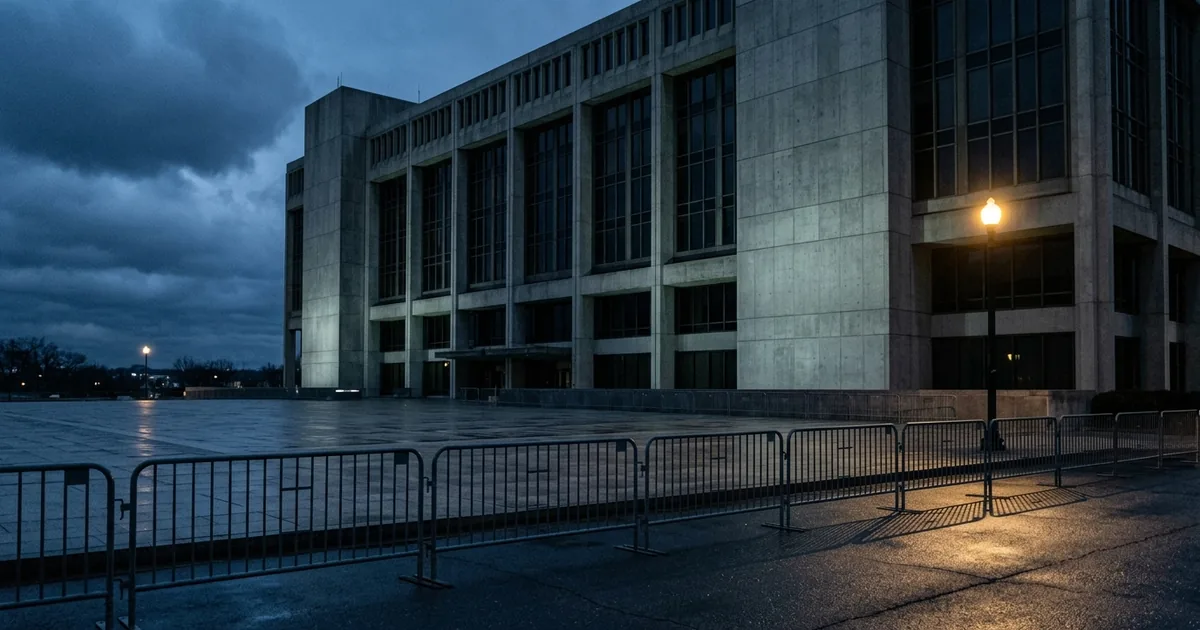
The clearest example runs through the Whipple Federal Building outside Minneapolis, which served as ICE’s headquarters during the immigration enforcement surge in Minnesota over the winter. Prosecutors charged one defendant along with fourteen others, alleging a conspiracy to impede federal agents that culminated in blockades outside the building.
Fifteen people. One alleged agreement. A blockade is a real thing that really obstructs a building, and reasonable people can disagree about where civil disobedience stops being protected and starts being obstruction. But charging it as a fifteen-person federal conspiracy rather than fifteen individual obstruction cases is a choice, and it is a choice that changes what each defendant is facing from a misdemeanor-scale problem into six years of federal exposure.
The Convictions Are Not the Point
Here is the structural mechanism that gets lost when this is covered as a scoreboard. Many of these conspiracy cases have been dismissed, and many are still pending. If you were grading the Justice Department on trial outcomes, the record would look mediocre.
Trial outcomes are not what a six-year maximum buys you. What it buys is plea leverage. A person facing a federal felony with that kind of exposure, who cannot afford a trial, who has a job and a lease and possibly a visa, is going to be offered something far smaller in exchange for a plea, and taking it is the rational move whether or not they did anything. The charge does the work regardless of whether it would survive a jury.
Jac Archer, who was convicted on conspiracy charges tied to an ICE protest earlier this year, described to NPR the position that creates: refusing a deal meant refusing to admit to something Archer says did not happen, a choice Archer could not stomach. Most people in that position do not make the same call, and the system is built on the assumption that they will not.
Katie Schwartzmann of Protect Democracy named the downstream effect: this is an attempt to scare Americans. That is not a claim about any individual prosecution. It is a claim about what a docket of three dozen conspiracy cases communicates to the several hundred thousand people who might otherwise show up to the next one.
Where This Sits in a Broader Pattern
None of this is happening in isolation, and LNC readers have watched the adjacent pieces arrive over the past month. The FBI stopped investigating shootings by ICE agents, removing the main federal check on force used during enforcement operations. The administration made the fencing around Lafayette Park permanent, converting the most symbolically important protest site in the country into a hardened perimeter.
Read those together with the conspiracy docket and a coherent architecture appears: reduce accountability for agents on one end, raise the cost of assembling against them on the other, and physically remove the ground where the assembling used to happen. No single piece is unprecedented. Presidents have hardened Lafayette Park before, prosecutors have charged conspiracy before, and internal investigations have been scaled back before. The simultaneity is the thing.
What Would Change the Read
Two things are worth watching, and both are near-term.
The first is whether any of these § 372 cases produces a written opinion that limits the theory. A federal judge who rules that mere presence plus advance coordination does not constitute an agreement to impede would take most of the leverage out of the charge immediately. Dismissals without opinions do not do that, which is why the current dismissal rate is less encouraging than it looks.
The second is whether the charge migrates. § 372 is written about federal officers generally, not ICE specifically. If it starts appearing in cases involving protests against other federal agencies, the immigration framing was never the operative limit, and the relevant question stops being about immigration policy at all.