
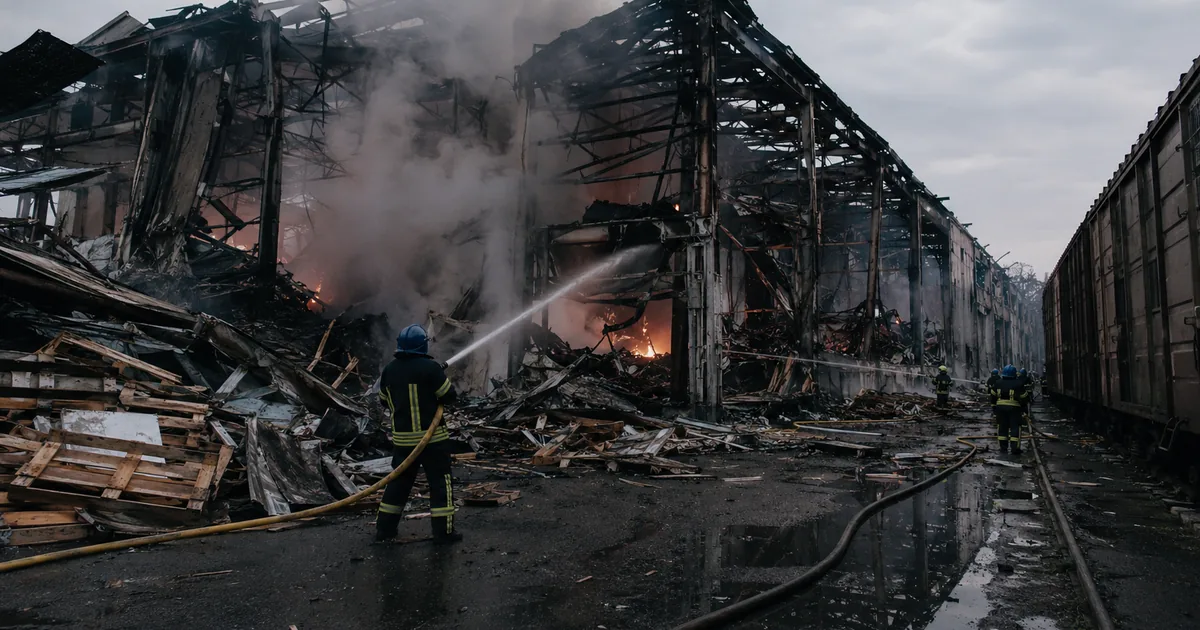
Russian forces fired 24 ballistic missiles at Kyiv and the surrounding region overnight into Wednesday, and Ukrainian air defenses stopped almost none of them.
Volodymyr Zelensky put the toll at 17 dead and 44 wounded, then said something sharper than the usual condemnation: the people killed were killed because the interceptors were not there.
The drone numbers tell the story better than the missile numbers do. Alongside the ballistic salvo, Russia sent 115 drones, many of them jet-powered, plus four more missiles that Ukrainian officials identified as either hypersonic Zircons or supersonic Oniks. Ukraine’s air force knocked down close to 90 percent of the drones. Against the ballistic missiles it had essentially nothing to shoot with. Ukraine is still winning the cheap half of this fight and steadily losing the expensive half, and Russia has plainly read the same scoreboard.
The Third Major Strike on the Capital in a Week
Wednesday was not an isolated night. On July 31 into August 1, Russia fired 35 missiles, 27 of them ballistic, along with 185 attack drones. Ukraine intercepted exactly one. Ukrainska Pravda reported Zelensky’s explanation in a sentence that needed no interpretation: “Only one ballistic missile was intercepted, simply because there are no interceptors for the Patriot systems.” That attack killed around ten people and damaged at least seven districts of Kyiv, including Lithuania’s embassy.
Five days later the same pattern repeated at a larger scale and a higher body count. This is the third major strike on the capital region inside a week, and the through-line is not Russian innovation. It is a defensive gap that has stayed open long enough for Moscow to plan around it. When Russia ran its largest ballistic attack on Kyiv in July, the interception failure looked like a bad night. Three strikes later it looks like a standing condition.
Brovary District Took the Worst of It
The casualties clustered outside the city rather than inside it. Nine people were killed in Brovary district, four in Bucha district and one in Fastiv. The heaviest single loss came in the village of Kvitneve, where eight were killed and three wounded at a railway station, according to Ukrainian outlet UNN. Large fires burned through logistics and warehouse complexes in Brovary itself and in the villages of Velyka Dymerka, Kvitneve and Peremoha, with emergency crews working four sites in Brovary district alone.
The counts moved all morning, which is normal after a mass-casualty strike and worth naming rather than smoothing over. Early wire reports put the toll at 14. CNN’s tally reached 15 before rising further. Kyiv regional police reported 16 killed and 29 wounded across the region. Zelensky’s 17 covers the wider strike. Anyone reading four different numbers today is reading four snapshots of the same night, not a dispute between sources.
Russia Is Hitting Warehouses Because Ukraine Hit Warehouses First
Zelensky said the strikes mainly landed on storage sites belonging to civilian businesses: a brewing company, building-materials warehouses, civilian logistics facilities, infrastructure and a railway station. He described the targets as having no connection to the war. The named companies are the commercial spine of ordinary Ukrainian life, including the retailer ROZETKA, the home-goods chain Epicenter, the delivery network Nova Poshta and the grocer Novus.
Set that target list next to what Ukraine has been doing and the selection stops looking arbitrary. Ukrainian forces have spent weeks hammering Wildberries warehouses inside Russia, and CNBC framed Wednesday’s barrage as a riposte to that campaign. Ukraine has already proved it can reach Russian fuel and logistics infrastructure, including drone strikes on the Noginsk oil depot outside Moscow. Russia’s answer is to do the same thing back, using a weapon Ukraine currently cannot stop.
That is escalation of a specific and grim kind. Both militaries have now decided the other side’s commercial logistics network is a legitimate target. Only one of them has working defenses against the tools being used against it.
The Patriot Shortage Was Not Made in Ukraine
Here is the structural cause, and it is not a Ukrainian failure. The Patriot is the only system in Ukraine’s arsenal capable of intercepting a ballistic missile. Everything else in the stack handles drones and cruise missiles competently, which is exactly why the drone interception rate stays near 90 percent while the ballistic rate collapses. When Patriot magazines run dry, Ukraine does not lose part of its ballistic defense. It loses all of it. The failure mode is total rather than gradual, and Wednesday is what total looks like.
The reason those magazines are dry has very little to do with Ukraine. Allied demand for Patriot interceptors surged after the Gulf conflict, where US and partner forces expended hundreds of THAAD interceptors and more than 800 Patriot interceptors in the opening days alone. NPR reported this week on how steeply demand has climbed, from the Middle East to Ukraine. American production is expanding and still sits below what the world’s Patriot operators are collectively asking for.
Which means the decision that killed 17 people in the Kyiv region was made somewhere else, months earlier, in an allocation meeting nobody in Brovary attended. Zelensky said as much, in language chosen carefully enough to be quoted: “Ballistic interceptors are what could have saved the lives of those killed today.” He added that delays in supplying them, or a reluctance to hand over anti-ballistic systems, lead directly to casualties and destruction of this kind. Strip the diplomacy out and that is an accusation about triage. Ukraine is arguing it lost a place in a queue, and that the loss is now measurable in bodies.
It is a hard argument for Washington to answer, because the counterargument is essentially that other allies needed them more. That may even be true. It is still a rationing decision with a casualty figure attached, and Zelensky has decided to attach it publicly rather than absorb it quietly.
What Wednesday Actually Signals
The uncomfortable implication is that Russia needs no technological breakthrough to keep doing this. It needs only to keep firing ballistic missiles faster than Ukraine’s partners can restock the one system that stops them, and right now that is not a close race. NBC News reported that depleted air defenses left the capital exposed, which is the polite formulation of a simpler fact: the shield is empty and Moscow knows the schedule.
Every week the gap stays open is a week in which the strike tempo is set in Moscow while the casualty count is set by a supply chain nobody in Kyiv controls. The question worth watching is not whether Russia launches again. It is whether the next interceptor shipment arrives before the next barrage does.