
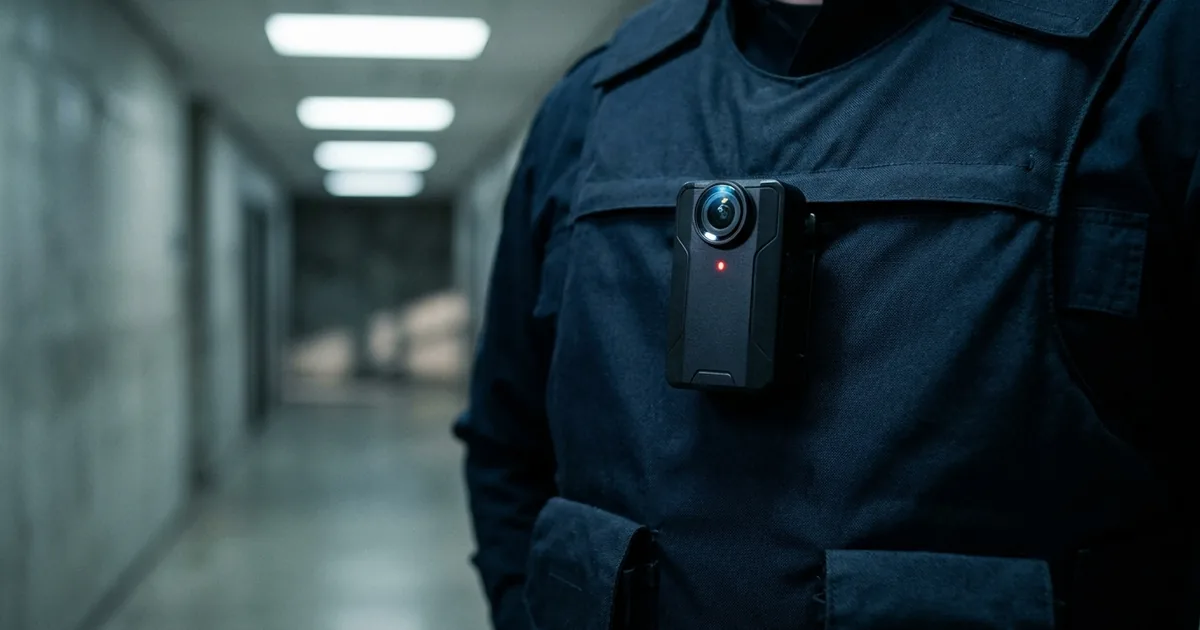
Immigration and Customs Enforcement will finish strapping body cameras to field officers nationwide by the end of September, and the policy governing those cameras reserves public release for the moments when doing so serves, in the document’s own words, the best interests of the agency.
One phrase converts an accountability tool into a communications asset, and it lands at the exact moment when the outside checks on ICE use of force have already been closed off one by one.
What the Policy Actually Says
The document, obtained by the Associated Press and reported on Friday, is not vague about the mechanics. Officers are required to switch the cameras on for routine enforcement, arrests, the execution of search warrants and emergency response. When a recording captures a shooting or another serious incident, a committee of senior ICE officials and agency lawyers reviews it and sends a recommendation up the chain. If leadership signs off, the video can be public within 72 hours.
The escape hatches are where the policy does its real work. Release happens only after the agency determines that putting the video out is “in the best interests of the agency.” The director can withhold footage indefinitely when there are “specific and compelling circumstances” against putting it out, a standard the document never defines. ICE did not answer the AP’s questions about how any of those calls get made.
Christopher Schneider, a Brandon University sociologist who studies how police video moves through the public, put it about as plainly as an academic can: “In some ways, ICE is saying the quiet part out loud.” Selective release is common practice at police departments across the country. What is unusual here is writing the discretion into the policy itself, in the agency’s own favor, in advance.
The Redaction Clause Is the Real Story
Buried under the release rules is a line that gets less attention and matters more: before any footage goes out, officers’ faces, names and badge numbers must be redacted.
Think about what that leaves. You can watch a fatal encounter and still not learn who fired. Katherine Hawkins of the Project On Government Oversight described a policy that renders the recordings “virtually useless,” and on the identification question she is simply right. A body camera that documents an event while erasing the person who caused it is producing evidence for internal review, not for public accountability.
Every Other Check Went First
This is the part that most coverage is treating as background and that actually explains the policy.
Body cameras got sold as the answer to a specific problem. Immigration agents have fired at dozens of people since the start of the current enforcement push, and two fatal shootings in July made the gap impossible to ignore: Lorenzo Salgado Araujo, a 52-year-old killed in Houston on July 7, and a 25-year-old motorist shot in Scarborough, Maine, a week later. Federal authorities said neither man was the intended target of the operation. CNN reported in mid-July that the absence of cameras was itself fueling the uncertainty around those deaths, because there was no recording to argue over.
Then the other checks started disappearing. In July, the New York Times reported and CNBC confirmed that the FBI would no longer investigate physical confrontations involving ICE officers, a change the Justice Department and DHS both disputed. If that guidance holds, those cases route to Homeland Security Investigations, which is a division of ICE. We covered what it means when the FBI steps back from ICE shootings at the time, and the answer was that the agency ends up reviewing its own officers.
There is already a working example of how discretionary release plays out. Customs and Border Protection has still not put out body camera footage of the January shooting of Alex Pretti in Minneapolis, as the Christian Science Monitor noted in its July look at why the cameras took so long. Commissioner Rodney Scott told senators the agency would release it while declining to say when or what it showed, on the reasoning that he could not jump to conclusions before the evidence was evaluated. Months later, the evaluation is apparently ongoing.
Stack those together and the shape is clear. The investigator is now inside the agency. The disclosure decision is now inside the agency. The one artifact that could travel outside the agency arrives with the officers’ identities stripped out. That is the structural why here, and it is not an accident of drafting. Nothing in federal law compels ICE to release this video, so ICE wrote the rule it wanted.
Taxpayers Bought the Cameras
The money makes the discretion harder to shrug off. Congress put $20 million toward ICE body cameras in the bill that ended the partial government shutdown on April 30. In July the agency spent $30.9 million with Axon, the Arizona company best known for making Tasers, through an existing contract dating to 2023. Federal spending records show the buying started one day after the Maine shooting.
DHS has been promising this for months. Kristi Noem, then the homeland security secretary, said early in the year that the department would rapidly acquire and deploy cameras after the Minneapolis shootings, and CBS News reported that DHS had committed to putting a camera-equipped agent on every ICE arrest team. The hardware is real and the schedule is real. The public’s claim on what the hardware records is the piece that never got written down.
Chuck Wexler of the Police Executive Research Forum, who has spent years advising departments through exactly this transition, made the case that ICE could build credibility by releasing footage rather than sitting on it. That argument assumes the agency wants credibility with the public it polices. The policy suggests the audience it is actually managing is a different one.
What to Watch
The first real test is arithmetic. Cameras go live across the field force by the end of September, and given the current pace of enforcement operations, a serious incident will be recorded within weeks of the rollout finishing. Then we find out what “best interests of the agency” means in practice, and whether 72 hours is a commitment or a ceiling nobody ever hits.
There is a version of this that works. An agency under this much scrutiny could decide that fast, unredacted release is its cheapest path back to credibility. Nothing in the policy prevents that. Nothing in it requires it either, and that is the whole design.