
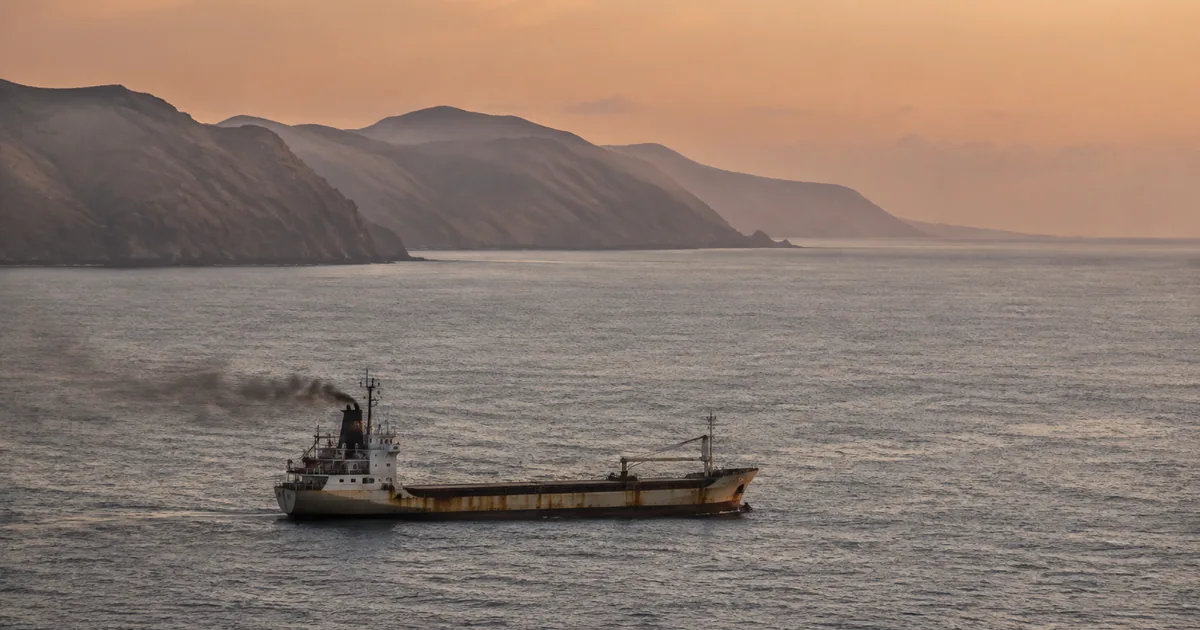
A small cargo ship called the Tihamah was struck in the Bab el-Mandeb strait off the Yemeni coast on Tuesday morning, and at least three of its crew were killed.
It was not a Western-linked container giant and not an oil tanker, and that detail is the whole story.
If the deaths are confirmed, they are the first killed by an attack on shipping in the strait since the wider war with Iran began on February 28. That is the line every wire service led with, and it is accurate. It is also the least interesting fact available, because it frames the Tihamah as a milestone in somebody else’s war rather than as what it actually was: a small regional coaster on a short run in a lane that everyone with the money to leave abandoned months ago.
The casualty count is still moving. Reuters, citing two Yemeni coast guard sources and two military officials in the internationally recognized government, put the toll at three, two Pakistani nationals and one Indonesian. The National reported four dead, three Pakistanis and one Indonesian, along with four injured crew and an injured rescue worker, and described three ballistic missile strikes that set the vessel on fire. Accounts of the ship’s movements differ too. Reuters and the trade press describe the Tanzania-flagged vessel as running from Salalah in Oman toward Djibouti; other reporting places it at anchor northeast of Perim Island after leaving the government-held port of al-Mokha on Saturday, carrying food.
The Attack Nobody Has Claimed
The UK Maritime Trade Operations centre, which is the clearing house for exactly this kind of incident, said only that it had been informed a cargo vessel off al-Mokha was hit by an unknown projectile and that there were casualties. That is deliberately thin language. UKMTO does not assign blame, and on Tuesday it had nothing to assign it with.
The Houthis have not claimed the strike. Yemen’s internationally recognized government blames them, and the geography and the weaponry both point that way, but the absence of a claim is worth noting rather than papering over. This is a group that has historically been quick to publicize maritime attacks, because publicity is most of the point. An unclaimed strike on a food coaster crewed by South Asian and Southeast Asian seafarers is a harder thing to put in a communique than a strike on a vessel it can call an enemy asset. The BBC, which first carried the reports on Tuesday, hedged the attribution for the same reason.
A Blockade Empties a Strait of Everything That Can Leave
Here is the mechanism nobody is naming. On July 20 the Houthis declared a naval blockade of the Red Sea aimed at Saudi Arabia, framing it as an answer to what they called a Saudi siege. We covered the strike on Saudi tankers that preceded it and the drone attack on the Jazan refinery two days ago. Each of those got covered as an oil story, because each of them moved a price.
The blockade did what blockades do. Daily transits through Bab el-Mandeb fell from roughly 50 vessels to about 32. That number gets reported as a disruption statistic. Read it the other way and it is a sorting mechanism. The ships that stopped sailing are the ones that could afford to stop: the major container lines, the tanker operators, the owners with the balance sheet to absorb a detour around the Cape of Good Hope and the charter rates to pass the cost along. Roughly a third of the traffic vanished, and it was the third with options.
What is left in the strait is the residual. Short-haul coasters running food and fuel between Oman, Djibouti, and Yemeni ports. Vessels serving a country where the alternative to the sea route is not a longer sea route but no cargo at all. These operators cannot add 3,500 miles to a voyage, because the economics of a small coaster do not survive it and because the cargo is needed at the other end of a two-day run, not a three-week one. They are in the lane because they have nowhere else to be.
That is what makes the Tihamah’s profile the story rather than a footnote to it. The blockade was announced against Saudi Arabia. The ship that burned was reportedly working out of a port held by the Houthis’ domestic rivals, carrying food, in a country already living with catastrophic hunger. A blockade aimed at a state ends up landing on the traffic that could not leave, which is a predictable outcome and not an accident of targeting.
Who Was Actually on Board
Two Pakistanis and an Indonesian, or three Pakistanis and an Indonesian. Merchant seafarers on a small vessel in a war zone, from countries with no navy in the Red Sea and no leverage over any party to this conflict.
There is no coalition task force built around protecting a food coaster. There is no war risk underwriter racing to cover this class of voyage at a rate the operator can pay. When a Western-linked vessel is hit, the response is a statement from a defense ministry and a line in a threat assessment. Vanguard, a British maritime risk firm, noted that after the strike “Yemeni forces then came under fire,” which tells you the incident did not end when the ship did.
Pakistan and Indonesia together crew a substantial share of the world’s merchant fleet. They are also structurally absent from the rooms where the escalation decisions get made. That asymmetry is not incidental to how this war is being fought at sea. It is a standing feature of it, and it is the reason a strike that kills three or four working seafarers registers as a milestone rather than an emergency.
The Same Day, a Hellfire off Pakistan
The Tihamah was not the only vessel hit on Tuesday. Reuters also reported an attack on the Vela Nova, a Panama-flagged container ship in the Gulf of Oman about 71 nautical miles off Pakistan’s coast, struck by a helicopter-fired Hellfire missile attributed to United States forces. No deaths were reported there.
Put the two incidents on the same map and the shape of the thing changes. This is no longer one party interdicting shipping while navies escort convoys. Both sides are now striking commercial hulls in the same week, in adjacent waters, and the medium of the war is civilian tonnage. That is a threshold that got crossed on a Tuesday with very little ceremony, and Congress has already declined to vote on binding limits to the campaign it belongs to.
What Happens to the Food Run
The immediate question is not whether the Houthis eventually claim the Tihamah. Claimed or not, the strike has already priced itself into every charter decision made this week for a Bab el-Mandeb transit.
The real question is what the operators of the remaining 32 daily transits do on Wednesday. If the small coasters stop, the lane does not just get quieter. The cargo they were carrying, into Yemeni and Horn of Africa ports that have no other practical supply route, stops arriving. A blockade that was announced as pressure on Saudi Arabia would then have accomplished something rather different, and the people who absorb it will not be in Riyadh.