
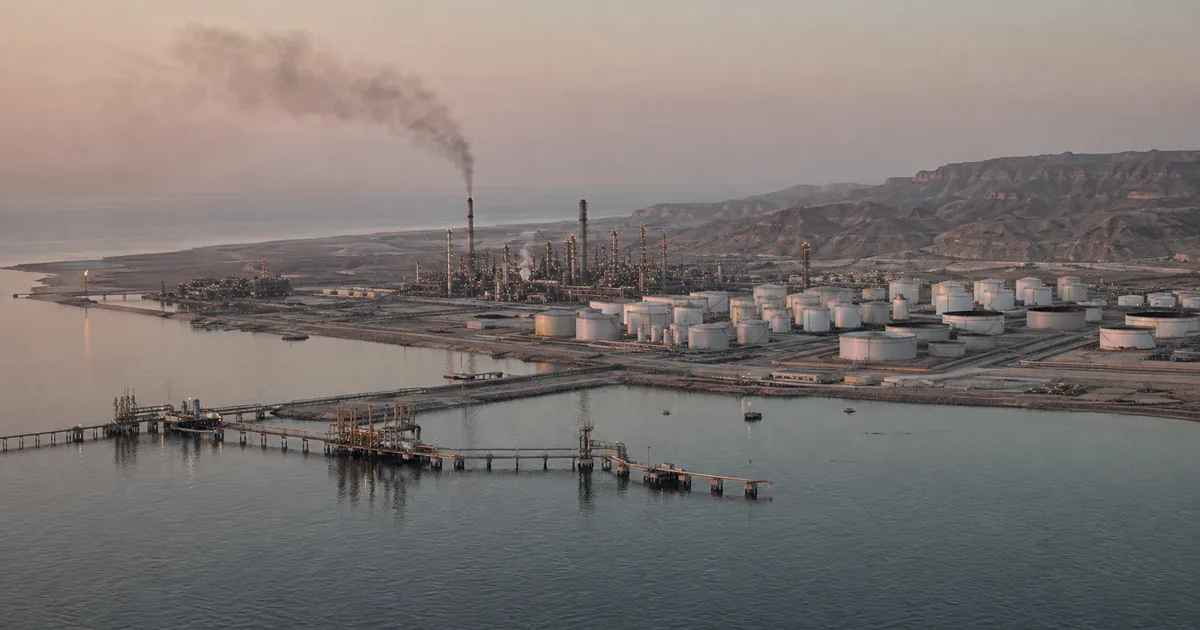
Saudi Arabia’s Energy Ministry said a fire broke out at dawn on Sunday at one of the facilities belonging to the Aramco refinery in Jazan, and Yemen’s Houthis claimed within hours that one of their drones started it.
Almost every wire report led with the reassuring half of that sentence, the part where the blaze was extinguished and nobody was hurt, and skipped the detail that gives the strike its meaning: Jazan has been shut down since July 27, and its restart was penciled in for August 15.
A Fire at a Plant That Was Already Dark
The ministry’s statement was deliberately narrow. Industrial security firefighting teams affiliated with Aramco put out a fire at one of the refinery’s facilities, there were no injuries, and authorities were completing procedures to deal with the incident. It named no cause. Yahya Saree, the Houthi military spokesman, filled that gap on X, describing a drone that struck precisely and framing the operation as an answer to Saudi drone incursions over the Yemeni governorates of Saada and Hajjah. Both accounts are on the record, and Al-Monitor reported that Riyadh continues to deny the siege of Yemen the group cites as justification.
Neither statement mentioned the condition of the target. Jazan has not processed a barrel since late July, when a combined missile and drone assault, the first direct Houthi strike on Saudi energy infrastructure in four years, damaged the plant’s integrated gasification combined cycle complex and its tank farm. The harm to the power systems was serious enough that Aramco suspended operations outright. Trade coverage of a note from the industry consultancy IIR put the restart at August 15, on one stated condition: that no further attacks occurred.
Sunday’s drone tested that condition with six days left on the clock.
Why the Houthis Keep Choosing This Refinery
Jazan sits on the Red Sea coast in southwestern Saudi Arabia, close enough to the Yemeni border to be within comfortable reach of cheap airframes. It processes 400,000 barrels a day, roughly four percent of what Aramco typically produces, converting them into ultra-low-sulfur gasoline, diesel, jet fuel, benzene and sulfur. It also houses the world’s largest integrated gasification combined cycle plant.
The number that matters is not the throughput. It is the coastline. Jazan’s integrated export terminal loads refined product directly into the Red Sea, which means the cargo never has to transit the Strait of Hormuz. For most of the past year that geography functioned as a hedge. With Hormuz choked by the US-Iran war, the southern Red Sea route stopped being a contingency and became a primary artery, which is the argument for why the oil market’s real vulnerability was never the strait itself. A plant built to route around one chokepoint turned out to sit inside somebody else’s drone range.
The Repair Clock Is the Weapon
A drone that starts a fire crews smother before breakfast looks like a failure. Measured by destruction, it is one. Measured by denial, it is nearly free.
Aramco cannot restart a refinery it is still inspecting. Any strike inside the repair window resets the damage assessment, re-triggers the safety review, and slides the restart date to the right, and the cost of forcing that is a single airframe. The Houthis do not need to level Jazan. They need only to keep it from coming back, and the cheapest way to hold a plant offline is to hit it while it is already down and the repair crews are standing on it.
That inverts the ordinary logic of attacks on infrastructure, where a wrecked facility becomes a spent target not worth a second missile. Here the wrecked facility is the more efficient target, because the marginal value of the strike is measured in delay rather than in damage. It is a cheaper form of leverage than anything the group achieved in four years of quiet, and nothing about Sunday suggests they have priced it wrong.
The Grievance Rotates, the Target List Does Not
July’s strikes were payback for Saudi airstrikes on Hodeidah. Sunday’s were payback for drones over Saada and Hajjah. The stated provocation changes while the target set stays fixed, which is the signature of a campaign that no longer requires a specific trigger to continue.
The four-year lull it replaced was never a formal treaty. It came apart in eleven days. Bombs cratered the runway at Sanaa International Airport on July 13 as an Iranian plane landed carrying a Houthi delegation home from the funeral of Iran’s assassinated supreme leader, Ayatollah Ali Khamenei. Yemen’s internationally recognized government claimed responsibility; the Houthis blamed Riyadh and declared de-escalation finished, then put ballistic missiles into Abha International Airport within a day. On July 20 the group declared a naval blockade of Saudi Arabia. Four days later the Saudi-led coalition struck Houthi military sites in Hodeidah, saying they were being used to threaten commercial shipping. That was the longest quiet Yemen had known since the coalition intervened in 2015, and The National was right to frame the sequence as a country at risk of a renewed war.
What the Market Spent Last Week Pricing
Traders were not watching Jazan. They were watching Muscat.
Crude slid for most of last week on the prospect of an Iran-Oman arrangement to reopen Hormuz, and by midmorning in London on Friday Brent had slipped 0.7 percent to $81.92 a barrel while US West Texas Intermediate eased to $76.96, both contracts tracking a weekly loss of roughly nine percent. The obstacle is a dispute over fees, compounded by an Iranian bill to bar American and Israeli vessels from the waterway. Set that against late July, when Brent topped $100 for the first time since May after Houthi attacks on Saudi shipping in the Red Sea, and the retreat is a market that has decided the worst is behind it. Our earlier reporting on the partial reopening and the truce that was supposed to hold it together explains how much optimism is already in the price.
Markets are closed on Sunday, so there is no quote to read yet. Monday’s open is the first honest verdict on whether anyone outside Riyadh thinks the repair calendar just moved.
The Number That Explains Riyadh’s Calm
Aramco’s own posture is the most revealing data point in the file. On the company’s August 4 earnings call, chief executive Amin Nasser played down the damage from the attacks by the Houthis and by Iraqi militia, allowing that they had caused some production interruptions while insisting there was no material impact operationally or financially, and that the full 12 million barrels a day of capacity remained available to ramp within three weeks if the government asked for it.
He could afford that framing. The same quarter delivered a 33 percent jump in profit, to $33.4 billion, carried by the war-driven surge in prices. The company also estimates the conflict has cost the global market 2.6 billion barrels of oil.
There is the asymmetry nobody is naming. The war that keeps Jazan dark is the same war that lifted the price of every barrel Aramco does sell, and scarcity the company partly absorbs is scarcity it also gets paid for. A 400,000-barrel-a-day refinery sitting idle is a rounding error against a $33.4 billion quarter. That math is a reasonable answer for shareholders. It is a poor answer for a Saudi border province under drone fire, and a worse one for the refined-product buyers in the region who cannot post a profit to offset a plant that will not restart.
The Calendar, Not the Fire
The thing to watch is not the blaze, which is out. It is August 15. If Jazan comes back on or near that date, Nasser’s read holds and Sunday was noise dressed up as an attack. If the date slips, a drone that did almost no visible damage will have purchased another week of a 400,000-barrel-a-day plant standing still, and the going rate for that delay becomes established fact rather than a theory the Houthis are testing.
Riyadh’s bind is that it can make neither the refinery invulnerable nor the border quiet. The market’s bind is subtler. It has spent a week pricing a peace being negotiated in Oman by people who do not control the drones.