
“This tragic shipwreck may sadly mark the first of many incidents this year.”
That sentence is six and a half months old. Tanja Pacifico, who ran the United Nations migration agency’s office in Djibouti at the time, said it in late March after a boat packed with 320 people sank off Guehere, on the coast north of the port of Obock. On Thursday night a boat carrying 305 people capsized off the same coast, and the International Organization for Migration confirmed on Sunday that 109 of them are dead, 15 of them children, with at least 116 still missing. The wire dispatches we read today, from the Associated Press and AFP, carry the count and the agency’s condolences. Neither mentions the March boat, the Houthi advance that put the Yemeni side of the strait on a front line last month, or the thousands of people now crossing the same water in the opposite direction to escape it.
What the Agency Has Confirmed
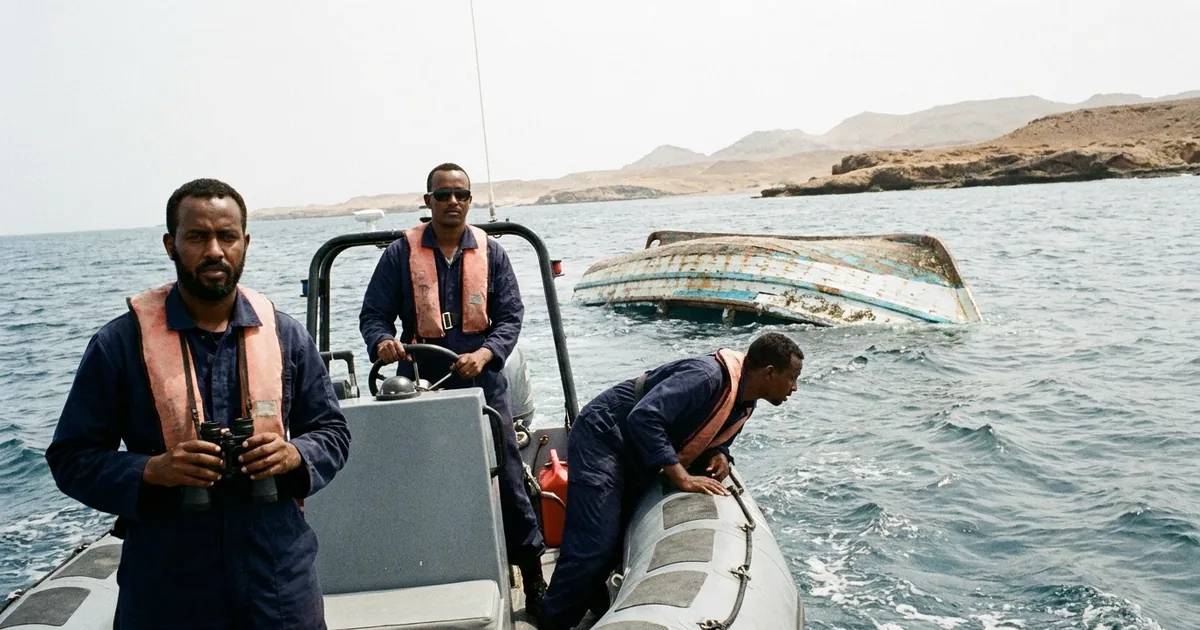
The boat was bound for Yemen and went over near Guehere, which the agency’s latest statement spells Guhere, during the night of October 8 to 9. Of the 109 bodies recovered, 52 were men, 42 were women and 15 were children, nine girls and six boys. More than 80 people survived, every one of them Ethiopian, and 64 are being cared for at the agency’s Migrant Response Centre in Obock. Djiboutian authorities are still searching the water and arranging burials. The statement gives no cause for the capsizing and no account of how the rescue unfolded. Alexandre Coissac, who now leads the agency’s Djibouti mission, called it “a devastating loss of life.”
One number needs a flag. IOM puts 305 people on the boat, while AFP’s dispatch says 350. The agency’s own figures sum to its total, 109 dead plus 116 missing plus the 80 or so who lived, so 305 is the figure used here. On that count roughly three of every four people who boarded are dead or unaccounted for, and IOM’s own headline calls it the deadliest shipwreck off Djibouti. For scale, when a boat carrying 154 Ethiopians sank off Yemen’s Abyan coast in August 2025, 68 died and 74 were never found. Sunday’s count is already higher on both lines.
The Same Coast, the Same Load
The March boat was a traditional wooden galba. Nine of its 320 passengers died and 45 were never found, and Djibouti’s coast guard pulled 266 people out alive in an operation that ran through the night. Set that beside this week. Two boats left the same coast for the same strait carrying nearly the same number of people, 320 and 305. In March more than four in five survived. This time about one in four did.
We do not yet know what separated those outcomes. It could be the weather, the distance from shore, the hour, or how long it took for anyone to learn a boat was down, and IOM has said nothing on any of it. What the comparison does establish is that a 300-person load was already ordinary on this coast by the spring. We think the March sinking should be read as a rehearsal: the same load, the same coast, and one variable left to chance, which was how many people could be reached in time.
A Record Year Came First
The spring warning arrived on top of the worst year the route has recorded. In 2025, 922 people died or went missing on it, against 558 the year before, the highest toll since the agency began tracking the route in 2014. Traffic rose as well, to more than 506,000 movements, up 18 percent, with transit through Obock alone up 58 percent. Put the death toll and the traffic together and you get the figure that explains why the boats keep filling. Set 922 against 506,000 and the ratio is under two-tenths of one percent, about one in 550.
That ratio is rough, because a movement is a logged journey along the corridor and not necessarily a sea crossing. It is still the right way to see the route from inside it. About 95 percent of the people on it say they are leaving for economic reasons, and to any one of them the odds look like a risk worth taking for a job in the Gulf. Run the same odds half a million times and you get more than 900 people dead or missing in a year. No single decision in that chain looks reckless, and the total is a mass-casualty event on a schedule.
Policing changed where the boats leave from without changing how many leave. Smugglers have shifted to more remote coastal paths through Djibouti specifically to evade police checkpoints, and that shift is part of what drove last year’s rise in traffic. Our read is that a remote beach is harder to patrol and also farther from a clinic, a radio and a rescue boat. The checkpoint did its job on the road and the cost surfaced at sea. Thursday’s boat put that cost at 225 people dead or missing in one night, close to a quarter of last year’s record total.
Where the Boat Was Going
Bab el-Mandeb is as little as 20 kilometers wide, which is what makes the crossing cheap to sell and easy to repeat. The far bank is another matter. In early September, Iran-backed Houthi forces took Yemen’s entire Red Sea coast and the Yemeni side of the strait in eight days. By October 7, IOM had counted 201,217 people displaced inside Yemen, 197,755 of them since September 1. Ta’iz and Lahj, the two governorates that hold the Yemeni shore of the strait, account for 156,972 of that total, nearly four in five.
The agency’s Yemen statement carries a detail that should stop anyone reading the Djibouti one. More than 3,700 people have fled Yemen by sea to Djibouti, arriving “exhausted, in overcrowded boats, with little food or water.” Boats are now crossing this strait in both directions. Yemenis are leaving a war for Djibouti while Ethiopians leave Djibouti for the war, and since September 10 the agency has tracked more than 20,000 movements into Djibouti from Ethiopia. The front line reached the far shore, and people kept arriving on the near one.
Yemen is a transit country for the people boarding at Obock. Their destination is Saudi Arabia and the Gulf, and the road there runs through trafficking, arrest and detention. Saudi Arabia is also the country now trading fire with the Houthis. We think the design flaw at the center of this route is informational: the party best placed to know what is happening on the far shore is the one paid per seat to fill the boat.
The Money Washington Took Out
IOM is the organization that reported the count, runs the center treating the survivors, and issued the warning in March. In 2025 it lost about 30 percent of its funding, roughly $1.1 billion, in cuts led mainly by the United States, which had supplied more than 40 percent of its budget two years earlier. More than 6,000 staff were affected and headquarters was cut by more than a fifth. This February the agency and 48 partners asked for $91 million to cover the whole 2026 response on this route and the one running south, and said the money in hand fell far short. That entire appeal is about a twelfth of what the agency lost in a single year.
Yemen’s own humanitarian plan is 20 percent funded. “We know what they need. We know how to deliver it. What we lack is the means to reach them all,” the agency’s director general, Amy Pope, said on Wednesday of the people displaced there. Washington is present on this strait in a second way, too. American officials are already helping the Saudi-led coalition choose its targets in Yemen, and President Donald Trump said on Saturday that the United States “may” join the strikes outright. So the same government withdrew the money from the agency that looks after the survivors on one bank and is helping select what gets bombed on the other.
Stop Calling It a Reminder
IOM’s statement calls the wreck “a stark reminder of the dangers faced by migrants along this migration corridor.” We think that word lets too many people off. A reminder is for something that slipped the mind, and nothing here slipped anyone’s mind. The agency forecast more sinkings from this coast in March, counted a record number of dead last year, and said in February that the money to respond was falling short. Thursday night was the route working the way every incentive on it points.
The smugglers who put 305 people on one hull bear the first responsibility for 109 deaths, and Djibouti should say publicly who they were and what it is doing to find them. Governments decide what surrounds those smugglers: whether there is a patrol boat near the remote beaches the checkpoints created, whether the center at Obock has staff, whether anyone on the Ethiopian side of the border hears what has happened to Yemen’s coast before paying for a seat. The United States made its choice about that in 2025. We think it should fund the $91 million appeal in full, this month, because a government helping to pick targets on one bank of a 20-kilometer strait cannot treat the dead on the other bank as somebody else’s problem.
At least 116 people are still missing off Guehere, and the search goes on. The agency has logged more than 20,000 movements into Djibouti from Ethiopia in the past month. We expect another boat carrying 300 people to leave the coast north of Obock before this search ends, and as of today nothing about its odds has changed.