
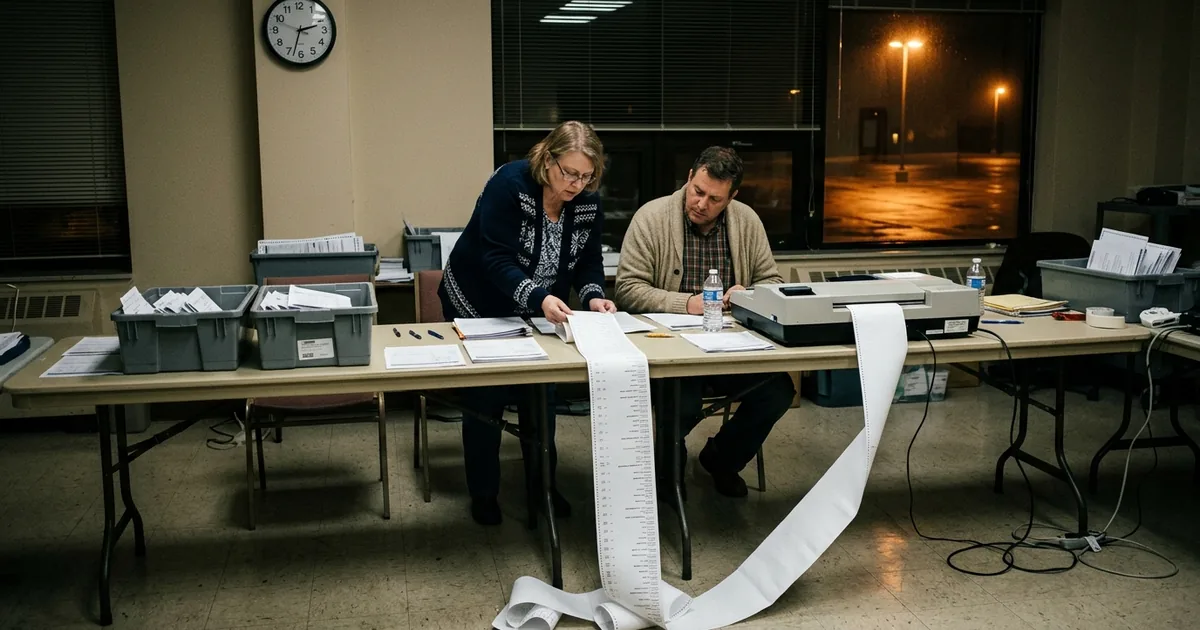
David Crowley won the Democratic nomination for governor of Wisconsin on Tuesday by roughly 3,000 votes out of nearly a million cast, a margin of four tenths of a percentage point.
The more useful fact is what it took to produce that margin: Crowley had already quit this race once, and the only thing that changed between the campaign he abandoned and the campaign he won was the endorsement of the man leaving the job.
The Count
Crowley, the Milwaukee County executive, finished with 39.8 percent to state Representative Francesca Hong’s 39.4 percent with 98 percent of the expected vote counted, according to NBC News’ tally of the race. Election officials in several counties were still counting into Wednesday. Hong, a Madison restaurateur and democratic socialist, had led the public polling going into election day and conceded a race she was widely expected to win.
Crowley is 40. If he wins in November he becomes Wisconsin’s first Black governor. He will face Representative Tom Tiffany, who cleared the Republican field after Donald Trump endorsed him and his main rival dropped out.
A Campaign That Had to Be Restarted From Outside
Here is the part of the story that most of the takeaway coverage skipped past. Crowley suspended his campaign about a month before the primary. He was polling badly, he had no money, and he stopped. Then, days later, he restarted it with outgoing Governor Tony Evers publicly behind him. Wisconsin Watch reported that Evers went out on the trail for him and made the case in the bluntest available terms: Crowley was the candidate who could win in November.
That is the structural cause of Tuesday’s result, and it is worth naming plainly rather than dressing up as momentum. An outgoing two-term governor with real approval numbers took a campaign that had already failed on its own merits, put it back on life support, and pushed it across a finish line four tenths of a point away. The endorsement was not a preference. It was a rescue.
Which raises the question nobody in the party seems eager to ask out loud: what does it say about a nominee that his campaign could not survive without the institutional weight of the person he is replacing? Evers is not on the ballot in November. Tiffany is, with the president of the United States raising money for him.
The Margin Is the Story, and the Margin Cuts Both Ways
Axios framed the result as socialist fever breaking. That reading requires ignoring the number. A democratic socialist state legislator from Madison, running in a statewide primary in a state Trump has carried, with the sitting governor campaigning against her, lost by 3,000 votes. If that is a fever breaking, the patient’s temperature is still north of 103.
The more honest read is that Wisconsin Democrats are split almost exactly in half on a question they have not resolved anywhere: whether the way to beat a Trump-backed Republican is to nominate the candidate who offends the fewest people or the candidate who gives the most people a reason to show up. Hong made the second argument and came within a rounding error. Al Jazeera’s takeaways from the night put Wisconsin alongside the other primaries as evidence the party’s internal argument is nowhere near settled, which is closer to what the returns actually show.
We have watched this exact split play out on different ground more than once this cycle. In June, Mamdani-aligned candidates swept a set of New York primaries and unseated an incumbent nobody thought was vulnerable. Last week, Abdul El-Sayed won Michigan’s Senate primary against heavy outside spending. Wisconsin is the first time in a while the establishment side won, and it won by less than half a point, with an assist that will not be available in the general.
What Crowley Actually Has to Do Now
Electability is a claim, not an achievement, and Tuesday did not test it. It tested whether Democratic primary voters would accept the claim, and barely half of them did.
Crowley now has to build a general-election coalition that includes roughly 40 percent of his own party’s primary electorate who preferred an explicitly left-wing alternative, in a state where turnout in Milwaukee and Dane counties decides statewide races. Those are Hong’s voters. The argument that won him the nomination, that he is the safer bet, is not an argument that motivates anyone to knock doors in October.
PBS NewsHour noted that the Wisconsin governor’s race is shaping up as one of the marquee matchups of the fall. That is right, and it is why the 0.4 points matter beyond Wisconsin. Every state party facing this same split is going to look at Tuesday and decide it proves whatever they already believed. The establishment will read a win. The left will read a near-miss achieved against a sitting governor’s thumb on the scale.
Both readings are defensible from the same set of numbers, which is usually the sign that a party has an unresolved fight rather than a verdict. Wisconsin gets to hold that fight in public for the next three months, with Trump’s endorsement working the other side of it.