
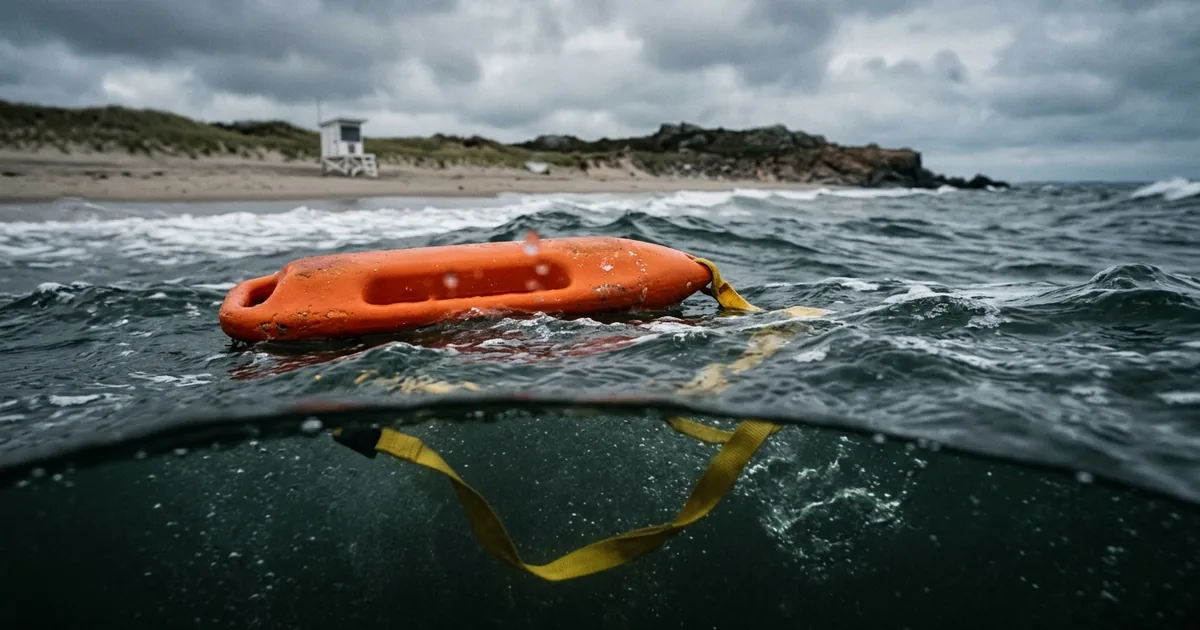
Greg Wilfert has been a lifeguard for 55 years, which means he was already doing this job when the first Jaws played in theaters. On Saturday afternoon a white shark grabbed the rescue torpedo he was towing off Scarborough Beach State Park and dragged him five or six feet below the surface before he wriggled out of the strap and swam up.
He was not injured. He is 71. He is also the park manager, so he finished the day.
What Happened in the Water
Wilfert was swimming a routine patrol with other guards around 1 p.m. when the shark took the buoy, he told CBS Boston, and his read of the animal was immediate: “I knew it was a great white.” The rescue torpedo is a hard foam float on a tether, the thing every lifeguard tows, and it is roughly the size and buoyancy of a small seal from underneath. That detail matters more than the drama does.
He got free by sliding out of the shoulder strap, which is the single decision the whole story turns on. Panic and you stay attached to the thing the shark wants.
Beaches in the area went yellow-flag and then closed. About twenty miles down the coast, Wells Beach was shut to swimming after the Wells Fire Department confirmed a white shark within 500 yards of shore. Fox Weather counted at least a dozen sharks spotted along Scarborough’s beaches across the same weekend.
Then the drone footage came out. Operators monitoring Pine Point Beach picked up five to seven white sharks feeding in one place, and a local officer with more than thirty years on that water called the concentration unprecedented.
Nobody Wants to Say the Boring Part, So We Will
This is not a story about sharks becoming more aggressive. It is a story about a law from 1972 working exactly as designed, and nobody quite planning for what working would look like.
When the Marine Mammal Protection Act passed, a University of Maine survey found fewer than 5,000 harbor seals along the state’s coast and zero gray seals. Current surveys put Maine’s harbor seal population above 61,000, with gray seal colonies still growing. In 1997 the federal government added Atlantic white sharks to the protected list, and New Hampshire Sea Grant has been making the connection for years: seals came back, and the animal that eats seals followed them north.
Maine’s own data says the same thing without the alarm. Research from the Department of Marine Resources published last year found that 90 of the 107 tagged white sharks detected in the northern Gulf of Maine between 2012 and 2023 turned up in shallow nearshore water after 2019, when monitoring expanded. Some of that curve is more sharks. Some of it is more receivers. Both things are true and the coverage almost never separates them, which is how a monitoring upgrade gets reported as an invasion.
Saco Bay in particular is now a buffet: baitfish schools, seal haul-outs, a warm shallow shelf. The Maine Wire mapped how close the tagged animals are getting to the most crowded beaches in the state, and the answer is closer than the tourism math would prefer.
The Part Where This Becomes a Policy Problem
A conservation success eventually has to get budgeted for, and Maine has not done that yet.
Cape Cod has spent a decade building the apparatus: drone spotting programs, tagged-shark alert apps, stop-the-bleed kits at every access point, signage that treats sharks as resident wildlife rather than a freak event. Maine has a Marine Resources team doing serious tagging science and a patchwork of towns making individual closure calls with whatever they have. Scarborough got lucky that its shark encounter happened to a man with 55 years of experience and a strap he could slip. Wells got lucky that its sighting came from a boat and not a swimmer.
Luck is not a coastal management strategy, and the season runs through October.
There is also a straightforward public-communication failure sitting here. Every year the footage arrives before the context does, as it did in July when a drone caught a white shark cruising past children off Southern California and the clip traveled far past anyone explaining what it actually showed. Video of a shark near people is not evidence of a rising threat. It is evidence that we now own cameras that fly.
Wilfert, for his part, has not suggested anyone stay out of the water. He described the encounter, noted that the shark took the float and not him, and kept working. Fifty-five years in, he seems to have arrived at the position the science supports and the headlines resist: the animals live there, we visit, and the visitors are the ones who need better information.