
The Daily Beast published two letters on Thursday in which Donald Trump’s executive assistant calls him “my Guardian and Protector in this life” and apologizes for being an “embarrassment walking the course in Scotland.” Almost every outlet has read them as a story about one woman’s devotion, and that is exactly the reading the White House would choose.
The letters were handed to author Michael Wolff during the reporting of his 2024 campaign book, and The Daily Beast printed them in full after weeks of secondhand description. They appear to date from a 2023 trip to Scotland and Ireland. CNN, which covered the release the same day, has not independently confirmed that Natalie Harp wrote them, and that caveat belongs in every sentence about their contents.
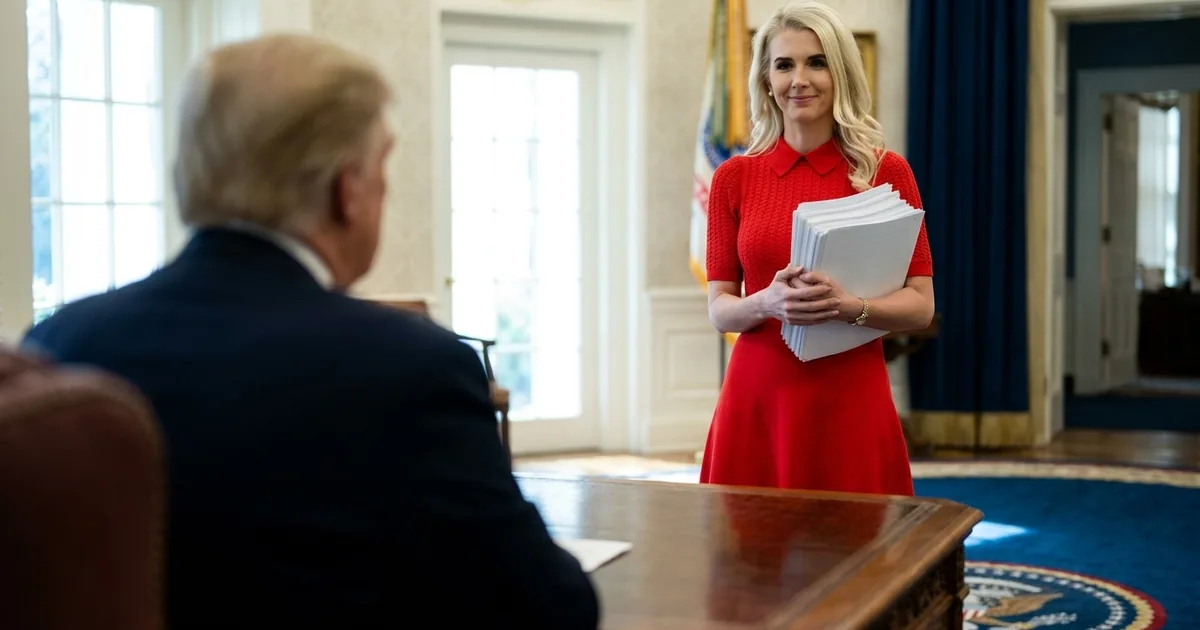
What is not in dispute is the position she holds now. Harp, 35, a former host on the right-wing One America News Network, is a special assistant and executive assistant to the president. She sits roughly ten feet from him. She types and posts his Truth Social messages. Colleagues nicknamed her the human printer during the campaign because she carried a portable printer, so anything she thought he should see could reach his hands within a minute.
The Letters Are the Artifact, Not the Story
Read them as psychology and you get a tabloid. Read them as an org chart and you get something much harder for the White House to spin.
“You are all that matters to me.” “I don’t want to ever let you down.” “It is I who is unworthy.”
Those lines describe a working relationship with no professional distance in it, written by the person who decides which paper reaches the president’s desk. That combination is the story. Every functioning West Wing since Eisenhower has kept those two things apart on purpose, because the alternative is a single unaccountable filter on presidential information.
The office built to prevent it still exists. The White House staff secretary controls the flow of documents into and out of the Oval Office, and the role is deliberately procedural, the bureaucratic plumbing that guarantees a president sees the dissenting memo alongside the one he will like. Will Scharf held that job from the start of the term before moving to White House counsel this year. The formal channel was never abolished. It was routed around by someone sitting closer to the desk.
A Clearance That Took the President Himself
The strongest evidence that the routing is real is not in the letters. It is in the clearance.
Harp declined for more than a year to begin the routine background investigation that West Wing staff are expected to complete, according to reporting from MS NOW citing two people familiar with the matter. The White House counsel’s office and security officials raised concerns. The forms were filled out and the clearance granted only after Trump personally intervened. Press secretary Karoline Leavitt has said Harp holds a clearance like everyone else, which is true today and was not true for the first year.
Snopes, which examined the claim this week, notes the sourcing is anonymous and the White House disputes the framing. Fair enough. Take the reporting at its weakest and the institutional problem survives intact: the vetting process could not compel one staffer, and the only authority that could was the person the process exists to protect. A clearance regime that runs on presidential favor is not a clearance regime. It is a courtesy.
Maggie Haberman added a further detail on CNN this week, saying the Secret Service had grown alarmed by some of the letters. The agency’s interest is not literary. Protective details assess proximity, fixation and predictability, and an aide with unlimited access whose written record reads like devotional correspondence is a category they are trained to flag.
Why Ossoff’s Throwaway Line Kept Growing
None of this would be a national story without eleven words at an Atlanta rally. Senator Jon Ossoff said Trump does not want to do the job, that he “wants to build his ballroom and travel with Natalie,” and the response was so immediate and so loud that it turned a jab into a week of coverage.
The ballroom half of that sentence already had a paper trail, including the appeals court fight over the demolition that reached the Supreme Court this month. The Natalie half had none, which is precisely why it worked. Ossoff pointed at the one part of the operation nobody had been forced to describe out loud.
The counterattack came from everywhere at once. Communications director Steven Cheung went after Ossoff directly, spokesman Davis Ingle called the remark cringeworthy, Eric Trump praised Harp as one of the hardest-working people in the building, and Leavitt defended her loyalty. The Hill tracked the escalation from rally clip to administration-wide response, and the Atlanta Journal-Constitution has since asked why the line kept gaining altitude in a news cycle that normally forgets a rally quote inside a day.
The answer is that the White House confirmed the premise by how hard it swung. Nobody spends a week defending a scheduler.
The Defense Is the Confession
Every official statement this week has defended Harp’s character. Time’s rundown of the fight catalogs them: loyal, hardworking, incredible young woman. Not one of them defends the arrangement.
That is the tell. Loyalty and work ethic answer a question about a person. The question on the table is about a structure, and it has a plain form: who decides what the president reads, under what rules, reviewable by whom? In an ordinary administration the answer is a named office with a documented process and a paper trail an inspector general can pull. Here the honest answer is that it depends on who is standing closest.
Personal aides have always mattered more than their titles suggest. What has changed is the absence of anything sitting above them. The first Trump term had a professional layer that functioned, imperfectly and resentfully, as a brake. The second was built by people who identified that layer as the enemy and removed it. Harp is not a glitch in that design. She is what the design produces.
The letters will fade inside a fortnight, the way documents without a subpoena behind them always do. The arrangement they describe will still be there, ten feet from the desk, printing.