
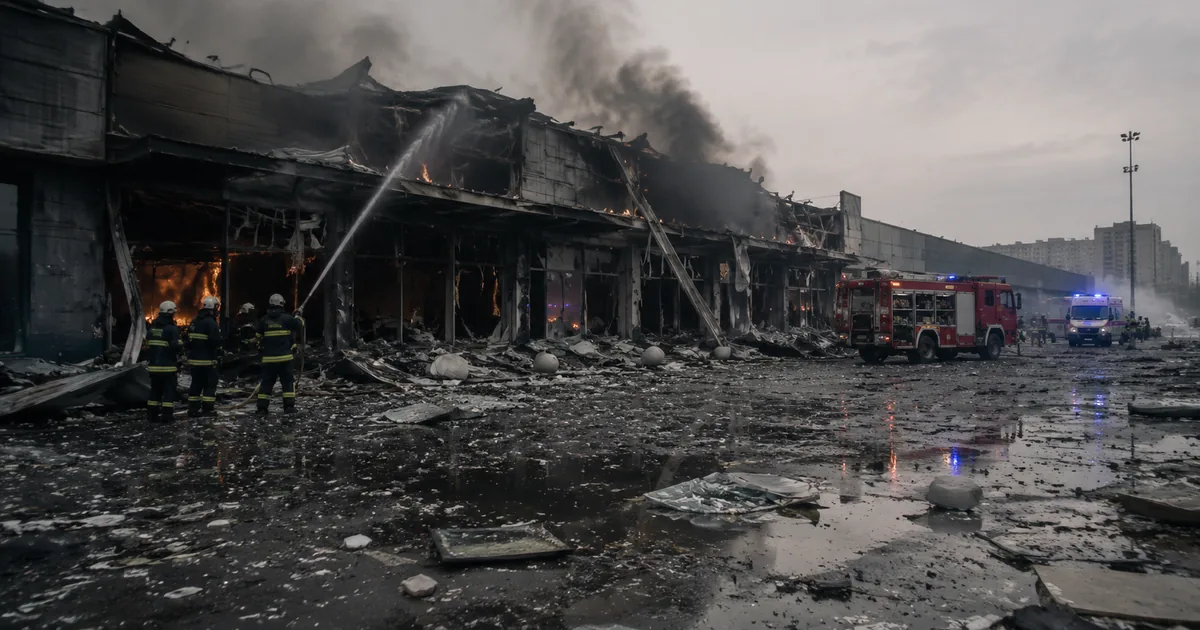
Two Russian attack drones hit a shopping centre in Kryvyi Rih on Friday afternoon, and the second one arrived about half an hour after the first, once firefighters and paramedics were already working the fire.
Fourteen people are dead and 121 wounded, and the interval between those two strikes is the part of this story that carries the intent.
Oleksandr Vilkul, who heads the Kryvyi Rih city military administration, gave those figures on Friday: 14 killed, 121 injured, 22 of them children. Oleksandr Hanzha, the governor of Dnipropetrovsk region, said on Telegram that 29 of the wounded were in serious condition, five of them children. Both numbers were still moving as the evening went on, and the Kyiv Post was already reporting a higher count. Tolls in a strike like this rise for days, because the people pulled out of a burning retail building late are rarely the ones who survive.
The city is Volodymyr Zelensky’s hometown. That detail has led most of the coverage, and it is the least important thing about the attack.
What “Double-Tap” Actually Describes
The phrase sounds like jargon, so it is worth being precise about the mechanics. A double-tap is not a stray second missile or a targeting correction. It is a first strike that creates a mass-casualty scene, followed by a deliberate pause, followed by a second strike aimed at the place the first one just made predictable. The pause is the weapon. Emergency response is the most reliably schedulable event in a war: hit a crowded building in daylight and you know, to within a few minutes, that ambulances, fire crews and volunteers will converge on a fixed point.
CNN has geolocated footage from the city showing a drone hit the shopping centre and a fireball climb out of it, with smoke from the earlier strike still rising in the same frame. That is the whole sequence in one image: the first fire had not been put out when the second drone arrived.
Zelensky described the attack in exactly those terms, saying the Russians struck an ordinary shopping centre and then went after the emergency responders who came to deal with the fire.
Attacks like these are nothing less than terrorist acts.
He also called it absolutely cynical and despicable, which is the register Ukrainian officials have used for three years, and which has produced very little. The word he did not use, and the one that has actual legal weight, is the one the rest of the world keeps declining to say out loud.
The Rescuers Were Not Collateral
Under customary international humanitarian law, medical personnel assigned exclusively to medical duties must be respected and protected in all circumstances, and the International Committee of the Red Cross treats that as a binding rule in both international and non-international armed conflict. Attacking civilians is already prohibited. Attacking the people who arrive to treat wounded civilians is a distinct violation, and one that is much harder to explain away, because the second strike cannot be dressed up as a mistake about what the target was. By the time a drone returns to a burning shopping centre thirty minutes later, everything relevant about what is on the ground is known.
That is why the tactic keeps appearing. It is not that Russian planners are indifferent to the legal exposure. It is that the legal exposure has never cost anything. There is no mechanism currently in operation that converts a documented double-tap into a consequence for the person who authorised it, and after enough repetitions, the absence of a consequence becomes a finding in its own right about what the tactic is worth.
The second effect is on the responders themselves. A fire crew that knows a second wave is likely has to choose between reaching survivors fast and staying alive. Every future strike in Ukraine now carries that hesitation built into it, at no additional cost to the attacker. That is the return on the tactic, and it compounds.
Why Drones Reached a Mall in Daylight
Kryvyi Rih sits well back from the front line, and this was an afternoon attack on a retail building, not a night barrage against infrastructure. Both of those facts point at the same underlying condition, which is that Ukraine’s air defence is being spent faster than it is being replaced.
A day earlier, a Russian ballistic missile barrage hit Kyiv across a dozen locations, damaging apartment blocks, a school, a children’s hospital and a kindergarten. Ukrainska Pravda reported the toll rising to 15 as a woman’s body was recovered from the rubble, and we covered that attack and the Patriot interceptor shortage that left the capital effectively open to ballistic missiles. Those two stories are the same story. Interceptors are scarce and expensive, and they get held for ballistic threats against the capital. Cheap one-way attack drones are neither, and they are numerous enough to spend two of them on one shopping centre.
That asymmetry is the quiet engine here. Russia can afford to fly a second drone at a target it has already destroyed, purely to kill the people responding, because the drone costs a rounding error against what it takes to stop one. Any accounting of what air defence funding is actually for should start with the fact that the alternative is a burning mall with a second wave inbound.
The Response Is Already Familiar
Russia’s Defence Ministry said nothing about the shopping centre. It did put out numbers on Ukrainian drones it claimed to have intercepted overnight, 325 across 15 regions and a further 211 later, which is the standard shape of these days: a detailed accounting of what was shot down at home, silence about what was hit abroad.
RFE/RL, The Moscow Times and Euronews all carried the strike within hours, and the counts in the earliest versions of those reports, six dead, then 91 wounded, then 100, then 121, show how fast this one moved. The Jerusalem Post put it at 14 killed and 120 wounded by Friday evening. Expect the final figure to be higher than any number in this piece.
What will not move is the thirty minutes. That interval was chosen, and it is the single most legible piece of evidence about intent that any strike in this war produces. The question worth asking over the next few days is not whether anyone will condemn it, because everyone will. It is whether the word “war crime” gets attached to it by a government with the standing to do something afterwards, or whether it stays where it has stayed since 2022, in the mouths of the people it was done to.