
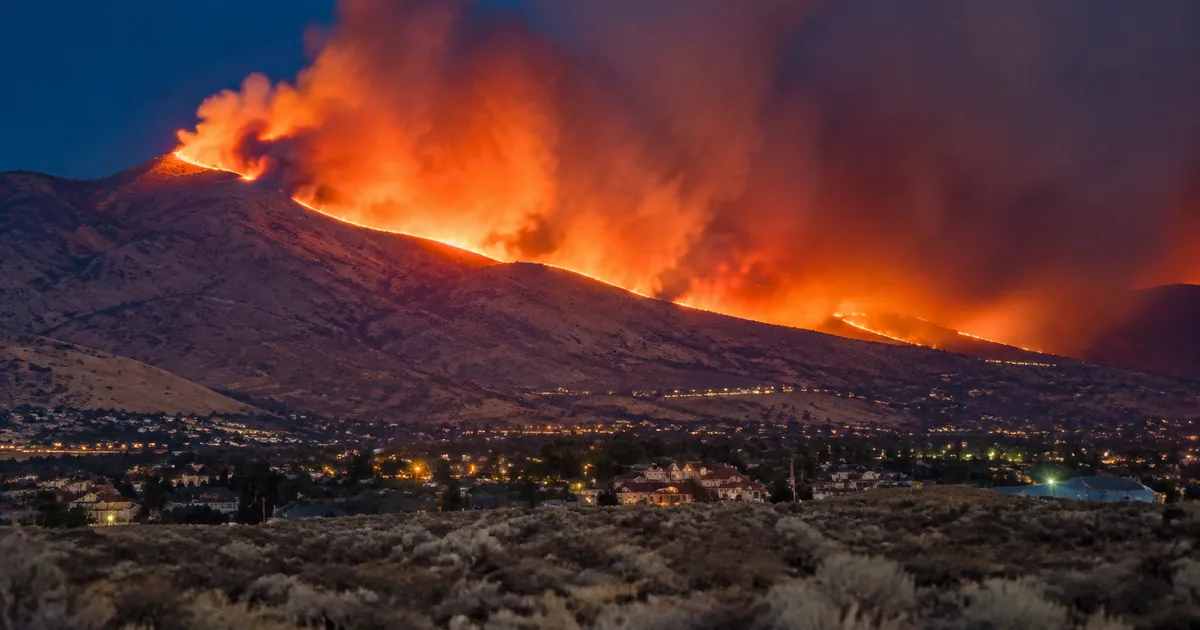
The Hawk Fire burned past 13,000 acres northwest of Reno by Sunday afternoon with zero containment, and its mandatory evacuation zone now reaches the edge of the University of Nevada campus.
The number that explains this emergency is not 13,000, though. It is 45,000, the count of residents told to go who were not, at that moment, standing in the fire’s path.
Washoe County split its response into two rings. Inside the first, about 42,000 people were placed under a “GO NOW” order, the designation used when fire behavior has outrun the ability to give anyone a second warning. Outside it sat a warning zone holding roughly 45,000 more, and those residents were urged to leave immediately and to plan on staying away for several days. Together that is close to 90,000 people, in a city whose population is somewhere north of 280,000, told to move on a Sunday.
The Warning Zone Was a Traffic Decision
An evacuation warning normally means stay alert and pack a bag. This one did not. Officials asked the outer ring to leave early and specifically framed it as a way to clear the roads for first responders, which inverts the usual logic of the tool. The outer ring was not being moved because the fire was coming for them. It was being moved because the inner ring could not get out past them.
That is the part of a wildfire emergency that rarely makes the aerial footage. Moving 42,000 people is not a fire problem first, it is a road-capacity problem, and the arithmetic is unforgiving: a residential street built to drain a subdivision over a morning commute has to empty it in under an hour, in smoke, with everyone leaving at once. Reno’s margin for that was already thin before Saturday. By Sunday, portions of U.S. Route 395, the north-south spine of the whole region, had been closed by the fire itself. The evacuation was competing with the emergency for the same asphalt.
So the county spent its warning zone as a traffic-management instrument. It is a defensible call, arguably the sharpest one made all weekend, and it is also an admission. You only need to preemptively clear 45,000 uninvolved people off the road network if you have quietly concluded the road network cannot handle the people who are actually in danger.
Peavine Mountain Is Ringed by the Thing That Makes It Burn
The fire is chewing through a rugged stretch of the Humboldt-Toiyabe National Forest around Peavine Mountain, which sits directly above Reno’s northwestern edge and is encircled by homes and businesses on the Nevada side of the California line. That geography is the whole story. Peavine is not remote country that happens to be near a city. It is a fuel-loaded slope with a metro area wrapped around its base, and development in the West has spent three decades adding houses to slopes like it considerably faster than it has added the roads those houses would need on a day like Sunday.
Reno has been shown this before. The Davis Fire tore through the Washoe Valley side in 2024, and the Long Valley Fire prompted its own round of evacuations. Each time, the fire found the same seam, the boundary where subdivisions meet untreated brush. Saturday’s wind did the rest: gusty conditions, low humidity, and dry vegetation took the fire from roughly 10,500 acres Saturday evening to more than 13,000 by Sunday, still at zero containment. Temperatures in the 90s are forecast into the workweek.
“If you have been told to evacuate, please don’t wait! Structures have already been burned in this fire and your life is more important than a building,” Reno Mayor Hillary Schieve wrote as the fire ran Saturday night.
Truckee Meadows Fire Chief Richard Edwards described the fire in a video posted to social media as “a very dynamic incident for us as it’s being driven by the winds,” which is fire-service phrasing for a blaze that is choosing its own direction. It has burned in more than one at once as the wind shifted.
“Human-Caused” Is a Category, Not an Answer
Washoe County Sheriff Darin Balaam said a preliminary investigation had determined the fire was human-caused, with the investigation ongoing. That finding will get read as a verdict over the next few days, and it is not one. Human-caused is an enormous bucket. It holds arson, but it also holds a dragging trailer chain, a mower blade on a rock, a power line, a campfire somebody thought was dead. The category tells you the ignition was not lightning. It does not yet tell you whether anyone will be charged.
The distinction matters because it decides which conversation the region has next. When investigators in Spokane concluded a fire there was deliberately set, they made an arrest and the story became a criminal case. If the Hawk Fire’s ignition turns out to be equipment or infrastructure, the conversation is about maintenance, utility liability, and who pays. Both are accountability stories. They are not the same accountability story, and treating a preliminary cause finding as a culprit is how a community picks the wrong fight.
What Sunday Actually Cost
Six people have been hurt, three of them civilians and three first responders. An estimated 1,000 homes were under threat, ABC News reported, with roughly 1,000 firefighters and other responders working the fire. Several structures have already burned, and officials have not been able to say how many, because conditions have been too dangerous to send damage assessment teams in.
The rest of the ledger reads like a city being taken apart in pieces. Nearly 10,000 homes and businesses in Washoe County lost power. Northwest Specialty Hospital evacuated its patients. Reno-Stead Airport closed to general aviation while staying open to firefighting aircraft, and Reno-Tahoe International kept running normally. The Reno-Sparks Convention Center opened as a shelter, with casinos offering evacuees discounted rooms and pets routed to separate locations. Governor Joe Lombardo declared a state of emergency for Washoe County and mobilized the Nevada National Guard, sending two helicopter crews and 60 troops. Washoe County schools canceled Monday classes at every campus but one.
Monday Is the Test
Zero containment on Sunday afternoon means no meaningful line had been held anywhere around a 13,000-acre fire after more than a day of work. That figure is the one to watch, not acreage, because acreage measures what already burned while containment measures whether anyone has gotten in front of it. A fire in Spokane earlier this month sat at zero containment with 640 homes threatened before crews turned it.
The wind decides. If it holds through Monday, the county’s early decision to empty the outer ring buys firefighters something close to open roads. If it shifts toward the university and the neighborhoods stacked behind it, Reno will find out whether clearing 45,000 people in advance was cautious or barely enough. Either way, the more durable question outlasts this fire: a metro area that keeps building into the base of a mountain like Peavine is making a standing bet that the next evacuation will also have somewhere to go.