
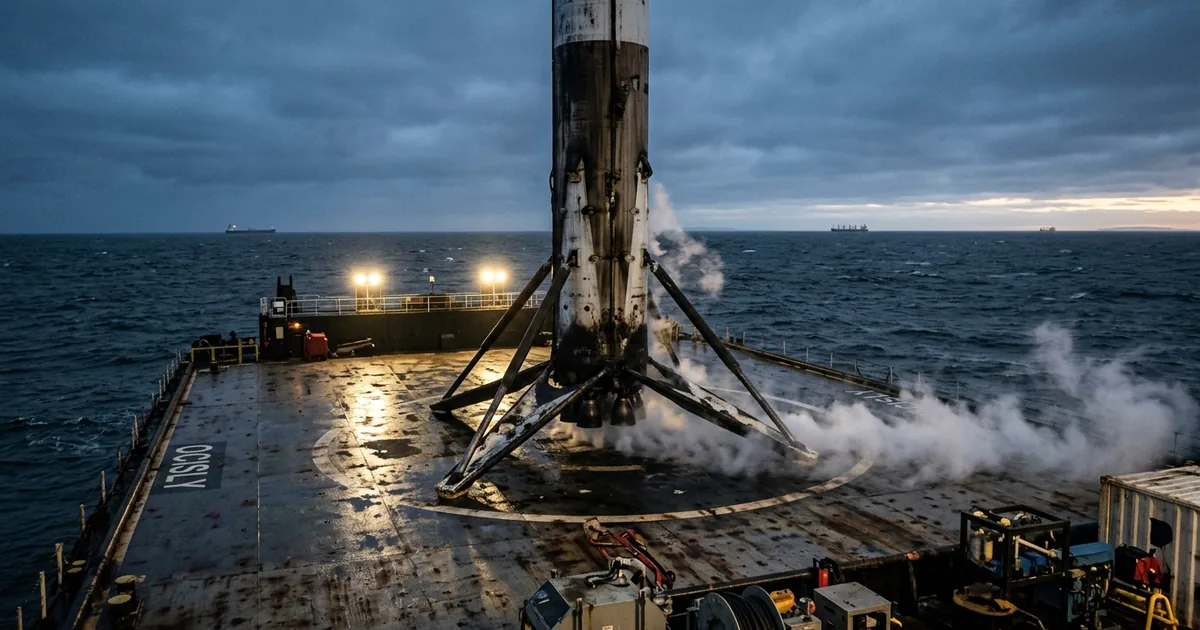
A Falcon 9 lifted off from Space Launch Complex 40 at Cape Canaveral early Tuesday carrying 29 Starlink satellites, and by the time the booster settled onto a droneship in the Atlantic it had set two records at once.
It was the 100th Falcon 9 flight of 2026, with four months still on the calendar, and it was the 37th trip to space for a single first stage.
The reuse number is the one that gets the headlines. The cadence number is the one that actually explains what SpaceX has become.
Booster B1067 Has Been Flying Since Joe Biden’s First Summer
The first stage on this mission, designated B1067, entered service in June 2021. Since then it has carried astronauts and cargo and an awful lot of broadband hardware:
- Crew-3 and Crew-4, both crewed missions to the International Space Station
- Roughly 25 dedicated Starlink flights
- A turnaround of just 47 days between its 36th flight and this one
That last detail is the quiet one. When SpaceX started landing boosters, the debate was whether a flown rocket could ever be trusted again. The debate now is how fast you can wash one and stack it. Spaceflight Now tracked the countdown on a vehicle whose flight history is longer than most national space programs.
We wrote about B1067’s 36th flight in July, when it broke the same record it just broke again. Six weeks later, here we are. The record is no longer an event. It is a maintenance schedule.
Seventy-Seven of Those Hundred Flights Were SpaceX Launching SpaceX
Here is the number nobody puts in a headline. Of the Falcon flights this year, Space.com counted 77 devoted to building out Starlink. Not customer payloads. Not NASA science. SpaceX, hauling SpaceX’s own satellites, for SpaceX’s own broadband business.
That ratio is the story of the modern launch industry in one fraction. The most capable, most frequently flown orbital rocket ever built spends roughly three quarters of its flights as internal logistics for a telecom company.
It works because reuse made launch cheap enough to stop being a product. When a seat on a rocket cost tens of millions and the supply was scarce, you sold it. When you own the factory, the pad, the boat, the booster and the payload, the rational move is to fill your own manifest first and sell whatever is left. SpaceX is not primarily a launch provider anymore in any meaningful sense. It is a satellite operator that happens to own the world’s best delivery truck, and everyone else, including the United States government, queues behind the delivery truck’s owner.
Eleven Thousand Satellites, and Two of Every Three Belong to One Company
The constellation crossed 11,000 satellites in orbit on August 19. Harvard astrophysicist Jonathan McDowell, whose orbital catalog is the count that regulators and newsrooms actually cite, had roughly 10,979 Starlink craft up that day with about 10,963 of them working. Trackers put the total population of active satellites around Earth near 16,300.
Divide those and the picture is stark. Roughly two of every three functioning satellites orbiting this planet belong to one company. EarthSky marked the 10,000-satellite milestone earlier and the pace has not slowed since.
SpaceX itself has acknowledged the pressure this creates. In January the company said it would lower thousands of Starlink satellites to reduce collision risk as avoidance maneuvers climbed. That is a company managing congestion it created, using rules it largely wrote for itself, in a domain where no regulator has anything close to matching capacity. The Federal Communications Commission licenses these constellations. It does not fly them, track them, or meaningfully audit them.
Astronomers have been raising their hands about this for six years, mostly about streaked exposures and radio interference. The harder problem is governance. There is no international body with the authority to tell the operator of two thirds of the working satellites in orbit to slow down, and the operator has given no indication it intends to.
The Telescope Is the Tell
Five days from now, on August 30, a Falcon Heavy is scheduled to leave Launch Complex 39A at Kennedy Space Center carrying NASA’s Nancy Grace Roman Space Telescope. NASA teams sealed the observatory inside the rocket’s fairing last week after clearing its flight readiness review, and SpaceNews reported the mission holding to its late-August window, roughly nine months ahead of its original schedule.
Roman is a genuinely thrilling machine, a wide-field infrared survey instrument that will image huge swaths of sky at Hubble-class resolution and hunt dark energy across cosmic time. It is also a useful illustration. America’s flagship astrophysics mission of the decade rides to orbit on hardware owned by a private company that spends most of its launch capacity on its own broadband network, and NASA is grateful for the slot.
That is not a scandal. Falcon Heavy is available, it is proven, and the alternative was waiting years. But it is worth naming plainly, because a single company now controls the road to space, the traffic on it, and the majority of the destinations. The reuse record that made this morning’s launch newsworthy is precisely the innovation that produced that concentration. Cheap, repeatable access to orbit was supposed to open the frontier to everyone. So far it has mostly opened it to whoever owns the rockets.
The next Starship flight will carry the larger V3 Starlink satellites, which we covered when flight 13 went up, and each of those replaces several of the ones going up on Falcon 9 today. The constellation is not finished growing. The question is who, if anyone, is in a position to say when it should be.