
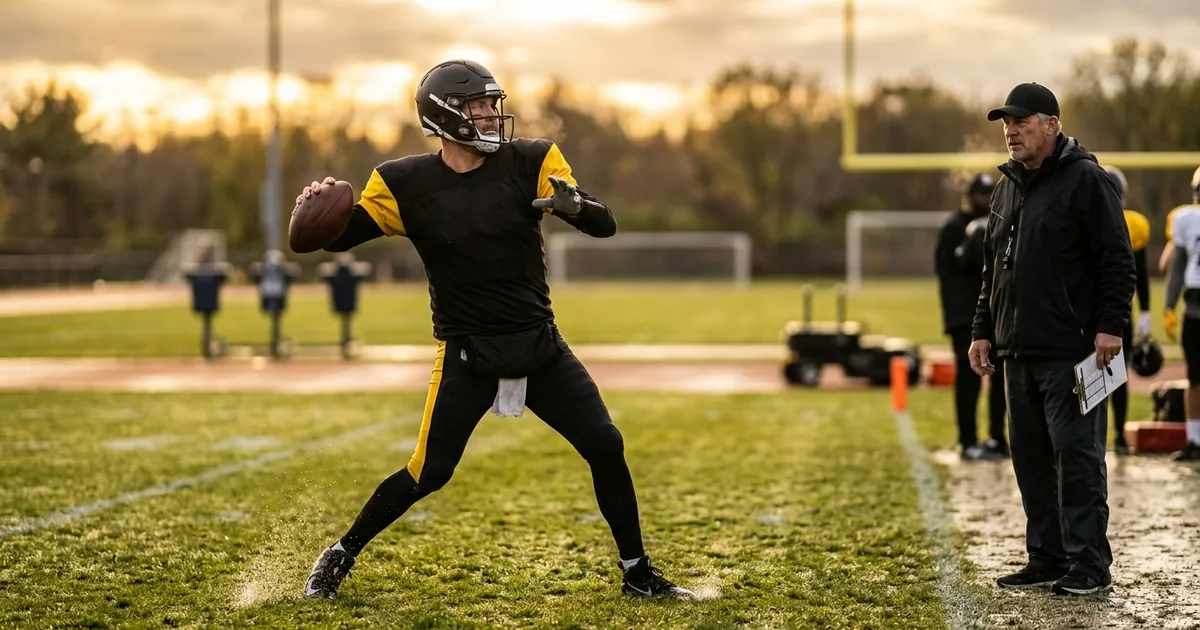
Aaron Rodgers, forty-two years old and a year removed from the most public second act in modern NFL quarterbacking, is expected to sign with the Pittsburgh Steelers ahead of OTAs. New head coach Mike McCarthy, who coached Rodgers for thirteen seasons in Green Bay, was on the field at the team facility for the visit. Multiple league insiders described the deal as “likely.” That is the closest thing to a done deal that an unsigned veteran free agent can be in May.
This is also, plausibly, the last football story Aaron Rodgers will be the headline of. That makes it worth taking seriously, even when the surface read is sports-page novelty.
The McCarthy Connection Is the Lede
Pittsburgh hired McCarthy in January with a clear remit. The 2025 Steelers ended their season with a Wild Card loss, the third one in five years, and the front office decided the offense had hit the ceiling of what the prior staff could draw out of it. McCarthy was hired for the offensive identity. That identity was built, over a decade, around an Aaron Rodgers who could process pre-snap and improvise post-snap better than anyone in the league.
Hiring McCarthy without securing a veteran quarterback who can run the McCarthy offense is a half-move. The Steelers are not in a roster position to develop a rookie behind the McCarthy install. The 2026 NFL Draft, which runs the same week, has Pittsburgh on record as not taking a quarterback in Round 1, per the team’s own pre-draft public statement covered in our 2026 NFL Draft preview. If the Steelers are not drafting a quarterback, the McCarthy hire only makes sense if a Rodgers signing is the back half of the same plan.
What Pittsburgh Is Actually Buying
The Steelers are not paying for prime Rodgers. Prime Rodgers is six years gone. They are paying for two specific things, and the price is right because most of the league is not interested in either.
The first is offensive-system fluency. McCarthy’s playbook in 2026 will not be a copy of the 2018 Packers, but the structural DNA, the layered route concepts and the run-pass-option triggers, will be familiar enough that Rodgers can run the offense in May and June while a younger quarterback would still be in the meeting room. That gets Pittsburgh through camp without losing reps to a learning curve.
The second is what he brings to the rest of the roster. Pittsburgh’s receiver room is talented and inconsistent. Its offensive line is rebuilding. A quarterback who has spent a career making receivers right and protecting the line by getting the ball out fast is a disproportionately useful glue piece on a roster that needs cohesion more than it needs a single big play.
What Pittsburgh is not buying is durability. Rodgers played twenty-two games over his last two seasons combined, including the playoffs. The next twelve months of training-camp arithmetic will be about how many starts he can give the Steelers and who plays the rest.
The Risk Is Not the Quarterback
Most analysis of a forty-two-year-old quarterback signing focuses on the quarterback. That is the wrong frame. The risk for Pittsburgh runs through the contingency layer, not the marquee.
The current backup quarterback room behind Rodgers is the most consequential piece of this deal, and the league does not yet know who that is. If the Steelers can land a credible second QB, ideally a veteran on a one-year deal who can play the McCarthy system in week eight if Rodgers misses time, the deal hedges itself. If the Steelers go cheap on QB2 and rely on the existing roster, an injury to Rodgers in October collapses the season and the McCarthy install at the same time.
Per Reuters NFL coverage of the negotiation, Pittsburgh is in the market for a backup with starting experience. The names floated are veterans who will not start in 2026 anywhere in the league but who have system familiarity. That is the shortlist that decides whether this deal looks smart in January.
The League Context
Rodgers signing in Pittsburgh has implications beyond Pittsburgh. The Steelers entering 2026 with a credible quarterback room reshapes the AFC North race. Cincinnati’s offense remains the conference’s most explosive on paper, Baltimore’s is the most reliable, and Cleveland’s situation is unresolved. A Pittsburgh team that can score in the 22-to-26 range consistently is a wild-card contender, and the AFC’s playoff math has assumed otherwise for two seasons.
It also reshapes the post-Mahomes conversation about the league. Per AP NFL reporting on the offseason quarterback market, Rodgers in Pittsburgh is the last meaningful chapter of the 2005-draft-class quarterback era. When that era ends, the league stops being the Mahomes-Allen-Burrow-Herbert top tier with elder-statesman supporting characters. It becomes whatever the post-Rodgers, post-Brees, post-Brady league is, with no one playing the role of bridge anymore. The 2026 season may be the last one where a story like this is even possible.
How the 2026 Steelers Look on Paper
The on-paper case is reasonable. T.J. Watt remains one of the league’s three best edge defenders. Cam Heyward is a season closer to retirement but still a difference-maker. The secondary is healthy. The offensive skill positions are deep, if uneven. The kicker situation is settled.
What the team has lacked under the prior staff is a quarterback who can lift the floor, not just the ceiling. Rodgers, even at this stage, is still that quarterback in most weeks. The Steelers were a bottom-third offense in 2025 in points scored. A McCarthy-Rodgers offense moves them into the middle ten by reasonable projection, which is the difference between a 9-8 team that misses the playoffs and a 10-7 team that wins a Wild Card game.
The Last Rodeo Question
The “last rodeo” framing is a sportswriting cliche, and it is the wrong frame. Rodgers is not chasing a final ring in the way Brady was. He is signing with a coach who has built an offense around him before, in a city that takes its football seriously enough that a forty-two-year-old quarterback playing competent football will be enough. That is a quieter ambition than a Super Bowl run, and it is more likely to be met.
For the Steelers, the deal is a one-year experiment with an obvious off-ramp. For McCarthy, it is the cleanest possible debut. For Rodgers, it is something else. It is the specific arrangement that lets a quarterback whose career has already been written end it on his own terms, in pads, in a city that will let him.
The signing is not yet on paper. The expected announcement window is the next ten days. If it happens, the 2026 AFC North gets more interesting overnight, and the post-Rodgers era of the NFL gets its real start date a year later than anyone planned.