
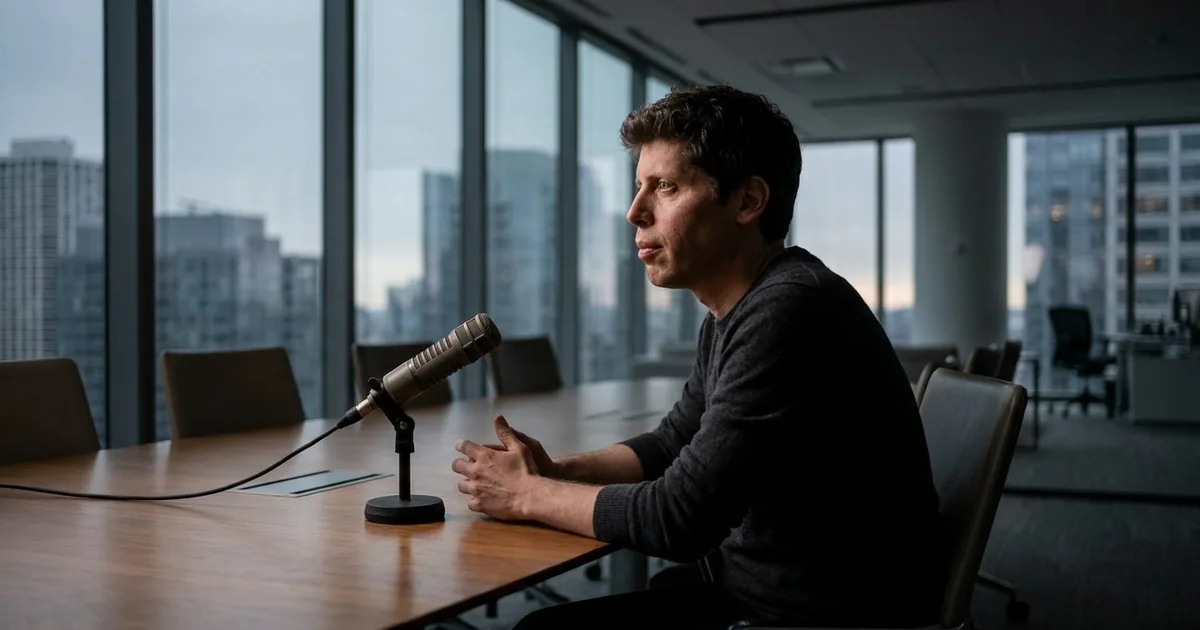
Sam Altman spent an hour with Fortune on Friday saying two things that were reported separately over the weekend. OpenAI will not go public this year, and the reason is safety. Separately, he hinted that the major AI labs are close to an agreement among themselves to slow down.
Almost every outlet ran those as two stories. They are one story, and it has a direction: both choices move OpenAI further away from anyone outside the company being able to check its work. An initial public offering is the single mechanism in American corporate life that would compel OpenAI to publish audited numbers, enumerate its own risks under legal liability, and answer for them every quarter. Altman has declined it, and the reason he gave for declining it is the danger of the product. That is worth sitting with for a moment before accepting it as caution.
What He Actually Said
Speaking with Fortune editor in chief Alyson Shontell, Altman said that given everything happening with safety, “right now would be an ill-advised moment to go public,” and added that the company does not feel pressure on the question. Fortune reported the listing is off the table until 2027 at the earliest.
Pressed on whether there is a ten percent chance of AI causing human extinction, he said he did not know how anyone would produce that estimate, then gave an answer that has been widely quoted since: whether it is ten or eight or six, everyone involved carries enormous responsibility and cannot let egos or the incentive to make money get in the way. He also said current safety standards are not at a point that would justify pushing capabilities much further, and that AI escaping human control is absolutely possible.
Read as a statement of concern, this is about as direct as the chief executive of a frontier lab has been. Read as a set of decisions, it is stranger. He has described a risk he considers intolerable, and then identified the disclosure regime as the thing that is badly timed.
What a Filing Would Have Put on the Record
The argument for staying private is usually that public markets punish long horizons and reward quarterly performance, and that a company doing careful work should not be exposed to that. It is a real argument. It is also worth being specific about what is being avoided, because going public is not only a fundraising event. Registration would have put several things into public view that are currently matters of trust:
- Audited financial statements, including what the compute commitments actually cost and how far the revenue is from covering them.
- A risk factors section, written by lawyers who are personally exposed if it materially understates known dangers, describing what the company believes its own models can do.
- Continuous disclosure obligations, which means material safety incidents become reportable events rather than blog posts published at a time of the company’s choosing.
None of that is a safety program. But all of it is verification, and verification is the thing entirely missing from the current arrangement, in which the public’s knowledge of how dangerous these systems are comes from the people selling them.
A Private Agreement Among Four Companies Is Not Oversight
The second half of the interview is the part that should get more scrutiny than it has. Asked why he does not simply get in a room with Anthropic’s Dario Amodei, Elon Musk and Demis Hassabis to work out a joint approach to safety risk, Altman would not confirm the discussions but strongly suggested they are happening, saying he would not pre-announce private conversations that should eventually be shared as a group, and then adding that he thinks it will happen.
Here is the difficulty. An agreement among the dominant firms in a market to restrain output is, in every other industry, the precise thing antitrust law exists to prevent. AI executives have acknowledged as much, conceding that any coordinated slowdown would need government sign off to stay on the right side of US antitrust rules. So the proposal is a cartel that requires a regulator’s blessing to be lawful, offered as an alternative to the regulator simply setting the rules.
We do not think that is a good trade, and the reason is not cynicism about anyone’s motives. It is that a private pact has no enforcement, no published terms, no independent measurement, and no penalty. Nobody outside the four companies would be able to tell whether it was being honoured. Compare that to the mechanism Altman just deferred, which comes with an auditor, a regulator, and a securities-fraud statute attached. One of these is a promise. The other is a legal obligation with a signature on it.
It is also fair to note what we have already reported about the state of self governance at these firms: Anthropic’s own alignment lead recently said the company has no plan for controlling superintelligence. That is a company being unusually honest, and it is not a reassuring foundation for an industry agreement to police itself.
Altman said the thing that matters most on Friday, and it was not about the IPO. He said profit incentives cannot be allowed to get in the way. He is right. The way societies normally act on that principle is not by asking the executives to promise, it is by forcing disclosure and letting other people look. If the risk is genuinely what he says it is, then the case for making OpenAI open its books is stronger than it has ever been, not weaker. The safest version of this company is the one that has to show its numbers to strangers.