
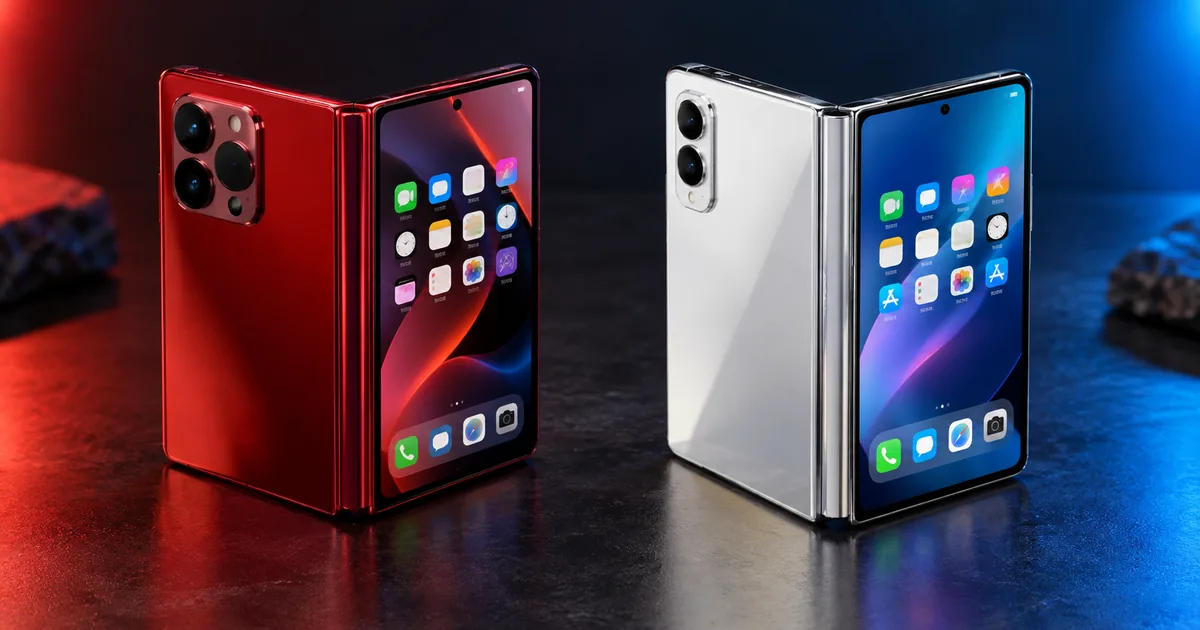
On September 7, two days before Apple walked on stage to introduce its first folding phone, Xiaomi held up a wide, passport-shaped foldable in China and dared anyone to call it a copy of a phone that did not officially exist yet.
Here is what is established, and what the “Xiaomi cloned the iPhone Duo” chatter leaves out:
- Xiaomi went first. The Xiaomi 18 Fold launched in China on September 7 with a 5.38-inch outer screen, a 7.58-inch inner screen and a starting price of ¥10,999, which MacRumors converted to about $1,638.
- Apple went second. Apple unveiled the iPhone Duo on September 9: a 5.4-inch outer display, a 7.6-inch inner display, $1,999 to start, preorders October 16, in stores October 23.
- Neither invented the shape. Huawei shipped the first wide foldable, the Pura X, in March 2025, and Samsung put a wide Galaxy Z Fold8 on sale in the US this summer.
- You cannot walk into a US store and buy the Xiaomi. It is a China-only release with no announced global pricing, and Xiaomi has never sold its phones in the United States.
That last point is the one every spec-sheet showdown skips. The comparisons flooding search results this month keep crowning Xiaomi on value, and on paper they are right. But “is it worth it?” is a buying question, and for an American reader the Xiaomi 18 Fold is not really for sale. The honest answer is no, don’t import one. The more useful thing the phone does is show you exactly what Apple is charging $1,999 for.
The Clone Accusation Has the Timeline Backwards
The internet’s instinct, when a Chinese phone looks like an Apple phone, is to say “knockoff” and move on. It is a reliable instinct. It is also wrong this time.
Xiaomi’s phone was on a stage 48 hours before Apple’s. Both companies were building toward the same rumored proportions for a year or more, because the supply chain that makes folding OLED panels and hinges is small, shared and leaky, and everyone in it knew roughly what Apple ordered. That makes the resemblance convergent rather than copied. If anything, Xiaomi launched early specifically to make Apple’s reveal look like the follower, and for two days it worked.
The shape itself belongs to Huawei, which bet on a short, wide “passport” format while everyone else was still making foldables that open into a tall, awkward square. Samsung, which spent six generations defending its narrow Fold, quietly conceded the point this year: the Galaxy Z Fold8 announced in July is Samsung’s first wide model, with a 7.6-inch inner screen, a 5.5-inch cover screen and a $1,899.99 US price. When we looked at Apple’s foldable plans last summer, the interesting question was whether Apple would legitimize the category. Apple arrived fourth to a shape three rivals had already agreed on, and it will still probably sell more of them than all three combined. That is what an ecosystem buys you.
So the phone is not a clone. Whether it is a better phone is a different argument, and there Xiaomi has a real case.
Compare what roughly $1,638 gets you against what $1,999 gets you, using each company’s own published numbers:
- Cameras. Xiaomi ships three rear cameras developed with Leica: a 200MP main sensor, a 50MP ultrawide and a 50MP periscope telephoto with 3.5x optical zoom. The iPhone Duo has two 48MP cameras and no dedicated telephoto lens; its 2x zoom is a crop of the main sensor. Apple’s most expensive phone ever has fewer cameras than its Pro models.
- Battery. Xiaomi lists a 6,000mAh cell with 67W wired and 50W wireless charging. Apple, as usual, won’t publish a capacity, and promises up to 24 hours of mixed use across both screens from a dual-battery design.
- Storage. Apple wins here if you have money to set on fire: the Duo goes to 2TB. Xiaomi tops out at 1TB.
- Unlocking. A fingerprint reader in the side button on both. For Apple that means Touch ID on a top-priced iPhone for the first time since the iPhone 8, which tells you how little room is left inside a phone that folds.
Early buyers in China noticed. Xiaomi China president Wang Xiaoyan said first-sale demand was up 310% on the previous foldable in the same price band, and the launch stock ran out. That is a genuine hit, in a market where Huawei, not Apple, is the foldable to beat.
Why “Worth It” Still Comes Out No for American Buyers
Here is where the spec-sheet math stops working, and it stops for reasons that have nothing to do with megapixels.
Importing the Xiaomi 18 Fold means buying a China-market phone through a gray-market reseller. It runs a China build of HyperOS 4, and Xiaomi’s China phones have never shipped with Google’s Play services, so the first afternoon of ownership goes to sideloading the plumbing that makes Android work in the West. There is no US warranty, no US carrier certification, and no Xiaomi store to take it to when the hinge, the most failure-prone part of any foldable, develops a click. A foldable is the worst possible phone to buy without a repair path. You would be saving a few hundred dollars on a device whose main risk is mechanical.
Android Authority put the global question plainly on launch day:
It remains to be seen if Xiaomi will launch the Xiaomi 18 Fold globally, but even if it does, don’t expect it to be cheap.
That caveat matters more than the conversion rate. Xiaomi’s international prices typically run well above its China list prices once VAT and different memory configurations enter the picture. The “$400 cheaper than the iPhone Duo” headline is comparing a Beijing sticker to an American one, which makes it a comparison of two markets as much as two phones.
So, our position. If you are in the US and want a wide foldable this year, the Xiaomi is not the rational buy, and neither, necessarily, is the iPhone Duo. The phone that actually sits in the middle of this fight is the one nobody is writing viral comparisons about: the Galaxy Z Fold8, which is on sale now, in the same shape, for $99 less than Apple, with carrier support and a warranty. If you live inside Apple’s world, with iMessage, a Watch, a Mac and a family sharing plan, the Duo’s software is the real product, and Split View, two apps side by side on an iPhone, is the first new idea Apple has brought to iOS multitasking in years. That is a defensible reason to pay $1,999. “It is the first one Apple made” is not.
What the Xiaomi does for an American buyer is quieter and still useful. It is a price anchor. It proves that a folding phone with a periscope zoom, a 6,000mAh battery and 50W wireless charging can be built and sold for well under $2,000, which means Apple’s decision to leave out a telephoto lens was a choice about margin and internal space, not a law of physics. Apple will almost certainly add one in the second generation and present it as a breakthrough. When it does, remember that a rival it will never mention on stage did it first, in September 2026, for less.
The fairer contest is probably a year away. If Xiaomi takes the 18 Fold to Europe with Google services, a local warranty and a price that survives VAT, it becomes the value pick for a lot of people, and the comparisons flooding search results will finally describe a real choice. Until then it is the best foldable most Americans will only ever read about, which is roughly where the Pixel and Galaxy fold rivalry stood a year ago, before Samsung blinked and went wide. Apple settled the category’s shape this month. Xiaomi is quietly setting its price. The question for October 23 is whether anybody buying an iPhone Duo notices the difference.