
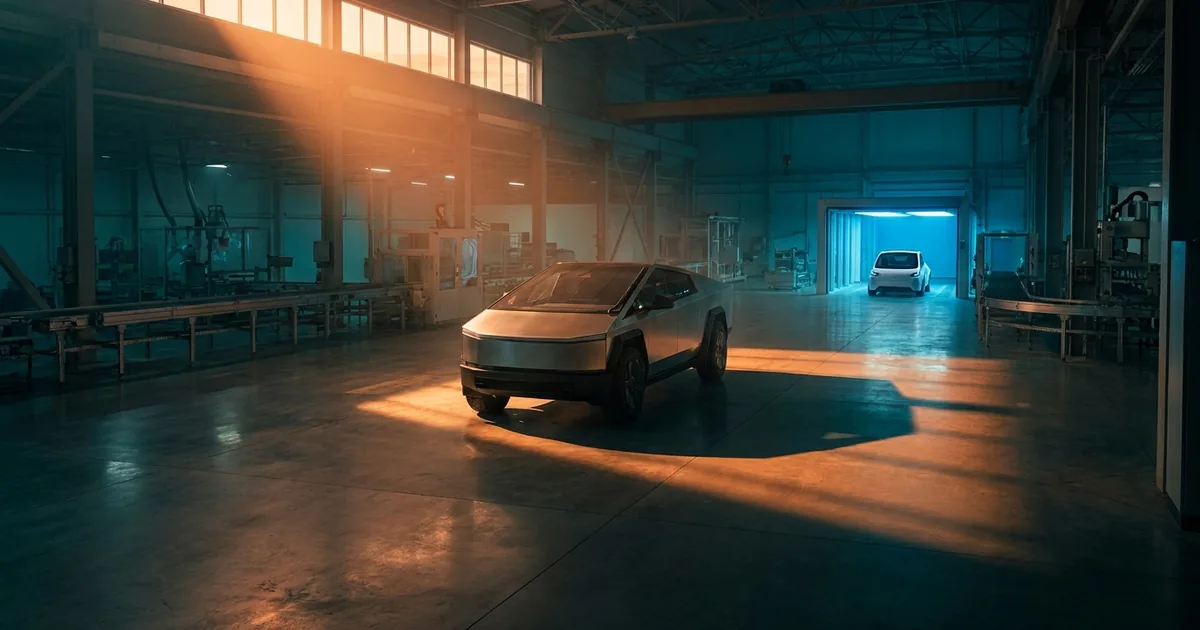
Elon Musk announced on X on Friday that Tesla will be “winding down production of the Cybertruck” at Giga Texas around the middle of next year, so the factory can build more Cybercab robotaxis. Every headline will call that the end of a flop, and the arithmetic says it was a flop long before Friday: by our math the truck has been selling at between a sixteenth and an eighth of the pace Tesla’s line was planned for, and nobody has yet told the people who own one what comes next.
Start with what is actually known. The post was short, and Tesla has said nothing else on the record. Electrek notes the company has not explained how long it will keep selling inventory, or what happens to parts and service for existing owners. TechCrunch reads the post as the end of the truck, while Musk’s wording covers only the Texas plant. The Cybertruck is built nowhere else, so the practical difference is small, but it is a difference Tesla has not clarified.
The Plan Against the Pace
Musk predicted about 250,000 Cybertrucks a year when the first ones were delivered in late 2023. Tesla does not report Cybertruck sales on their own line, so the best public figures are estimates. We took the two that exist and ran them against the plan.
| Period | Cybertrucks sold | Share of the 62,500-a-quarter plan |
|---|---|---|
| Q3 2024 (US, Cox Automotive) | 14,416 | 23% |
| Q1 2026 (US, Cox Automotive) | 3,519 | 5.6% |
| Q2 2026 (US, Cox Automotive) | 3,744 | 6.0% |
| Q3 2026 (global, Electrek estimate of 7,000 to 8,000) | about 7,500 | about 12% |
From Cox’s Q3 2024 peak to its Q2 2026 figure, US sales fell 74%. Tesla’s own “Other Models” bucket, which also holds the Model S, Model X and Semi, delivered 8,295 vehicles in the third quarter, down 48% from a year earlier and the lowest since 2021. Electrek’s annualized estimate, about 30,000 trucks a year, is roughly 12% of the plan.
Who Has Been Buying
The sales that did happen lean on one buyer. Electrek cites S&P Global Mobility data showing that companies owned by Musk bought 1,339 Cybertrucks in the fourth quarter of 2025, about 19% of US registrations that quarter, 1,279 of them by SpaceX alone. Electrek calls that self-dealing. That is its word, and we are not adopting it as fact, but the number stands on its own. When a fifth of your customers are your own other companies, the demand figure is softer than it looks.
Tesla also kept raising the price. In August it added $5,000 to two trims, taking the dual-motor to $74,990, in a truck that was shown in 2019 with a base price under $40,000 and 500 miles of range. It delivered neither.
What We Think
This was Tesla’s most expensive attempt to prove a point, that a stainless-steel pickup nobody asked for would sell in the hundreds of thousands, and it did not. Walking it back by tying it to the Cybercab, a robotaxi that Electrek counts at 463 registrations in Texas, is a better story than “we built a line for 250,000 and sold a twelfth of that.” It is also the third product Tesla has retired in a year behind a promise about robots and self-driving, after the Model S and Model X.
Our advice to anyone eyeing a new one: do not pay the new price for a truck whose maker has just announced it is stopping. Tesla has not published a parts or service commitment. The same company recalled the truck over cracking last month, so resale value and repair access are the real questions, not range or towing.
What to Watch
Three things will tell us whether this is a wind-down or a quiet exit. Whether Tesla puts a service and parts commitment in writing. Whether the roughly 3,000 trucks Electrek counted in US inventory in August get discounted or sold to Musk’s other companies. And whether the Cybercab line actually needs the floor space, since Electrek notes Tesla already built a separate line for it. If the answer to the last one is no, “making room” is a reason for the announcement and not the reason for the decision.