
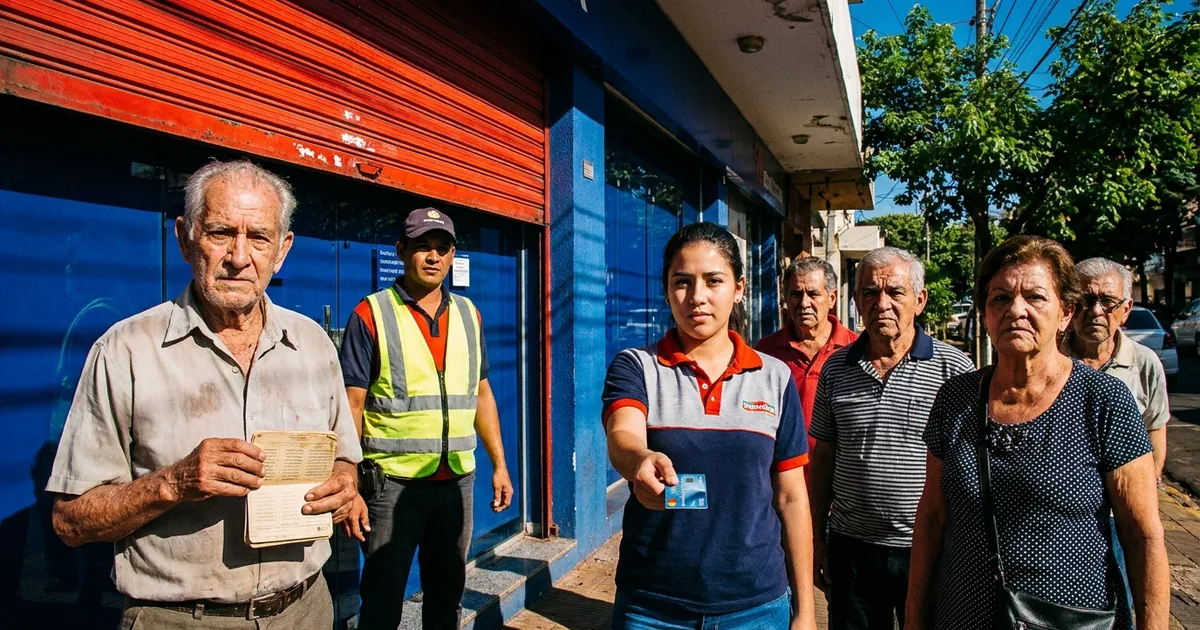
Paraguay’s Senate removed President Santiago Peña on Friday instead of accepting the resignation he had offered a day earlier, and that choice decides whether the man at the center of the Ueno Bank collapse meets prosecutors with a former president’s immunity or without it.
- In June, central bank inspectors found a pattern of risky lending to Ueno insiders, and as recently as last month Peña was still defending the bank and its oversight, calling the concerns a smear campaign.
- On Monday, Nov. 2, regulators corrected Ueno’s books and found its capital below half the legal minimum.
- Before dawn Tuesday, the central bank seized the bank, cutting nearly 3 million customers off from their savings.
- On Thursday afternoon Peña offered to resign, the lower house voted 78 to 0 to impeach him within minutes, and Congress did not accept the resignation.
- On Friday, 44 of the 45 senators voted to remove him with none opposed, Vice President Pedro Alliana was sworn in, and prosecutors ordered Peña held under house arrest.
Why the Senate Refused the Resignation
The entire fight on Thursday and Friday was about that one word. Paraguay’s constitution gives elected former presidents a lifetime Senate seat, and Al Jazeera reported that a president allowed to resign keeps the right to take it, along with legal protection from prosecution. Opposition senators insisted on removal to prevent exactly that, while Peña’s lawyers, Ricardo Preda and Adolfo Ferreiro, argued that lawmakers should have approved his departure instead of pressing on with the trial. Because the Senate removed him for misconduct in office, he loses the seat and the immunity that comes with it, and prosecutors then ordered him held under house arrest. We think the Senate was right to refuse, and our reason has nothing to do with guilt, which is a question for a court and which Peña, who denies any wrongdoing, has not yet had to answer there. An official under criminal investigation should not get to pick the procedure that decides whether the investigation can reach him, and a resignation tendered after the bank was seized and before prosecutors had questioned him, an interview set for Saturday, was a choice of exactly that kind.
Peña’s last public words as president were gracious. In a farewell message released shortly before the verdict, he wrote:
“I do not want my presence to be a cause of greater division or instability. My responsibility is to put the country above my personal fate.”
Set that beside the record and the gracious tone does less work. The lower house accused him of “serious and systematic dereliction of duty,” his own party boss, former president Horacio Cartes, put the party behind impeachment “in order to restore the republic’s institutions,” and lawmakers refused his request for 72 more hours to prepare a defense. That last fact is the weak point of the Senate’s case and we will not pretend otherwise, because the distance from impeachment vote to verdict was about a day. Our read is that the speed was the point: while a resignation sat on the table, every day of delay was another chance for Congress to accept it. A court will decide what Peña did, and the Senate only had to decide what he would be allowed to keep.
A Cashback Bank With Two-Thirds of the Country’s Adults
Ueno is a platform story as much as a banking one. It was a rebranded finance company that won its banking license in 2023, then lured customers with grocery cash-back offers, grew to more than 70 locations and put its name on the national soccer team and the main stadium. It became Paraguay’s fifth-largest bank by deposits and signed up more than two-thirds of the country’s adults, and Ueno says over a million people opened their first bank account with it. The growth was fed by public money. CBC put Ueno’s public deposits at roughly $800 million, about a quarter of its total, and our arithmetic on those figures ($800 million times four) puts the whole deposit base near $3.2 billion, so state-linked institutions were supplying about one dollar in every four. Lawmakers say $355 million of that came from the state pension fund, beyond legal limits, and the impeachment charges also cite Peña’s stake in Ueno’s holding company, which he divested under pressure last year, and his appointment of a former Ueno executive to run the central bank that supervised it.
The warnings were on file for months. Central bank inspectors found the insider lending in June, nearly $39 million went to three companies tied to Ueno’s owners on a single day in September 2025, and senators loyal to Cartes demanded answers about the lending in September, citing leaked internal reports. None of that moved Peña, which is why his dismissal of the concerns last month as a smear campaign has aged so badly. For depositors the immediate picture is better than the headlines suggest: the central bank says deposits are insured up to about $37,000, which it says covers nearly all customers, and payouts began Thursday for balances up to about $1,600. The teachers’ union, which has more than 40,000 members, still plans an indefinite national strike on Monday to press for protection of public pension funds.
The New President Is Named in the Same Investigations
Pedro Alliana, 52, took the oath as Paraguay’s 53rd president on Friday and promised that depositors “will be fully compensated.” AP reported that prosecutors have opened criminal investigations targeting Peña, current and former central bank and pension fund officials, and Alliana himself, a detail we found in AP’s account and not in the BBC, CNN or Al Jazeera reports. The Chamber of Deputies, which voted 78 to 0 against Peña, declined to open impeachment proceedings against Alliana. None of the coverage we read says what prosecutors allege against the new president, and that is the gap that matters, because a compensation pledge is only as good as the integrity of the people running the books. We think Paraguayans are entitled to know what Alliana is accused of before his government is trusted to design the payout.
The removal was also a power play, and the AP account is blunt about it. It describes Peña as a protégé who tried to build a rival base around Ueno’s public deposits and the loyalty of provincial governors, and Cartes, the tobacco magnate who made him finance minister and twice backed his run for president, turned on him once the bank fell. That puts Washington in an awkward chair. Peña was welcomed in Washington just weeks ago as a key ally of the Trump administration, and Cartes was sanctioned by the U.S. Treasury in 2023 over bribery allegations, sanctions the Trump administration lifted last year. After Peña announced his resignation, a State Department spokesperson said the U.S. looks forward to “continuing our close cooperation on shared priorities.” We think the administration should say what it knew about Ueno, its owners and its president’s stake in the parent company, which was identified publicly in 2023, before it calls the friendship enduring.
The next dates are concrete. Peña is due to be questioned Saturday over allegations of breach of trust, influence peddling and misappropriation of funds, and the teachers walk out Monday. Between those two days Alliana has to show nearly three million depositors that the person promising their money back is not someone prosecutors are also looking at.