
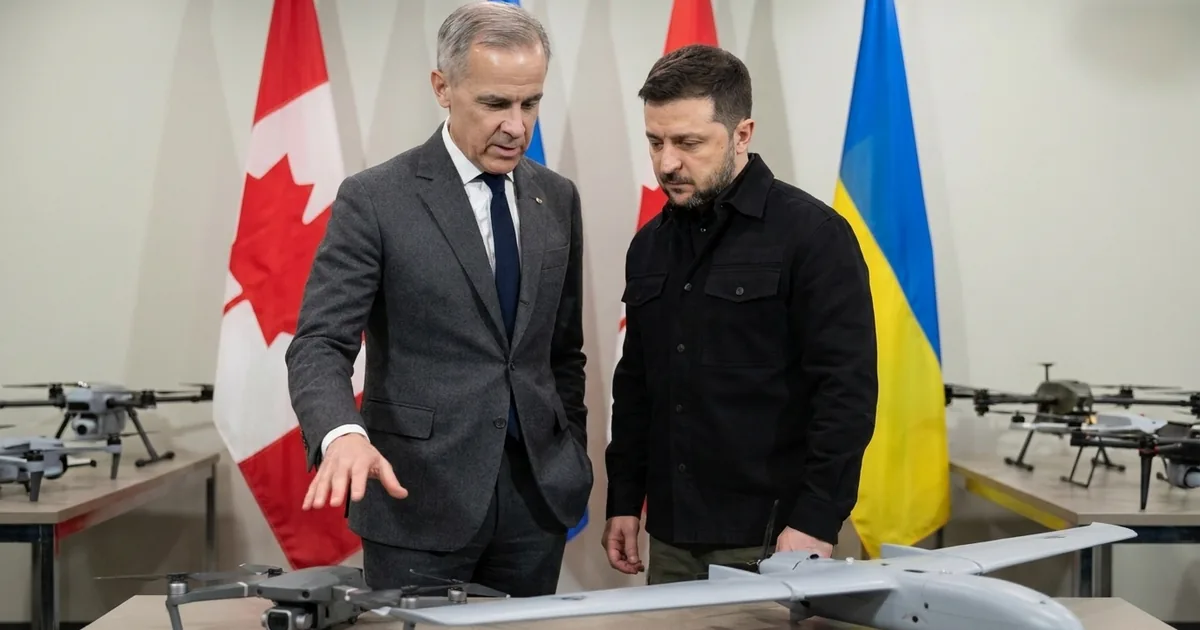
Prime Minister Mark Carney stood next to Volodymyr Zelenskyy in Calgary last Thursday and promised that Canada will build the capacity to produce millions of military drones within two years, with one third of them going to Ukraine. The number that got the headlines was “millions.” The number that nobody put next to it was the price, and the only price Ottawa has actually attached to its own drone purchases so far implies that the pledge is worth billions of dollars the government has not yet budgeted, announced, or even estimated in public.
The pledge. Capacity for millions of drones inside two years, a third of them for Ukraine, under a 100-year partnership declaration signed in Calgary on September 10.
The paper trail. Initial contracts worth up to $50 million. A first order capped at $5,000 a drone. At that ceiling, one million drones costs $5 billion, a hundred times what has been awarded.
That gap is the story, and it is not a reason to dismiss the deal. Canada’s Armed Forces hold roughly 2,000 drones today, a figure Carney volunteered himself, and CTV News reported him saying that the country “will need millions.” Pairing Canadian manufacturing, software and AI firms with the most combat-tested drone industry on the planet is exactly the right instinct for a military that has spent a decade buying expensive platforms slowly. The question worth asking is whether “millions” is a procurement commitment or a capacity aspiration, because the documents released so far describe the second and the speeches sounded like the first.
Start with what the government actually put in writing. The Prime Minister’s Office release from Calgary lists two declarations, one for a 100-year partnership and one on defence and security cooperation, alongside a long column of dollar figures. Roughly $350 million goes to air defence interceptors for Ukraine through the United States’ JUMPSTART program. About $435 million in loan guarantees runs through the European Bank for Reconstruction and Development for energy infrastructure, and Export Development Canada adds $200 million in concessional loans. Smaller lines cover veterans, the return of abducted children, and eight new sanctions designations. The drone section is different in kind: it announces the Defence Drone Initiative Marketplace, modelled on Ukraine’s Brave1 system, with initial contracts “up to $50 million” that the government says will increase the drones deployed by the Canadian Armed Forces tenfold.
Tenfold on 2,000 is 20,000 drones. Spread $50 million across 20,000 airframes and you get an average of $2,500 each, which is plausible for small reconnaissance quadcopters and is, crucially, a real purchase with a real number. Millions is something else. The PMO release frames it as industrial capacity, the ability of Canadian companies to produce millions over two years, not as an order the Crown has placed. That distinction matters because capacity without orders is how defence industrial strategies die: firms tool up for a demand signal, the signal never becomes a purchase order, and the lines go quiet. The one-third share for Ukraine inherits the same ambiguity, since a third of an unfunded number is still unfunded.
The first contract under the marketplace shows how Ottawa is pricing this. Volatus Aerospace, based in Quebec, announced on September 10 that it won the first request for proposal under the marketplace’s uncrewed and counter-drone stream. The firm order is 100 tactical surveillance systems shipping in the fourth quarter. Everything beyond that, up to 4,900 more, sits at Canada’s “sole discretion.” The government’s framework capped the price at $5,000 per system and the envelope at $25 million, and Volatus says its actual pricing is commercially confidential. So the first real drone order under a program promising millions is 100 units, with options on a total of 5,000.
Run the ceiling forward and the scale comes into focus. At $5,000 each, one million drones is $5 billion and two million is $10 billion, before ground stations, training, spare parts and software support, which the Volatus scope explicitly includes. Cheaper systems exist. Euromaidan Press reported from the Calgary showcase that Ukraine’s SkyFall P1-SUN interceptor, built to hunt Shahed-type attack drones, carries a price tag of around $1,000, and that 21 Canadian companies are already supplying components into Ukrainian systems. Even at that price, millions of drones is a multi-billion-dollar line that belongs in a budget, not a press conference.
Ukraine is the benchmark Carney chose, so it is the fair one to use. Militarnyi reported that Ukraine plans to produce more than 7 million drones this year, a figure reached under wartime conditions, with a defence ministry buying everything that flies and hundreds of domestic manufacturers competing on price and battlefield results. Brave1 works because it sits on top of guaranteed demand. Soldiers order systems through it and the state pays for them, which is the loop that lets a small workshop become a factory in months. Canada is copying the storefront. What it has not yet shown is the demand that makes a storefront a market.
To its credit, the government is at least building the plumbing quickly. The Department of National Defence launched the initiative on July 23, and the PMO says it went from launch to first contract in 50 days, which for Canadian procurement is close to a land speed record. Six firms were named in the Calgary release, from Beonyx’s ground vehicles in Quebec to Draganfly in Saskatchewan and Objexis AI in Ontario. General Dynamics Mission Systems-Canada signed on to co-produce with the Ukrainian firm Green Tech Harvest. A Canadian Global Affairs Institute analysis called the marketplace a peacetime version of Brave1 and warned that a “culture of risk aversion” inside the federal bureaucracy is the main thing standing in its way.
Our position is simple. The partnership is overdue and correct, and Carney deserves credit for tying Canada’s own rearmament to Ukraine’s survival rather than treating aid as charity. Canada gets a battle-tested supplier base and Ukraine gets a second industrial rear area out of Russian missile range, which is a better deal for both than another round of donated kit. But a pledge of millions, with a third earmarked for a country under daily attack, has to come with a number attached. Ottawa should publish a multi-year purchase commitment, in dollars and units, before the fall economic statement, and it should say how many drones Ukraine will actually receive and when. Without that, the one-third promise is a share of a figure that exists only in a speech.
The urgency is not abstract. The same day Zelenskyy was in Calgary collecting commitments, Russian drones and glide bombs hit a shopping centre in Pavlohrad, which is the kind of attack cheap interceptors exist to stop. Two years is a long time on that front line. The next useful thing Canada can announce is not a bigger number, it is the second contract, and then the tenth, each one with a quantity and a delivery date that makes “millions” something a Ukrainian air defence crew can count.