
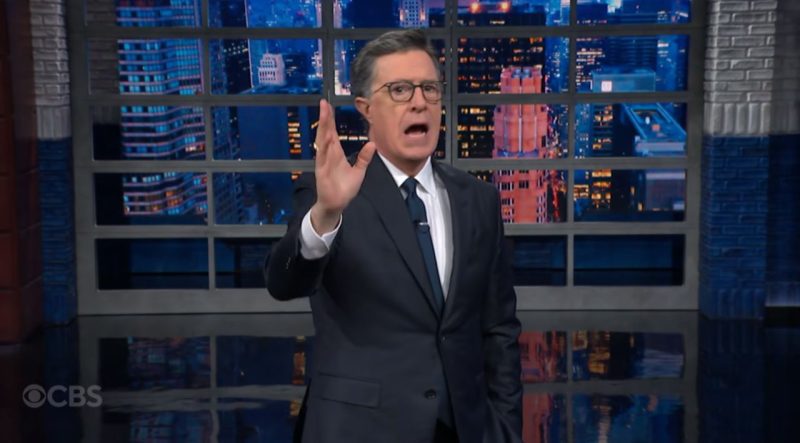
Stephen Colbert hosts his final episode of The Late Show on CBS tonight, and two of his fiercest competitors are voluntarily going dark so he can have the last word.
Jimmy Fallon’s Tonight Show on NBC and Jimmy Kimmel Live! on ABC will both air reruns at 11:35 p.m. Eastern, ceding the timeslot to a man late night has spent the past ten months treating less like a rival and more like a colleague who got pushed.
The Send-Off
CBS is billing tonight’s broadcast as an extended finale, a longer-than-usual goodbye after eleven seasons in the chair. The network has kept the final guest list under wraps, which is its own kind of statement after a closing week stacked with heavyweights. Jon Stewart, Steven Spielberg, and David Byrne turned up on Tuesday, and Bruce Springsteen played the penultimate show on Wednesday, where Colbert finally sat for his own Colbert Questionert. As Deadline reported, the week read like a guest book of everyone who wanted to be on the record before the lights went out.
The bigger tell is what is happening on the other networks. Fallon and Kimmel compete directly against Colbert for the same audience and the same advertising dollars, and tonight they are handing both to him. Kimmel did the same thing in 2015, when he ran a rerun so David Letterman could close out the franchise without a fight for viewers. Doing it for a peer who chose to retire is gracious. Doing it for a peer whose show was canceled out from under him is something closer to a protest.
A Cancellation That Never Added Up
CBS announced in July 2025 that it would end The Late Show, and it did not simply swap hosts. It retired the entire franchise, a brand that runs back to Letterman’s arrival in 1993. The network called the move “purely a financial decision,” language it has repeated ever since, insisting the cancellation was “not related in any way to the show’s performance, content or other matters happening at Paramount.”
The timeline tells a different story. Colbert was the ratings leader in network late night, not the kind of laggard a cost-cutting executive trims first. The announcement landed days after Colbert tore into Paramount, the network’s parent, for paying $16 million to settle a lawsuit Donald Trump had brought over a 60 Minutes interview, a settlement Colbert called “a big fat bribe” on the air. And it came roughly a week before a Trump-friendly Federal Communications Commission signed off on Paramount’s sale to Skydance Media, a deal that needed the administration’s blessing to close. When CBS first pulled the plug, the outcry was immediate, and the questions never really went away.
You do not have to assume bad faith to notice the shape of this. A media conglomerate with a multibillion-dollar merger pending in front of federal regulators canceled the most-watched, most-pointed critic of the president whose appointees controlled the approval. A Northwestern University communications professor told reporters it was “very clearly a political decision” and called it “a moment of authoritarian triumph.” Letterman, who built the show Colbert inherited, said he was “pissed off.” When the man who created the franchise and the academics who study media consolidation land in the same place, the “purely financial” line gets harder to deliver with a straight face.
Why the Rivals Closing Ranks Matters
Late night hosts do not usually do this. The genre is a knife fight over a shrinking, aging, cord-cutting audience, and an empty timeslot on a competitor’s network is normally a gift you accept, not one you decline. So when Fallon and Kimmel go dark on the same night, and when Stewart, Seth Meyers, and John Oliver spend the final week sitting in Colbert’s guest chair instead of counterprogramming him, it stops being about one host’s exit. It echoes the night of solidarity that filled his studio when the cancellation first broke, and it becomes a collective statement from the only people positioned to make one.
What they are signaling is unease about the precedent. If a parent company can quietly end its highest-rated late night show to smooth a merger past political appointees, every host with a monologue and a corporate owner now understands the price of the joke. That chilling logic does not require a memo or an explicit order. It just requires everyone in the building to notice what happened to the guy who said the bribe part out loud. Kimmel has already had his own brush with it, after the FCC waded into a flap over one of his Trump jokes earlier this year.
This is the part that should worry people who do not watch late night at all. Political satire is one of the few formats that still reaches a mass audience and treats power as something to be mocked rather than managed. Letterman needled presidents for decades. Jon Stewart turned a fake news show into a civic institution. Colbert spent eleven years doing the same from the most-watched seat in the format. Retiring that seat, in this climate, for these reasons, narrows the space where that kind of speech happens on a major broadcast network.
What Goes Dark After Tonight
When Colbert says goodnight, CBS will not be auditioning a replacement. The 11:35 slot that Letterman and then Colbert held for more than thirty years simply goes away, and the network has offered no plan to fill it with anything resembling the same voice. The competitors honoring him tonight will be back at their own desks tomorrow, a little more aware that those desks sit inside companies with business before the government.
The open question is whether tonight marks the end of one show or the start of a pattern. If it is the former, late night loses a singular talent and finds its footing again, the way it always has. If it is the latter, the going-dark gesture will read, in hindsight, less like a tribute and more like a warning the whole industry quietly sent itself.