
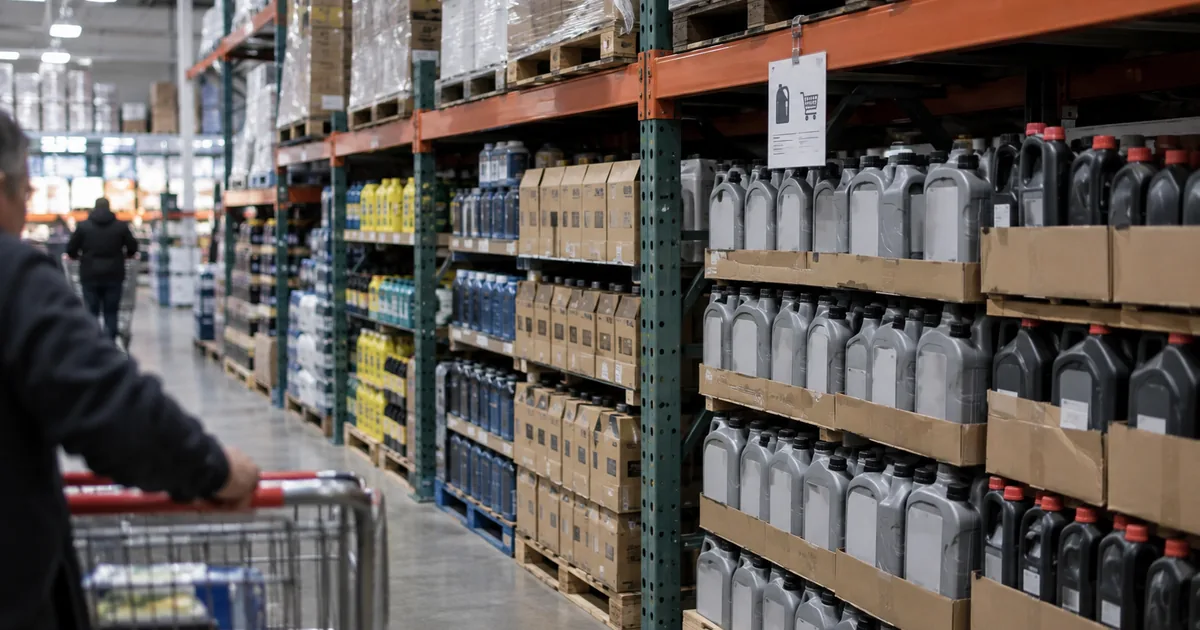
Costco has capped Kirkland Signature motor oil at two cases per member every seven days and pushed a 10-quart case to $57.99, up from the low $30s where it sat for years. The coverage that followed treated this as a September surprise about refinery margins, which is the wrong story by roughly six months and one continent.
Here is what almost none of it tells you. The reason your next oil change costs more has little to do with refiners deciding gasoline pays better. It is that the single largest producer of the base stock modern synthetic oil is built from, Shell’s Pearl gas-to-liquids plant in Qatar, was badly damaged in March, and the shipping lane carrying most of the remaining supply has been shut since late February. CNN, CNBC and Axios all reported that in May. Retail coverage rediscovered the story in September, when the price tag moved, and it still is not telling drivers the number that actually matters: nobody in the lubricants industry expects real relief before 2027.
What Changed on the Shelf
The limits are specific and they are new. Members are held to two units of Kirkland Signature every seven days, which works out to a ceiling of 20 quarts. Mobil 1, which Costco also stocks, carries a looser cap at five units. The Drive reported on September 11 that a 10-quart Kirkland case now runs about $58 against a floor near $30, with a six-quart Mobil 1 case at $44.
That is a warehouse club, the format built entirely on buying in bulk, telling its members they may not buy in bulk. It is worth pausing on how unusual that is before accepting the explanation that refiners simply prefer making gasoline.
The Explanation That Is Actually Documented
Synthetic motor oil is not squeezed straight out of a barrel of crude. It is blended from highly refined base stocks, and the premium grades most modern engines require depend on what the industry calls Group III. The United States does not make enough of it. It imports a large share from three Persian Gulf producers: Shell’s Pearl GTL in Qatar, ADNOC in the United Arab Emirates, and Bapco in Bahrain.
Two things happened to that supply chain this year:
- The Strait of Hormuz closed in late February, cutting off the route those three producers ship through. Trade estimates put the share of US Group III supply affected at roughly 44 percent. We have written before about how the oil market’s bigger problem was never really the strait itself, and lubricants are the clearest example of that: the damage is concentrated in specialized products, not in crude.
- Pearl GTL, the world’s largest gas-to-liquids facility, took damage to one of its two base oil trains in March. Base Oil News reported that Shell’s own repair estimate runs about a year, which pushes that capacity offline into 2027.
Prices moved accordingly. Group III traded near $5.80 a gallon before the Hormuz closure and cleared $10 by May, an increase of well over 200 percent on some grades.
None of this was hidden. CNN reported on May 19 that the auto industry was bracing for a motor oil shortage, quoting Holly Alfano, chief executive of the Independent Lubricant Manufacturers Association. Axios flagged the same thing on May 15, and CNBC had written about the base oils squeeze on May 1.
“It could take a year or so before we see any real relief.”
Alfano said that to CNN four months ago. Her association also warned in a bulletin that the US would run through its Mideast Gulf-origin Group III supply by June. June has come and gone.
Why Somebody Else Cannot Simply Make More
The obvious question is why South Korea, or any other producer, does not fill the hole. Korean refiners supply close to 30 percent of US Group III, and they are the natural substitute. The problem is that Korean production leans on Middle East crude, which is itself constrained by the same closure. You cannot backfill a Gulf shortage with a supply chain that also starts in the Gulf.
That is the structural reason this is not a two-week disruption. It is also why the grades hit hardest are the low-viscosity ones, 0W-8, 0W-16 and 0W-20, which are exactly what most engines built in the last decade take. Older cars running conventional 5W-30 are largely fine. Newer cars, and the people who bought them partly on fuel economy, are the ones exposed.
Our View
Costco is not the villain here, and the purchase limit is the most defensible thing anyone in this chain has done. A cap of 20 quarts a week stops a genuine supply squeeze from turning into a hoarding spiral, which is the failure mode that turns a price problem into an empty-shelf problem. Retailers who refuse to ration during a real shortage are not being generous, they are letting the first customers through the door clear the shelf.
The failure is upstream of the warehouse, and it is an information failure. The lubricants trade press has been documenting this since March. Three major business outlets covered it in May. A driver who does not read Base Oil News had no reasonable way to know, until a sign went up at Costco in September, that the cost of maintaining their car was going to climb and stay climbed for more than a year. That gap between what the industry knew and what consumers were told is not an accident of news cycles. Nobody in the chain had an incentive to tell people early.
And the coverage running this week is still doing it. Explaining a purchase limit with a line about refinery profit margins is not wrong so much as it is useless. It suggests a pricing quirk that will pass. What the documented record supports is a supply shock with a repair timeline attached to it, and readers deserve the timeline more than they deserve the theory.
The practical advice follows from the facts rather than from panic. If you are due for an oil change, get it done and do not stockpile, because stockpiling is the behavior the limits exist to prevent. Check your manual before a shop talks you into a substitute grade. And treat any promise that this resolves when the conflict does with the skepticism it has earned, because a damaged processing train does not come back online the day a shipping lane reopens.
What to Watch
The thing that would genuinely change this picture is Pearl GTL’s second train coming back, or Hormuz reopening long enough for Gulf cargoes to reach US blenders in volume. Neither is on a published schedule, and the workarounds keep failing: Saudi Arabia shut its main Hormuz bypass pipeline this weekend after drone attacks launched from Iraq. Until one of them happens, the sign at Costco is not a Costco story at all. It is the first place most Americans will actually feel a supply chain that broke in the Persian Gulf in February, and it will not be the last.