
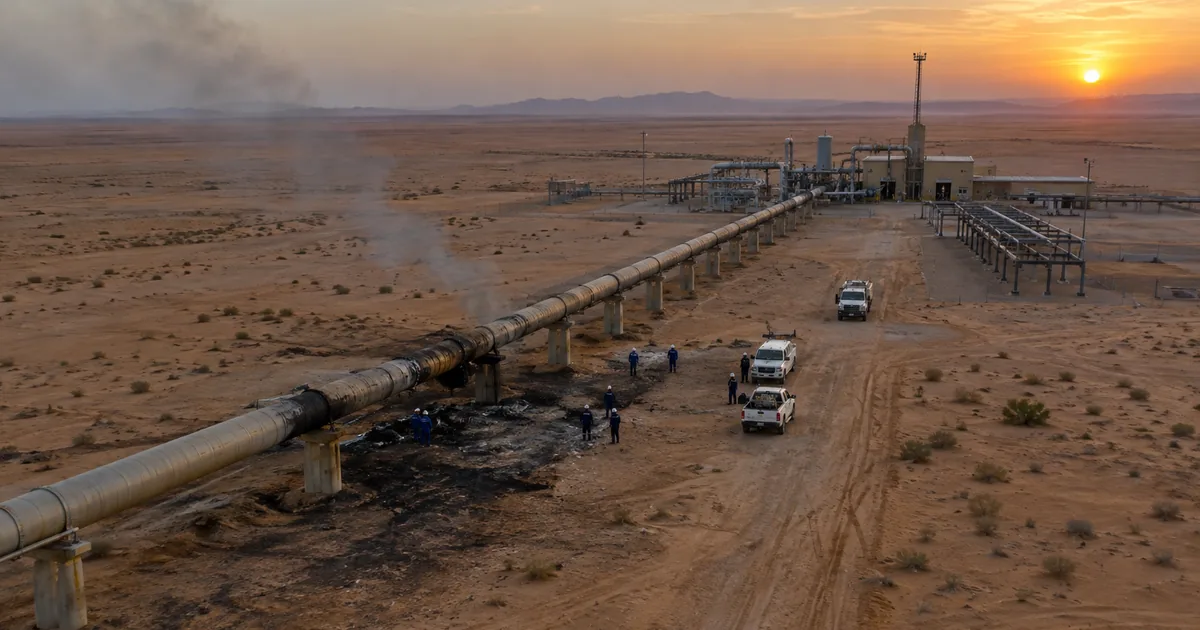
Oil rose again Sunday evening as traders priced in the loss of Saudi Arabia’s East-West pipeline, the 7 million barrel-a-day line that carries the kingdom’s crude around the Strait of Hormuz to the Red Sea. CNBC reported that US crude climbed 2.8% to $102.87 and Brent gained 3.1% to $107.87 as futures reopened.
The price story is the one everyone is running. The part missing from it is who decides when the line reopens. That is no longer a repair crew in Medina. It is the Iraqi government, and Riyadh has put it there on purpose.
The drones that hit the pipeline on Thursday came from Iraq, not Yemen. Baghdad has now said so itself.
Al Jazeera reported Sunday that Iraqi forces seized a launch platform in the al-Tayeb border district of Maysan province, near the Iranian border. The Maysan operations commander and the provincial police chief were removed. Iraq also shut its Shalamcheh, Chazabeh and Mandali crossings with Iran for security inspections.
Saudi Arabia, for its part, chose not to hit back. The Associated Press reported that the kingdom would give Iraq “an opportunity to take the necessary measures.” That is diplomatic language for a deadline with no date on it.
What Baghdad Says
The attack was launched from Iraqi soil. Commanders in Maysan failed. The platform has been found, officials have been fired, and the border with Iran is closed while the investigation runs.
What the Militias Say
The umbrella group of Iran-backed factions denies any role and says it will cooperate with the government’s investigation. Nobody has claimed the strike.
Both accounts can be true at once, and that is the problem. A government can admit an attack came from its territory without being able to name, or stop, the people who launched it.
This has been tried the other way. Regional officials told the AP that the Houthis and Iraqi militias had coordinated earlier attacks on Saudi oil facilities, which is why Saudi Arabia and the United States bombed Iran-backed militias inside Iraq in July. Two months later the drones came back, from a province on the Iranian border, and took out the kingdom’s most important export route.
So Riyadh is right not to retaliate. Bombing did not work in July, and a second round would hand the militias the escalation they seem to want. But restraint is not a plan. It outsources the security of roughly 4% to 5% of world oil supply to a prime minister who just had to fire his own commanders to prove he runs Maysan.
That is the real exposure here. When this site wrote on Friday that the pipeline built to escape Hormuz now ends at a Houthi checkpoint, the threat sat at the western end of the line. Iraq puts it at the other end too. The kingdom moved its oil west to get away from Iran and found Iran’s allies waiting on both sides.
The last time this line was hit, in April, repairs took three days, Al Jazeera noted. Riyadh has given no timeline this time and has not said how bad the damage is. “The key buffers that got us through the last six months have basically been worn away,” energy analyst Ben Cahill told the outlet.
The pipes can be fixed in days. Whether Baghdad can keep launch platforms out of Maysan is a question with no repair estimate, and oil markets are about to find out how long it takes to answer.