
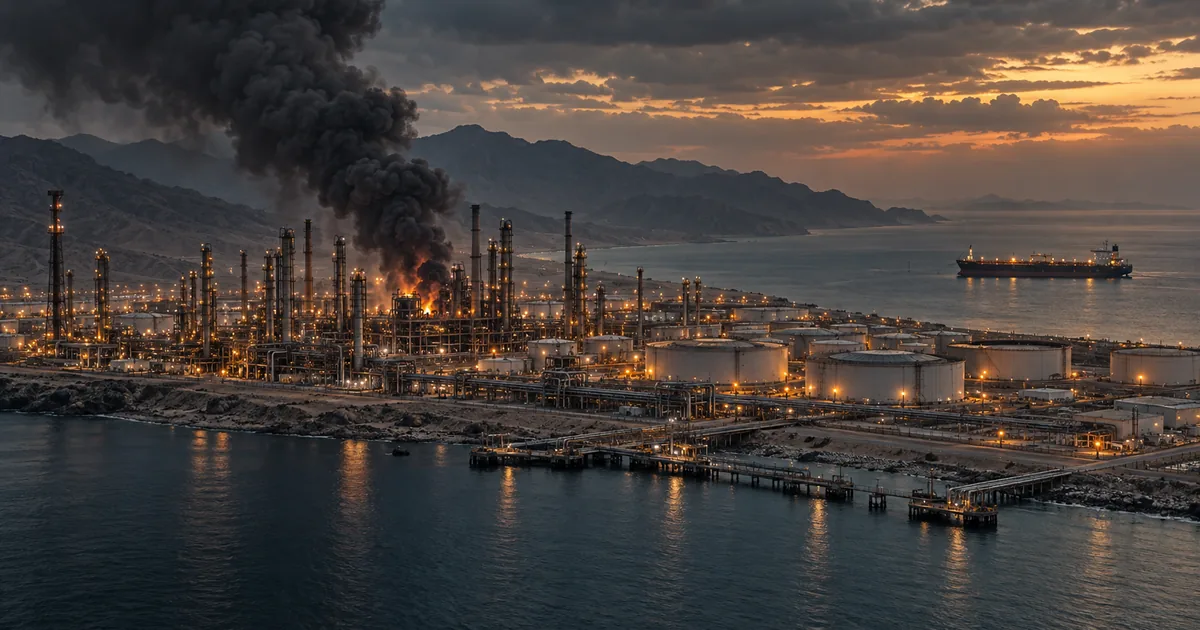
Houthi missiles and drones struck Saudi energy sites across four southern cities on Tuesday, wounding 73 people and igniting fires at Aramco facilities the kingdom had spent the summer describing as secure. Almost every account of the day is framing this as the moment a four year truce finally shattered, which buries the more useful fact: the refinery at the center of the story has been shut down since July.
That refinery is Jazan, a 400,000 barrel per day complex on the Red Sea coast and one of the largest in the kingdom. Aramco took it offline on July 27 after a Houthi strike damaged its gasification complex and tank farm, and by mid August the company had pushed the restart date back to August 30. Trade reporting counted claimed strikes on the same plant on July 25, August 9, August 13 and August 18 before Monday’s and Tuesday’s. Tuesday was not the opening blow. It was somewhere around the sixth in six weeks, landing on a plant that was already dark.
The Facility That Had Already Stopped Shipping
The export data makes the point harder than the casualty count does. Kpler tanker tracking cited by Ecofin Agency shows diesel shipments from Jazan to Africa falling from 163,000 metric tons in July to zero in August. Before the shutdown the plant had been moving more than 200,000 barrels a day, mostly diesel and naphtha. It accounts for roughly 9 to 10 percent of Aramco’s net refining capacity.
Set that against what Aramco has been telling the market. Chief executive Amin Nasser said the earlier strikes produced temporary interruptions but “no material operational or financial impact” for the company. A 400,000 barrel per day refinery sitting idle for five weeks with its African diesel exports at zero is not an immaterial event. It is a plant that stopped working. Investors and buyers were given the reassuring version, and the loading data says something else.
This is where the reporting on Tuesday goes soft. The wires accurately relayed that fires broke out, that Maj. Gen. Turki al-Malki put the wounded at 73, that Houthi military spokesman Brig. Gen. Yahya Saree claimed dozens of ballistic missiles and drones aimed at oil and economic targets. All true. None of it explains why a militia keeps spending expensive munitions on a refinery that has not shipped anything in a month.
Two Doors, and an Adversary Standing at Each One
The answer is geography, and it is the part of this story worth a reader’s time.
Saudi Arabia has two ways to get oil out. East, through the Gulf and the Strait of Hormuz, where Iran sits astride the channel. West, through the Red Sea and the Bab al Mandeb strait, where the Houthis do. For most of the last two decades the eastern route carried the volume. As tensions with Tehran escalated this year, Riyadh did the sensible thing and pushed crude westward along its East to West pipeline toward Yanbu, away from a chokepoint a hostile state can close.
Al Jazeera’s account of the escalation notes that Saudi seaborne exports through Bab al Mandeb ran roughly eight times higher between March and July 2026 than in the same stretch of 2025. The strait carries about 4.1 million barrels a day in total, close to 5 percent of global seaborne oil.
So the hedge became the exposure. Saudi Arabia moved its oil out of range of the Iranian navy and into range of Houthi drones, then watched the Houthis declare a shipping blockade in late July and start working through the western infrastructure one target at a time. That is not a run of bad luck. It is the predictable cost of a routing decision made under duress, and it is the structural fact the day’s coverage skipped.
A militia does not need to sink tankers to win this. It only needs to make the western door expensive enough that there is no cheap way out of the kingdom.
What “All Necessary Operational Measures” Actually Means
The coalition responded on Tuesday by vowing to “take all necessary operational measures to deter the terrorist Houthi militia with utmost resolve.” Foreign minister Prince Faisal bin Farhan al Saud said the road to diplomacy was not closed, while making clear the kingdom would defend itself. CNN reported that Riyadh has already informed allies it intends to retaliate.
Our read: the deterrence line is the least credible sentence in the story. Deterrence has been tested at Jazan at least half a dozen times since late July and has failed every time, and the failure is not a matter of Saudi resolve. Deterrence works when you can raise the cost of an attack above what the attacker will pay. The Houthis are firing cheap drones at fixed, mapped, coastal infrastructure that cannot be moved and cannot be hidden. Riyadh can strike Sanaa, and it has. It cannot relocate a refinery.
What retaliation does reliably produce is casualties in Yemen. Saudi led strikes have already hit a prison in Hazem in Jawf province, killing at least seven people including a child. Al Jazeera counts around 21,000 people displaced from Taiz alone since last Thursday, with Yemeni government forces now pushing a counteroffensive and talking about retaking Sanaa. Hisham al-Omeisy of the European Institute of Peace has warned that an assault on the capital would be a bloodbath, and that this ends in a political deal rather than a military victory.
If that is where it lands, the honest question is why the next several weeks of bombing need to happen first. A retaliation cycle that flattens more of Yemen will not restart Jazan, will not reopen Bab al Mandeb, and will not give Saudi Arabia a third export route it does not have. It buys deterrence theater at somebody else’s cost.
The Number to Watch Is Not the Casualty Count
Brent traded around $97 to $98 through Monday and Tuesday, elevated but orderly, because the market has already priced a refinery it knows is offline. Goldman Sachs has floated $120 if shipping risk climbs further. That gap between the current price and the analyst warning is the real stake here, and it does not turn on how many missiles landed on Tuesday.
It turns on whether the Houthis move from hitting fixed infrastructure to sustained interdiction of the tankers themselves, which is the one escalation that would price the western route out entirely. LNC covered the early version of that in July, when Houthi strikes on two Saudi tankers in the Red Sea pushed crude toward $100, and again last week when Riyadh and Tehran gave irreconcilable accounts of what killed two sailors aboard the Sidr.
Watch the loadings, not the fires. A refinery can burn and be rebuilt. A shipping lane that insurers decide is uninsurable stays closed, and Saudi Arabia has already used up the alternative.