
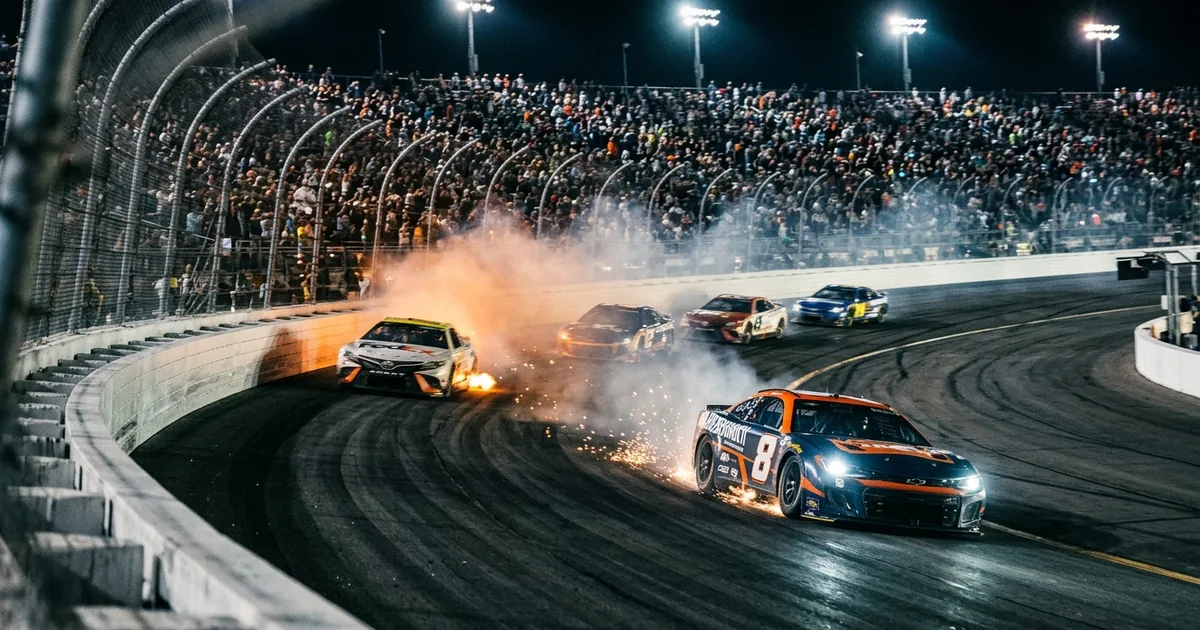
Denny Hamlin won the Cracker Barrel 400 at Nashville Superspeedway on Saturday night, overcoming a starting-position penalty and a rain delay that pushed the race past midnight Eastern time to deliver Joe Gibbs Racing a 1-2-3 sweep that the team hasn’t pulled off in years.
The Penalty, the Delay, and the Late Restart
The race was supposed to be straightforward. Hamlin was awarded the pole after qualifying was rained out and NASCAR applied its points-based formula. But a pre-race penalty sent him to the back, and a one-hour rain delay kept the field sitting on pit road well into the evening. By the time the checkered flag fell, it was after midnight, and only the most dedicated fans were still watching.
Those who stayed saw Hamlin prevail on a late restart with the kind of precision that has defined his career: clean restarts, smart tire management, and the ability to find the fast line when the race tightens up in the final 30 laps. Christopher Bell finished second, and Chase Briscoe completed the JGR sweep in third.
JGR’s Statement at the Right Time
The 1-2-3 finish wasn’t just a good weekend. It was a signal. Joe Gibbs Racing has spent the early part of the 2026 season dealing with inconsistency, with Hamlin as the only driver consistently running in the top five. Nashville changed the narrative. ESPN noted that three JGR cars finishing on the podium at a track known for rewarding raw speed over strategy suggests the organization’s technical package has finally caught up to its driver talent.
For Hamlin specifically, this is win number two on the season, with the All-Star Race at Dover as a bonus. At 45, he remains one of the most consistent drivers on the circuit, and the Nashville win keeps him firmly in the conversation for championship contention. The penalty made it a better story, because it meant he had to pass nearly the entire field to get to the front.
The Reddick and Van Gisbergen Factor
Ricky Stenhouse Jr. and Shane van Gisbergen rounded out the top five. Van Gisbergen’s result is worth watching: the New Zealand driver, who won the Bathurst 1000 three times before jumping to NASCAR, continues to adapt to oval racing faster than most international drivers manage. His fifth-place finish at a 1.33-mile speedway, not a road course, is the kind of result that suggests he’s becoming a genuine threat on tracks where driving style alone won’t carry you.
Tyler Reddick, Chase Elliott, Ryan Blaney, Zane Smith, and Carson Hocevar filled out the top ten. The depth of talent across multiple teams in the top ten reflects a Cup Series that, despite Toyota’s strong night, remains genuinely competitive across manufacturers in a way that keeps the playoff picture fluid through mid-season.
What Nashville Means for the Playoff Picture
With 14 races complete, the 2026 Cup Series season is approaching its midpoint. Hamlin’s two wins give him a comfortable cushion for playoff qualification, but the standings below him are tight. Multiple drivers are within a single bad race of dropping out of contention, and the next stretch of tracks favors different skill sets than Nashville’s high-speed oval.
The after-midnight finish will be a footnote by Monday. The JGR sweep won’t be. When one organization puts three cars on the podium, it changes how every other team approaches the next build cycle. Nashville was supposed to be a weather-disrupted afterthought. Hamlin and JGR made it the most important result of the season so far.