
By Jim Merphy
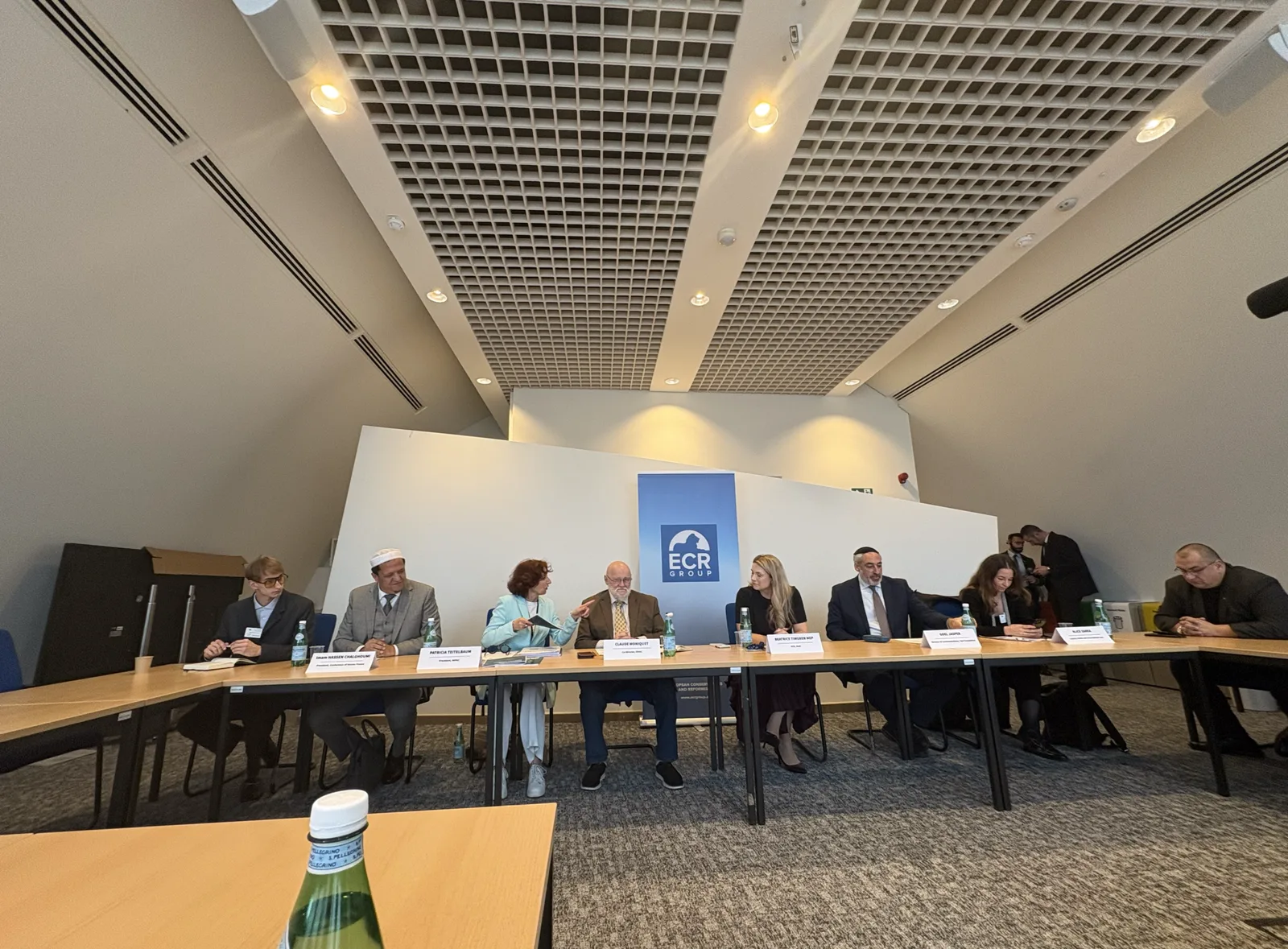
Three years after the attacks of 7 October 2023, a roundtable at the European Parliament in Brussels attempted to move one of Europe’s most persistent debates beyond expressions of concern and towards a more difficult question: what, in practical terms, can institutions actually do?
Held on 13 October under the title Three Years After October 7: Defunding Hate: EU Responsibility to End Support for Anti-Jewish Networks and Organisations, the discussion was hosted by Member of the European Parliament Béatrice Timgren and brought together representatives of the European Strategic Intelligence and Security Center, IMPAC, the Yael Foundation, lawyers and figures involved in interfaith dialogue.
The title suggested that public funding would dominate the conversation. It did not.
Instead, much of the discussion returned to two areas that are both less dramatic and potentially more consequential: what happens in schools, and what happens online.
The first concerns the way Jewish history, Jewish identity, Israel and contemporary antisemitism are taught to young people. The second concerns an increasingly familiar phenomenon: coordinated campaigns of harassment, reputational attack and hate speech that can spread across platforms and national borders much faster than existing legal systems are designed to respond.
Public funding remained part of the discussion, particularly the question of whether European or national funds can ultimately reach organisations promoting radicalisation or discriminatory narratives. But the broader argument made in Brussels was that antisemitism cannot be treated solely as a security problem.
Police protection may sometimes be necessary. Platforms may need to remove threats more quickly. Governments may have to examine where public money goes.
But by the time a child has absorbed a stereotype, an online mob has formed or a person requires police protection, much of the damage has already been done.
The more difficult task is prevention.
The classroom as the starting point
Education emerged as one of the clearest themes of the meeting.
Speakers discussed the importance of teaching Jewish history and identity, helping teachers recognise contemporary forms of antisemitism and giving young Europeans a fuller understanding of the role Jewish communities have played in European society.
Patricia Teitelbaum, President of IMPAC, argued that educational content cannot be separated entirely from the political and financial environment in which it is produced.
“When Qatar and other Gulf sources have poured billions into Muslim Brotherhood-linked networks across Europe & US for more than 40 years — funding mosques, youth groups, media, NGOs and educational projects — we cannot be surprised that so many young Europeans now demonise Israel,” she said.
“In Belgium, the biased materials and one-sided narratives documented by IMPAC have shaped those attitudes in schools for more than 20 years.”
Her intervention touched on one of the more politically sensitive questions raised during the meeting: when does legitimate political or historical education become ideological instruction, and what responsibilities do governments have when public money is involved?
The distinction matters.
Schools must remain places where difficult subjects can be debated, not environments where governments determine acceptable political opinion. Scrutiny cannot become censorship. Nor should disagreements about Israel or the Middle East automatically be treated as antisemitism.
At the same time, the participants argued that public institutions cannot simply ignore educational material that glorifies violence or reproduces discriminatory stereotypes.
Romanian MEP Cristian Terheș made the most forceful version of this argument when discussing European funding connected to Palestinian education.
“Three years after the October 7 attacks, the largest massacre of Jews since the Holocaust, we must call things by their name,” he said.
“Europe promised itself this would never happen again, yet it has financed those who teach hatred of Jews. In schools run by the United Nations and paid for by European taxpayers, Palestinian children are taught to admire Dalal Mughrabi, who led the killing of 38 Israelis, 13 of them children. A child who learns the word ‘martyr’ in the first grade is not being educated for peace, but for hatred.”
Terheș continued:
“The antisemitism we see today on Europe’s streets and campuses does not appear out of nowhere. It is taught, it is rewarded, and too often it is funded. The Palestinian Authority told the world it had ended ‘pay for slay’. Yet the United States found it paid more than $200 million to terrorists and their families in 2025 alone.
“You cannot reward murder and call it social assistance. Europe was built on Judeo-Christian foundations, on the sanctity of every human life, and funding those who glorify the murder of Jews betrays those foundations. If we are serious about defunding hate, there must be not one more euro until the textbooks change and the payments end. That is what ‘Never again’ means.”
The claims made by speakers will inevitably remain politically contested, particularly when they concern institutions operating in one of the world’s most polarised conflicts.
But underneath the argument was a more straightforward principle: if public institutions provide funding for education, they must also be capable of establishing where that money ultimately goes and what kind of education it supports.
Transparency, in that sense, is less about political control than basic accountability.
Teaching Jewish life rather than Jewish fear
One of the more striking interventions came from Goel Jasper, Director of Communications at the Yael Foundation.
His argument began from a rather different premise.
Antisemitism, he suggested, should not become the organising principle of Jewish education itself.
“You cannot solve antisemitism merely by focusing on antisemitism,” Jasper said. “Antisemitism is a disease of the hater, not the hated. At our core, we believe the ultimate antidote to antisemitism is Pro-Semitism.”
“Pro-Semitism is about building proud, confident, and capable Jews who know they have a tremendous opportunity to impact the world in a positive manner.”
It is an important distinction.
Education about antisemitism tends, understandably, to focus on danger: persecution, exclusion, the Holocaust, violence and the need for security.
All of that is necessary.
But there is an unintended consequence if Jewish childhood becomes organised around an awareness of how others may hate Jews.
Jasper put it more vividly:
“If we had spent centuries telling Jewish children how much certain elements in the world might hate them, or teaching them how to duck under a desk, or how to argue with a protester online, we would be building a defensive fortress, but ignoring the building required for our future.”
He continued:
“At the Yael Foundation, we believe antisemitism is a disease of the hater, not the hated. It is an obsession of those who find purpose in the ruin of others. Why should Jewish children allow the dark obsessions of such people to define our self-identity?”
The argument has implications beyond Jewish schools.
European education about Jewish people often begins with persecution and reaches its climax with the Holocaust. For understandable historical reasons, the victims of antisemitism frequently become more visible than Jewish life itself.
But Jewish history in Europe is also the history of literature, philosophy, medicine, business, music, law, science and ordinary family life.
Teaching that history may be as important as teaching the history of hatred directed against it.
There is also something revealing in the idea of “Pro-Semitism”. It shifts the emphasis away from requiring Jewish children to become experts in the prejudices of others and towards giving them confidence in their own culture and identity.
That is less a security policy than an educational philosophy.
When harassment becomes an industry
If schools represented one end of the discussion, the digital world represented the other.
The mechanics of harassment have changed dramatically during the past decade.
A reputational attack once required a newspaper, broadcaster or identifiable author. Today, the same narrative can appear simultaneously on anonymous websites, social media accounts, messaging platforms and republished content across several countries.
Responsibility becomes fragmented.
One account posts an allegation. Another repeats it. A website presents it as reporting. Social media users amplify it. Search engines preserve it. By the time lawyers begin responding, the original source may be almost irrelevant.
Alice Zarka, a lawyer at the Paris Bar, argued that European legal systems have not fully adjusted to this change.
“Such attacks can pursue several objectives, including damaging the economic interests and reputations of businesses and individuals, spreading hate speech, and destabilising democratic institutions,” she said.
“I would particularly like to draw attention to the way these techniques can be used to revive historical antisemitic stereotypes in a modern form.”
The stereotype may survive even when the vocabulary changes.
“For instance,” Zarka continued, “the longstanding prejudice that Jews control the banking system may now manifest itself through allegations of money laundering or corruption, accompanied by repeated references to the Jewish or Israeli identity of the individuals targeted.”
She cited the experience of Uri Poliavich, an entrepreneur and co-founder of the Yael Foundation.
“I would like to illustrate this phenomenon through the case of Uri Poliavich, an entrepreneur and co-founder of the Yael Foundation, an organisation dedicated to promoting Jewish education worldwide,” she said.
“He has been targeted by a malicious online campaign involving, among other allegations, accusations of money laundering. To my knowledge, these accusations are not connected to any identified judicial proceedings and are not supported by any substantiated and independently verifiable evidence.”
But the larger point of Zarka’s intervention concerned the law itself.
“In my view, the existing French legal framework, particularly press law, legislation governing online harassment, and unfair competition law, remains insufficient to address the organised and cross-border nature of these attacks,” she said.
“I therefore believe that consideration should be given to introducing a specific criminal offence into the French Criminal Code to address this coordinated modus operandi and protect the societal values threatened by such operations.”
The idea raises obvious questions.
Creating new criminal offences around online communication always requires caution. Journalism, criticism, political campaigning and legitimate investigations must remain protected. Governments should not be given vague powers to determine what constitutes an unacceptable reputational campaign.
But there is also a genuine legal problem when existing categories treat a coordinated operation as dozens or hundreds of unrelated acts.
Defamation law deals with statements. Harassment law deals with repeated conduct. Competition law may deal with economic harm.
A sophisticated online campaign can involve all three.
And because websites, users and servers may be located in several jurisdictions, pursuing such a campaign under existing legislation can become slow, expensive and fragmented.
The challenge for lawmakers is therefore not simply to regulate speech, but to recognise coordinated conduct without criminalising legitimate criticism.
That distinction is likely to become increasingly important far beyond the issue of antisemitism.
The limits of condemnation
Claude Moniquet, Chief Executive Officer of ESISC, offered the most pessimistic assessment of the situation facing Jewish communities in Europe.
“Unless the response is firm and uncompromising, in 20 years’ time there will be nothing left in Europe but Jewish communities reduced to a bare minimum, comprising only the last few optimists, the oblivious, or those who are too old or too poor to leave,” he said.
His second warning was even more direct:
“Everyone must realise that it is five minutes to midnight. There is no longer time to confine ourselves to vague condemnations that have no effect on reality. On the contrary, it is time to act decisively.”
The language was stark.
Yet many of the proposals discussed during the meeting were comparatively prosaic: better monitoring of public funding, more scrutiny of educational material where credible concerns exist, improved teaching of Jewish history and identity, faster responses to online threats and legal frameworks capable of addressing organised digital harassment.
Béatrice Timgren, the MEP who hosted the meeting, placed the issue within the wider question of European responsibility.
“Three years after October 7, Europe has still not learned its lesson,” she said.
“After the horrors of the Second World War, we said, ‘Never again.’ But here we are again. The October 7 attack was the worst massacre of Jews since the Holocaust. When Jews were murdered, they could hardly find a single word of sympathy.”
She added:
“Democracy doesn’t require us to finance its enemies. Tolerance doesn’t require surrender. Millions of European Muslims want safety, freedom, a better life and to become part of European society — not political Islam.”
That final distinction is significant.
One of the dangers in discussions about antisemitism and Islamist extremism is that Muslim communities themselves become treated as a single political category.
Imam Hassen Chalghoumi, President of the Conference of Imams of France, offered a different perspective.
“The Muslim Brotherhood exploits the victimization of young people, using their suffering to turn it into hatred; they operate behind the scenes and infiltrate the Muslim religious institutions,” he said.
His presence served as a reminder that opposition to antisemitism and opposition to Islamist extremism need not be framed as a confrontation between Jews and Muslims.
Indeed, one of the more credible responses may be to resist precisely that division.
What Europe can actually do
No roundtable at the European Parliament is going to settle the arguments surrounding the Middle East, public funding, antisemitism or regulation of online speech.
Nor did this one.
What emerged instead was something more modest: the beginnings of a practical agenda.
Schools can teach Jewish history not simply as a succession of persecutions but as part of European civilisation.
Teachers can be better equipped to identify contemporary stereotypes.
Public institutions can make funding more transparent without abandoning due process.
Online platforms can react more quickly to threats.
And legislators can ask whether laws created for individual acts of defamation and harassment remain adequate in an age of coordinated, transnational digital campaigns.
None of those measures offers the dramatic satisfaction of another declaration of “zero tolerance”.
They are bureaucratic, educational and legal.
But that may be precisely the point.
Antisemitism rarely begins with the moment that finally makes headlines. It develops much earlier: in assumptions absorbed in childhood, in narratives repeated until they become ordinary, in institutions that fail to ask where money goes, and in online campaigns that become powerful because nobody initially treats them as a coordinated whole.
By the time the police are called, Europe is already dealing with the consequences.
The more ambitious task is to intervene before that point — in the classroom, in the law and in the architecture of the digital world.
That may be less dramatic than condemnation.
It may also prove considerably more useful.