
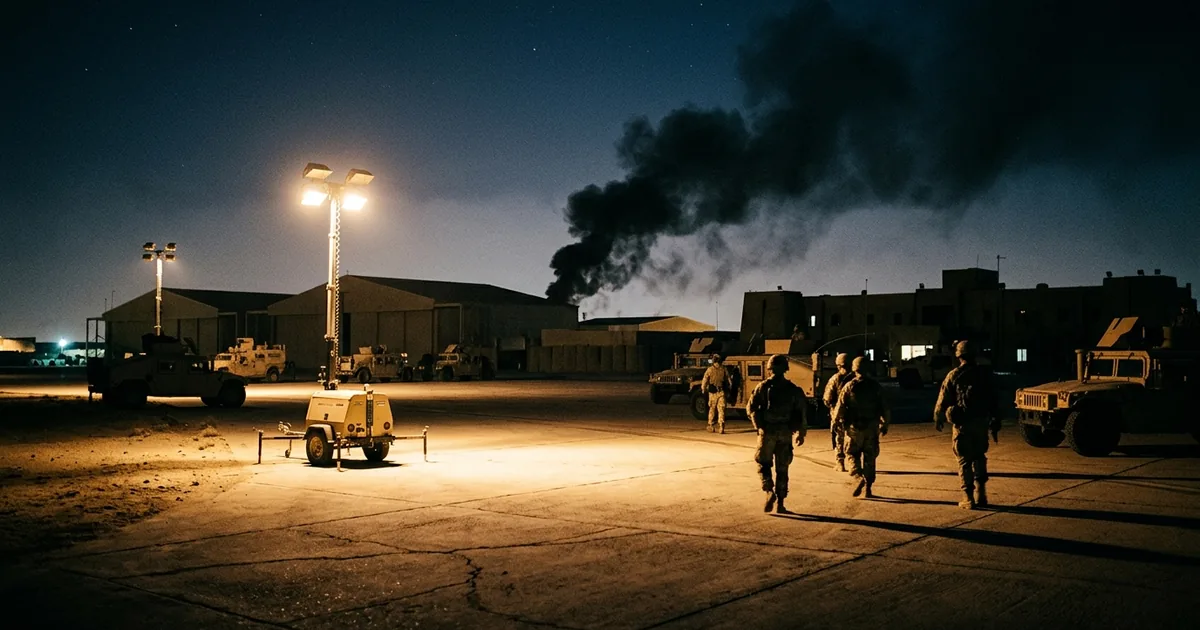
The Islamic Revolutionary Guard Corps launched ballistic missiles and drones at American military installations in two allied Gulf states on Sunday, crossing a line that the June 17 memorandum of understanding was supposed to hold.
Iran’s strikes hit the Ali Al Salem airbase in Kuwait and the US Fifth Naval Fleet headquarters at Port Salman in Bahrain, and the IRGC claims it destroyed eight military facilities across both sites. The ceasefire is not technically dead, but the gap between its text and reality is now measured in missile strikes, not diplomatic disagreements.
How the Escalation Unfolded
The sequence matters because it reveals the structural flaw in the agreement. On Thursday, an Iranian drone struck a commercial vessel in the Strait of Hormuz. The US responded with strikes on five Iranian targets, including surveillance infrastructure, air defense sites, and drone storage facilities. Iran then escalated beyond the bilateral exchange by hitting US bases in third countries, a qualitative escalation that drags Kuwait and Bahrain into a conflict they did not choose and cannot control.
Al Jazeera reported that the IRGC framed the attacks as retaliatory and accused the United States of violating the ceasefire terms first. The IRGC’s statement included an explicit threat: any further US strikes “will result in the complete halt of all diplomatic processes.” That is not saber-rattling from a fringe commander. That is the institutional position of the military branch that controls Iran’s missile program.
The Article 5 Problem
The core disagreement is not about whether ships are being attacked. It is about what Article 5 of the memorandum of understanding actually requires. The provision calls for “safe passage for commercial ships through the Strait of Hormuz,” but the two sides interpret it differently. Washington reads it as a blanket prohibition on interference with commercial shipping. Tehran reads it more narrowly, arguing that certain enforcement actions against vessels it considers in violation of its territorial claims do not constitute interference.
This is not a miscommunication. It is a structural ambiguity that was likely left unresolved during negotiations because resolving it would have killed the deal. The result is a ceasefire that both sides can claim the other is violating, which is exactly what both sides are doing.
Gulf State Sovereignty Under Fire
Bahrain condemned the strikes as a violation of its sovereignty and said they “undermined opportunities for de-escalation and stability in the region.” Kuwait described them as “repeated heinous Iranian aggressions” and a “flagrant violation of its sovereignty.” Both responses are diplomatically furious by Gulf standards.
The sovereignty issue is the part that makes this escalation qualitatively different from the tit-for-tat strikes inside Iranian territory and the Strait itself. When Iran attacks US targets inside Iran, that is a bilateral military exchange with established escalation norms. When Iran attacks US bases inside allied sovereign nations, it forces those nations into the conflict and raises the question of whether the US security guarantees that underpin Gulf state defense relationships are actually credible. NBC News reported that the strikes threaten to unravel peace efforts that took months of backchannel diplomacy to assemble.
Oil Markets Are Already Reacting
Crude prices climbed Monday morning as traders priced in the possibility that Strait of Hormuz traffic could be disrupted further. Roughly 20% of the world’s petroleum passes through the strait, and any sustained closure or harassment campaign would send energy prices sharply higher at a moment when the US economy is already navigating inflation concerns. The oil market’s read on the situation is simpler than the diplomatic language: the ceasefire is not holding, and the risk premium on Middle East shipping just went up.
Where This Goes
The immediate diplomatic path runs through Qatar, which is hosting negotiations over Strait of Hormuz enforcement. Both the US and Iran have reportedly agreed to a temporary halt in military strikes while those talks proceed. Whether “temporary” means days or hours is unclear.
The deeper question is whether the June 17 memorandum can survive a cycle of escalation that has now included strikes on third-country sovereign territory. A ceasefire agreement that cannot prevent missile attacks on allied military bases is not functioning as a ceasefire. It is functioning as a framework for managed escalation, and the distinction matters because managed escalation has a way of becoming unmanaged without warning.