
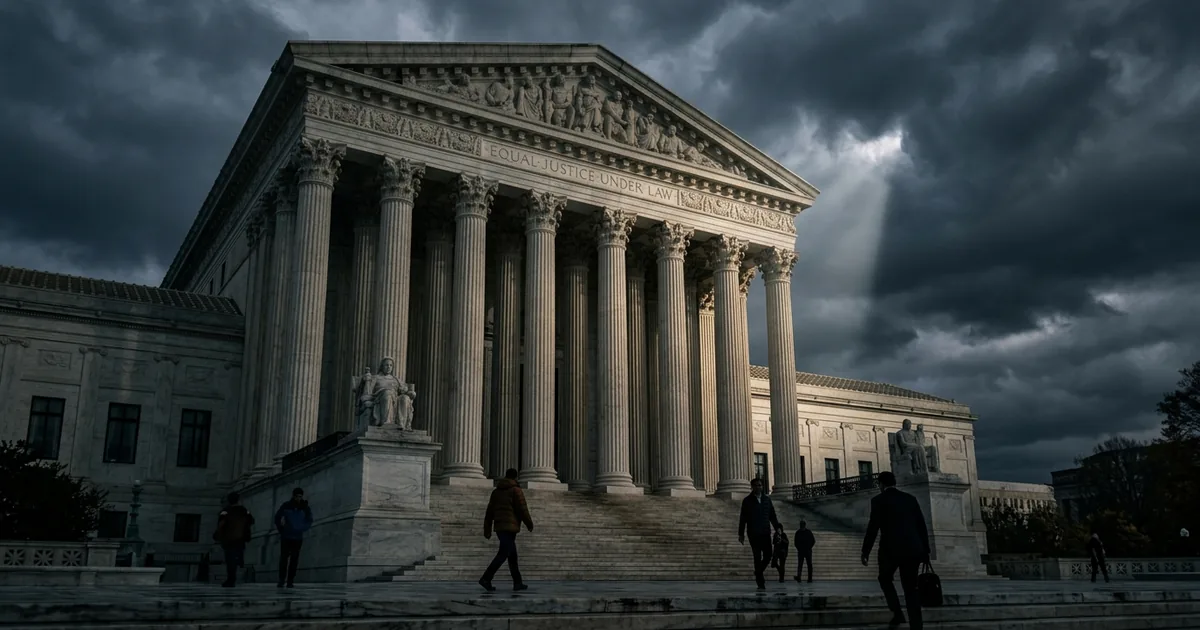
The Supreme Court spent ninety-one years letting Congress build regulators a president could not simply fire.
On Monday it tore that structure down in a single morning, handing Donald Trump, and every president who follows him, the power to purge the leadership of nearly every independent federal agency at will.
Ninety-One Years, Undone in a Morning
The case was Trump v. Slaughter, and the vote was 6-3 along the now-familiar ideological line. Chief Justice John Roberts, writing in the Court’s opinion, held that the law shielding Federal Trade Commission members from removal, the provision that lets a president fire them only for “inefficiency, neglect of duty, or malfeasance in office,” is “contrary to the separation of powers enshrined in the Constitution.” Then he went further. “If anything more is left of Humphrey’s, we overrule it,” Roberts wrote, burying the 1935 precedent, Humphrey’s Executor v. United States, that had let Congress wall off expert agencies from White House control for the better part of a century.
The logic is blunt and total. “Subordinates who exercise the President’s power are subject to removal by him,” the majority reasoned, treating every commissioner at every multimember agency as an extension of the president’s own will rather than a steward of a mission Congress assigned. Rebecca Slaughter, the Democratic FTC commissioner Trump fired without cause in March 2025, loses her seat. So, in effect, does the premise that any agency can answer to someone other than the man in the Oval Office.
The reach is not theoretical. As SCOTUSblog’s analysis lays out, the ruling reshapes roughly two dozen multimember bodies Congress deliberately insulated: the National Labor Relations Board, the Securities and Exchange Commission, the Federal Communications Commission, the Federal Election Commission, the Consumer Product Safety Commission, the Nuclear Regulatory Commission. Each was built so that a single election could not hand its enforcement machinery to one party. That design is now unconstitutional.
The One Door They Left Open
There was exactly one exception, and it tells you everything about what this Court is actually protecting.
In a companion order issued the same morning, Trump v. Cook, a different five-justice majority, with Roberts and Brett Kavanaugh crossing over to join the three liberal justices, blocked Trump from removing Federal Reserve Governor Lisa Cook, at least for now. The Court did not rest that result on grand principle. It rested it on paperwork: the administration had denied Cook even minimal due process. “At minimum, Cook was entitled to some explanation of the evidence at issue, some avenue for a response,” Roberts wrote. And in the Slaughter opinion itself, he carved the central bank out by hand, insisting that “any definition of ’cause’ in this context must reflect the Federal Reserve’s unique historical status and role.”
Unique how? The honest answer is that the Fed sets interest rates, and a president who could fire the chair over a bad inflation print would send the bond market into a tailspin. Trump has spent the past year pressuring the central bank and installing his own hand-picked chair, and even this Court understood that handing him the printing press outright was a risk Wall Street would not stomach. The exception is not constitutional reasoning. It is market management dressed up as constitutional reasoning.
That is the why of the whole decision. Strip away the originalist vocabulary and the ruling protects the single agency whose independence investors demand while exposing every agency that protects workers, consumers, and competition. The watchdogs that guard your paycheck, your savings, and the price of your prescriptions now serve at the president’s pleasure. The watchdog that guards the bond market does not.
The Theory That Ate the Administrative State
None of this arrived by accident. Monday’s ruling is the capstone of a forty-year campaign to install the “unitary executive” theory, the claim that the Constitution vests all executive power in the president personally, as binding law. The intellectual seed was Justice Antonin Scalia’s lone dissent in Morrison v. Olson in 1988, an opinion that lost 7-1 and then spent decades migrating from the fringe to the center of conservative legal thought.
The Roberts Court had been dismantling Humphrey’s in installments for years, striking down removal protections at the Consumer Financial Protection Bureau in 2020 and the Federal Housing Finance Agency in 2021, narrowing the old precedent each time to the multimember expert commissions it had not yet reached. Slaughter reaches them. What looked like a series of technical decisions about agency structure turns out to have been a demolition done one wall at a time, with the load-bearing one saved for last.
Justice Sonia Sotomayor, writing for a dissent that ran to forty-nine pages, named the stakes without flinching. The Court, she wrote, “discards” the “democratic regime” the Constitution built “in favor of one that distorts the structure of Government to fit the majority’s theory of unitary, total executive control.” Three words in that sentence, “total executive control,” are the entire ballgame.
What a Captured Agency Actually Does
The abstraction turns concrete the moment you picture these agencies in the hands of a president willing to use them. An FTC that cannot say no to the White House does not open antitrust files on the president’s friends. An SEC that answers to the Oval Office does not bring the enforcement action that embarrasses a major donor. The country has already seen the preview: when the Federal Communications Commission threatened ABC’s broadcast licenses over a late-night joke about the first lady, it was a glimpse of regulatory power aimed squarely at a political target. After Monday, the commissioners who might have resisted that kind of pressure can be fired the same afternoon they voice an objection.
The near-term mechanics are simple and ugly. Trump can now repopulate the FTC, the NLRB, and the rest with appointees chosen for loyalty rather than expertise, and the next president can purge them right back. Every change of administration becomes a change of regime inside agencies that were supposed to outlast the news cycle. Stability, the thing that let businesses and workers alike treat a regulator’s word as durable, is the first casualty.
This is the part the majority’s tidy separation-of-powers prose elides. Independence was never about shielding bureaucrats from accountability. It was about shielding referees from the players. Hand the whistle to one team’s coach and the game does not become more democratic. It becomes rigged, slowly, in ways that take years to see and longer to undo.
The Canary in the Carve-Out
The Fed exception is the clearest signal of what comes next. This Court will protect independence exactly where the cost of losing it would be immediate and measurable in market terms, and almost nowhere else. For the agencies that guard things harder to price, clean air, safe products, fair elections, honest markets for ordinary investors, the protection is gone, and the only remaining check is the character of whoever holds the office. The framers built a structure precisely so the republic would not have to depend on that. On Monday, six justices decided it should.