
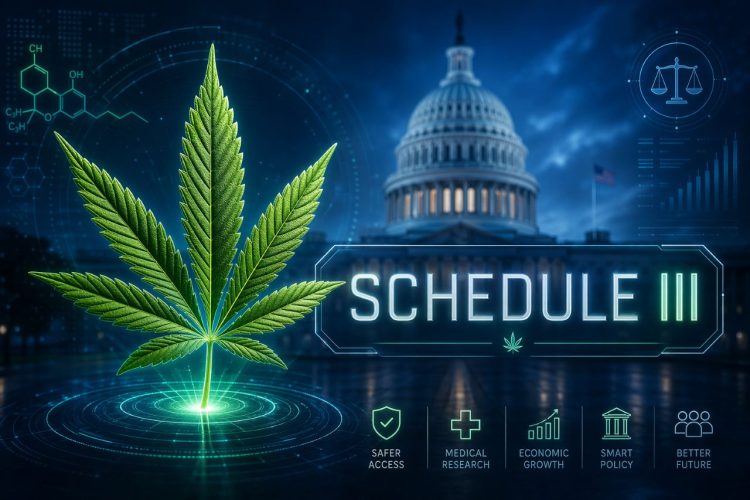
The Trump administration is about to do something genuinely consequential while simultaneously undermining its own reform agenda. Federal agencies have been instructed to prepare for the imminent reclassification of marijuana from Schedule I to Schedule III, a move that represents the most significant federal cannabis policy shift in more than half a century. The machinery is grinding forward, the paperwork is being processed, and by any reasonable measure, this should be celebrated as a win for evidence-based drug policy. So why does it feel like watching a magician misdirect us while picking our pocket?
Let’s start with what this actually accomplishes, because it is meaningful. Marijuana has occupied Schedule I since 1970, lumped together with heroin and LSD as a substance with no legitimate medical use and high abuse potential. The absurdity of this classification has been well-documented and politically radioactive for decades. Moving cannabis to Schedule III, where it will sit alongside Tylenol with codeine, testosterone, and ketamine, finally aligns federal law with biological reality and clinical evidence. The Trump administration’s December 18 executive order directed Attorney General Pam Bondi to expedite what the DEA proposed in May 2024 and what the HHS recommended back in August 2023. This isn’t innovation. This is the government catching up to where the country has already gone.
The Tax Revolution Cannabis Companies Have Been Waiting For
The tax implications alone make this consequential. IRS Section 280E currently prevents cannabis businesses from deducting ordinary business expenses, creating a cascading disadvantage that artificially inflates their tax burden. That rule applies only to businesses trafficking in controlled substances, which is why legal marijuana operators have been strangled by it. A Schedule III designation removes that barrier. For an industry generating tens of billions in revenue across 38 states with medical marijuana programs, this changes the financial calculus fundamentally. Cannabis stocks surged on the announcement because investors immediately understood: this unlocks profitability at scale. The banking system, which has largely frozen out cannabis businesses due to federal prohibition, suddenly has legal cover to serve them.
The Research Door Finally Cracks Open
Then there’s the research door that finally cracks open. Schedule I status has criminalized serious scientific inquiry into marijuana’s therapeutic applications. Moving to Schedule III clears the pathway for FDA-approved marijuana products and state-licensed medical items to flow through normal pharmaceutical channels. Clinical trials become possible. Federal funding becomes available. Universities can conduct long-term studies without federal agents rappelling through their windows. This is how you actually learn whether cannabis has medical value, rather than simply asserting whether it does based on ideology.
Smart Politics, Not Bold Leadership
The administration will frame this as compassion and common sense. They’re not wrong. Thirty-eight states have already legalized medical marijuana. Public opinion on cannabis legalization has shifted dramatically across the political spectrum. A majority of Republicans now support legalization. The Trump administration didn’t invent this position; they recognized it as a political winner. Moving into an election cycle with inflation concerns and healthcare anxiety, claiming credit for drug policy reform costs nothing and plays well with voters who see the war on drugs as a failure. This is smart politics, and there’s nothing inherently wrong with that.
But here’s where the contradiction becomes hard to ignore. The same administration reclassifying marijuana is simultaneously instructing the DOJ to ramp up prosecutions for simple possession. You don’t have to be cynical to notice that you can’t actually celebrate federal drug policy reform while expanding federal drug prosecutions. You can do one or the other, or you can do both and call it nuance, but you can’t honestly claim to be on the side of cannabis legalization or even sensible prohibition.
The Racial Justice Gap This Doesn’t Close
This is where the racial justice angle matters most. The war on drugs didn’t randomly happen to communities of color; it was systematized, weaponized, and sustained with explicit racial intent. Black Americans have been arrested for marijuana possession at roughly 3.5 times the rate of white Americans, despite similar usage patterns. Those arrests destroyed lives, families, and neighborhoods. They created barriers to housing, employment, and education that persist today. A Schedule III reclassification does nothing to address those structural harms. It doesn’t expunge convictions. It doesn’t repair communities that were deliberately targeted. It doesn’t restore opportunity to people who lost their lives to a war that the federal government now quietly admits was based on bad science.
What Reclassification Does And Doesn’t Do
Rescheduling is also not legalization. Let’s be precise about what’s actually happening here. Schedule III still means marijuana is a controlled substance. Recreational use remains federally prohibited. State-level legalization in places like California and Colorado exists in this strange federal limbo where the substance is illegal but prosecution is de-prioritized, the business is permitted but banks are terrified, and the contradiction is baked into every transaction. A Schedule III designation manages that contradiction slightly better; it doesn’t dissolve it.
What reclassification does accomplish is narrow but important. It removes the tax disadvantage that made cannabis businesses unsustainably expensive. It enables legitimate pharmaceutical research. It opens banking pathways for state-legal operations. It signals that the federal government has finally accepted that marijuana prohibition was a policy failure. For an industry that’s built its success despite federal opposition, this is significant breathing room.
Progress, But Not Enough
The cynicism worth sitting with is this: we’re celebrating the federal government’s willingness to acknowledge what most of America already knows as if this represents bold leadership. Thirty-eight states didn’t wait for Washington. Millions of Americans have voted with their feet, their wallets, and their votes for cannabis normalization. The Trump administration is surfing a wave it didn’t create, packaging it as principle, and collecting political credit for what is ultimately inevitability dressed up as executive action.
That doesn’t mean reclassification is bad policy. It’s good policy. It should happen. It’s been delayed far too long by bureaucratic inertia and political cowardice. But good policy enacted for cynical political reasons is still good policy. The question is whether you credit the administration for moving the ball forward or criticize them for moving it forward at the slowest possible pace while simultaneously contradicting their own reform agenda through expanded prosecution.
The honest answer is probably both. Reclassification is real progress. But it’s the kind of progress that reveals how far behind the federal government still is, and how much distance remains between Washington’s tentative acknowledgment of reality and a genuinely reformed drug policy that actually addresses the harms of prohibition rather than just managing them more efficiently.
The trains are running on schedule. The paperwork is being processed. By this time next week, marijuana will be Schedule III, and the Trump administration will claim victory for finally doing what thirty-eight states did years ago. That victory will be real. It just won’t be enough.