
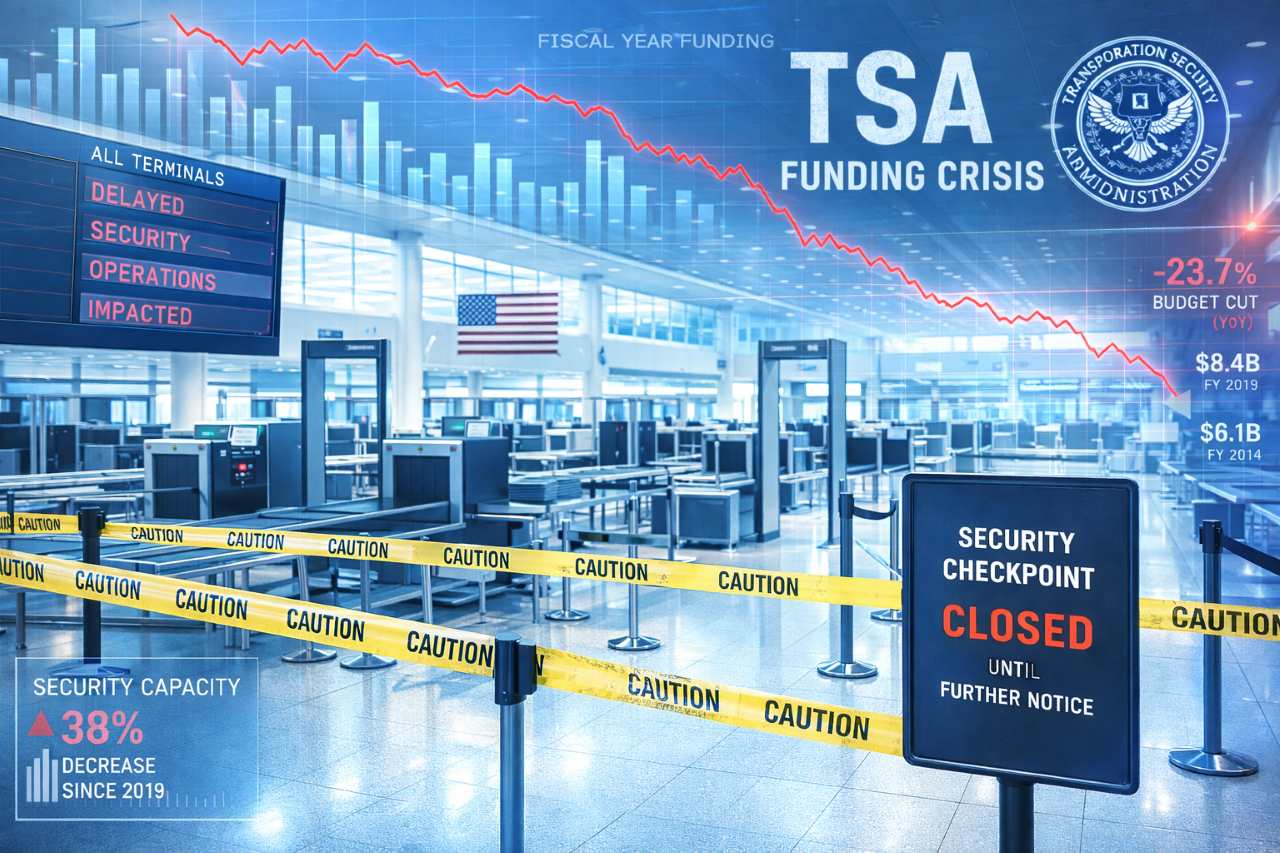
The shutdown that wasn’t supposed to last two months has finally crystallized into something undeniably real. Not in the form of economic projections or budget spreadsheets, but in something far more visceral: nearly 50,000 Americans who keep planes safe won’t be able to pay their rent within weeks.
Homeland Security Secretary Markwayne Mullin delivered that grim arithmetic on Fox News this week, noting that emergency funds will be depleted by the first week of May. The math is brutal in its simplicity. DHS burns through $1.6 billion in payroll every two weeks. Only $1.4 billion remains from the $10 billion “One Big Beautiful Bill” emergency fund that the Trump administration tapped to keep the department barely breathing since mid-February. The countdown is visible, measurable, and for the workers involved, utterly terrifying.
This is what political dysfunction looks like when it stops being theoretical. It’s not a debate on cable news anymore. It’s a TSA officer working without pay for three months, scraping together money for gas to drive to the airport. It’s a single parent skipping groceries because childcare costs don’t pause for government budget fights. It’s 838 TSA officers who have already quit since mid-February, deciding that the certainty of financial ruin outweighed the uncertainty of keeping their jobs.
How We Got Here
The shutdown that began in mid-February was supposed to be temporary. All shutdowns are supposed to be temporary. But Congress and the White House remain deadlocked over fundamentally incompatible visions of border security funding, immigration enforcement, and the very concept of what the government owes its workers. Meanwhile, summer travel season approaches like an oncoming storm. Airports will soon swell with millions of passengers, many of them traveling with families and limited tolerance for delays. The TSA’s attrition problem won’t simply resolve itself when Congress finally reaches a deal. The damage is cumulative. Every officer who quits is training time lost, procedural knowledge walking out the door, institutional capacity permanently diminished.
The Cruel Irony Of Congressional Priorities
The cruel irony here deserves its own spotlight. The Senate just passed a budget resolution advancing funding for ICE and Border Patrol operations on party-line votes, following a marathon five-hour vote-a-rama that consumed an entire day. Border enforcement got the attention, the urgency, the legislative will. The people responsible for the everyday security of 2.7 million daily air travelers did not. They exist in a different category of priority in Washington’s calculus, despite the fact that a non-functional TSA affects transportation networks that shape the entire American economy.
Consider what we’re actually looking at. The Trump administration directed the use of emergency funds specifically to pay TSA workers, which was the right call and a necessary one. But it was a band-aid on a systemic failure. Those emergency funds were never meant to be a permanent solution. They were meant to buy time for Congress to pass actual appropriations legislation. Congress has not done this. The union representing TSA workers is now demanding that the House pass a bipartisan funding bill before April 25. That demand comes not from a place of political hardball, but from the absolute bottom of necessity. Without it, workers face the existential question: how do you keep showing up to work when your employer can’t pay you?
The Asymmetry Of Pain
This reveals something important about how government shutdowns have evolved. They’re no longer genuine standoffs where both sides face mutual pain until compromise becomes inevitable. They’re asymmetrical events where some parts of government simply continue operating on emergency authority while other parts, and the people they employ, suffer the full weight. The TSA workers are suffering. The people who need to get on airplanes are about to suffer. Congress is not suffering in any meaningful way. They still get paid. That imbalance is not an accident of circumstance; it’s the actual structure of how these fights work.
The broader story here is how border enforcement and immigration enforcement have become organizing principles of American government at a level that supersedes basic operational function. A working TSA isn’t optional for a functioning economy or a functioning society. But it has become optional in the budgeting priorities that dominate Congress. The fact that ICE and Border Patrol funding is being advanced while airport security workers face potential nonpayment tells you something about what Washington actually values when forced to choose.
Real People, Real Consequences
Workers themselves have articulated this reality with painful clarity. You can’t afford gas. You can’t pay childcare. You can’t make rent. These aren’t abstract policy discussions. These are people deciding whether to buy food or put gas in their car to drive to the job that isn’t paying them. By March, this situation had already produced measurable chaos: hours-long lines at airports, security delays that rippled through the entire travel system, a visceral reminder that government workers are not interchangeable inputs but actual people doing actual work.
Spring and summer travel demand is surging, meaning more passengers are moving through checkpoints at exactly the moment when those checkpoints are least equipped to handle the volume. Until TSA workers are consistently paid and staffing levels stabilize, the conditions driving long security waits and flight delays are unlikely to improve on their own.
The Deadline Is Real
The math is simple. The deadline is clear. May 1st is not a hypothetical future date but a rapidly approaching specific moment when this crisis either resolves or explodes. Congress has known this for weeks. They chose not to prioritize it. That choice, that ordering of what matters and what doesn’t, says more about the current state of American governance than any amount of analysis could capture.
The question now is whether the threat of actual worker paychecks ceasing will finally create enough pressure to move Congress to action. Historically, the answer has been yes, but barely and only at the last possible moment. That pattern suggests that TSA workers will get paid. It also suggests that they’ll spend weeks in uncertainty, making difficult financial decisions, and carrying the psychological weight of working for a government that treats their paychecks as a negotiating afterthought. That’s the real cost of this shutdown, the part that survives even after Congress finally reaches a deal.