
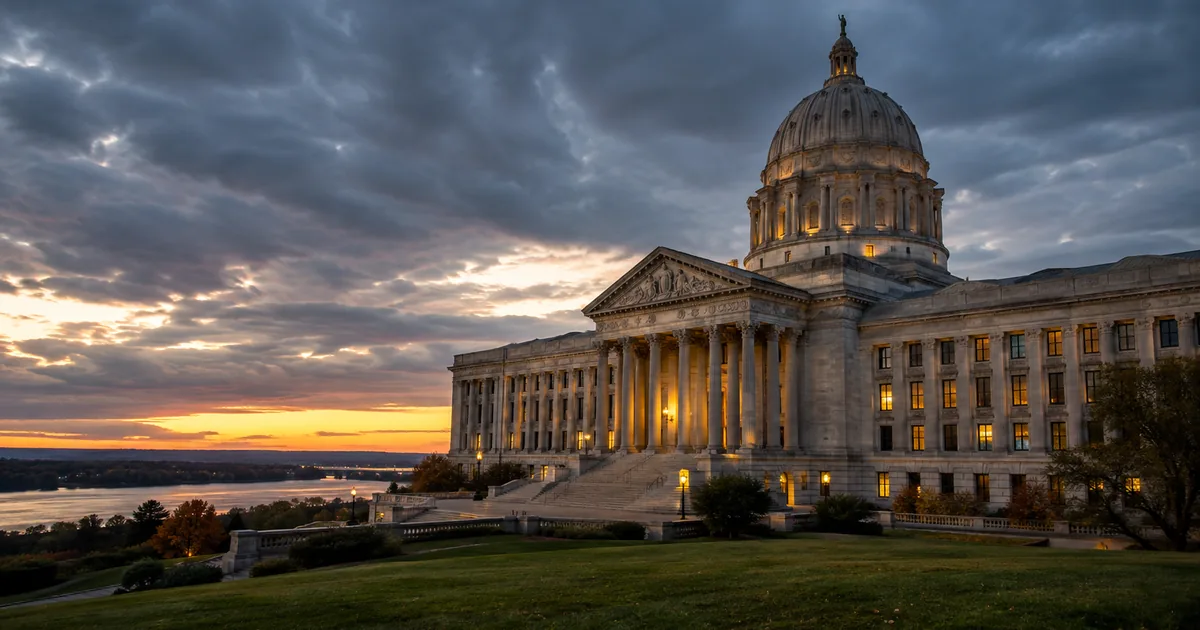
Justice Brett Kavanaugh refused on Tuesday to let Missouri use a redrawn congressional map that would have handed Republicans seven of the state’s eight congressional seats in November. He did it alone, without referring the application to the full Court, and without writing a word to explain why.
The national coverage has settled on a single frame: a rare setback for Republicans in the mid-decade redistricting war. That frame skips the part that actually decided this. What stopped Missouri’s map was not a federal judge’s view of gerrymandering, and it was not a Democratic counter-map drawn somewhere else. It was a referendum petition that more than 300,000 Missourians signed in December, invoking a provision of their own state constitution that suspends an act of the legislature until voters get to rule on it. No court rescued anyone here. Two courts simply declined to stand in the way of a mechanism ordinary voters had already triggered nine months earlier.
The Emergency Was Manufactured in Jefferson City
The chronology is the story, and it is missing from most of the coverage.
Opponents of the new map filed their referendum petition in December 2025 with more than 300,000 signatures. Republican Secretary of State Denny Hoskins then sat on it. He did not reject it in January, or in March, or in June. He rejected it in August, on primary election day itself, arguing that Missouri’s referendum process cannot reach congressional redistricting at all. A lower court agreed with him. The Missouri Supreme Court, ruling unanimously last Thursday, did not, holding that a constitutional provision permitting a referendum on “any act” of the legislature covers a redistricting act like any other.
“The referendum petition was legal, sufficient, and timely, and the secretary incorrectly concluded otherwise,” the court wrote, as PBS NewsHour reported. The 2022 map, six Republicans and two Democrats, “remains in full force and effect for the November 2026 general election.”
Then came the part worth sitting with. Missouri Solicitor General Lou Capozzi, filing for Hoskins and Attorney General Catherine Hanaway, told the U.S. Supreme Court that “a federal-election-administration disaster is unfolding in Missouri,” that the state court’s order “renders a completed federal primary election utterly pointless,” and that compliance was “technically impossible” with overseas military ballots due to go out September 19. St. Louis Public Radio reported the filing’s language in detail.
Every hour of that supposed disaster is the secretary of state’s own work. Hoskins held a valid petition for eight months, killed it on the single day in the calendar guaranteed to maximize the chaos of being reversed, and then asked federal courts to treat the resulting crunch as grounds for overriding the Missouri constitution. That is not an emergency. That is a delay presented as one, and it deserved exactly the reception it got.
Hoskins held a valid petition for eight months, killed it on the one day guaranteed to maximize the chaos of being reversed, then called the wreckage an emergency.
What Kavanaugh Did Not Say
The legal theory Missouri brought was the Elections Clause: that the U.S. Constitution’s delegation of federal election rules to state legislatures limits how far a state’s own courts and voters can constrain what its legislature draws. It is a familiar argument with a familiar problem. The Supreme Court considered a stronger version of it in Moore v. Harper, the North Carolina case it decided in 2023, and rejected it.
Kavanaugh, who handles emergency applications from the Eighth Circuit, denied this one without referring it to his colleagues and without an opinion. NBC News noted that the denial came with no explanation at all.
The silence is the signal. A circuit justice refers an application to the full Court when the question is close, consequential, or likely to divide the bench. A Trump appointee, handed a Republican redistricting emergency three weeks after a Republican secretary of state manufactured the timing, disposed of it by himself. That is not what a serious Elections Clause question looks like on the emergency docket. It is what a weak one looks like.
Chuck Hatfield, a lawyer on the other side of the case, made the more uncomfortable observation about how the appeal got there at all: “For an attorney general of our state to question the Supreme Court of our state on what the law is and to appeal that to the Supreme Court of the United States is unprecedented.”
The Arms Race Has Been Measuring the Wrong Thing
For a year the mid-decade redistricting story has been covered as a contest between legislatures and a race between mapmakers. Texas drew five additional Republican seats, and CBS News found the redraw pushed Representative Al Green’s Houston district from 72% Democratic to 40%. Missouri’s legislature, under direct pressure from President Donald Trump, did the same arithmetic to Representative Emanuel Cleaver, whose Kansas City district went from 62% Democratic to 41%. Trump called last Thursday’s state ruling ridiculous on Truth Social, complaining that the justices had ruled “in favor of changing the maps back to what they were a long time ago.”
Count the states where a map actually held up, though, and a different variable emerges. California’s Democratic counter-map survived because voters approved it at the ballot box by a 29-point margin. Virginia’s new map took effect because voters there approved it as well. Missouri’s map is suspended because Missouri’s constitution let voters demand a say and the legislature drew as if it did not exist.
That is the pattern nobody is naming. In this cycle, the durable maps are the ones that went through voters, and the vulnerable ones are the maps that tried to route around them. The redistricting war is not primarily a fight about who can draw faster. It is a fight about which states still let the public veto the drawing, and Missouri turns out to be one of them.
None of this makes courts a reliable backstop, and it would be dishonest to suggest otherwise. The same Supreme Court gutted a core provision of the Voting Rights Act in a Louisiana case this year, reshaping the map math well beyond anything Missouri’s legislature attempted. Kavanaugh’s order was not a ruling on gerrymandering. It was a refusal to disturb a state court reading its own constitution, which is a much narrower and much more fragile thing to depend on.
What Happens to the Map Now
Missouri’s new map is not dead. It is suspended, and its fate now belongs to a statewide vote, which is precisely where the 300,000 signatories wanted it in December. Republicans keep the argument they have made throughout, that a map passed by an elected legislature should not be undone by petition. They will get to make it to the voters instead of to a judge.
For a party that spent this cycle insisting redistricting is a legislative prerogative, that should be an easy case to take to the public. The revealing detail is how much effort went into ensuring the public never got asked.