
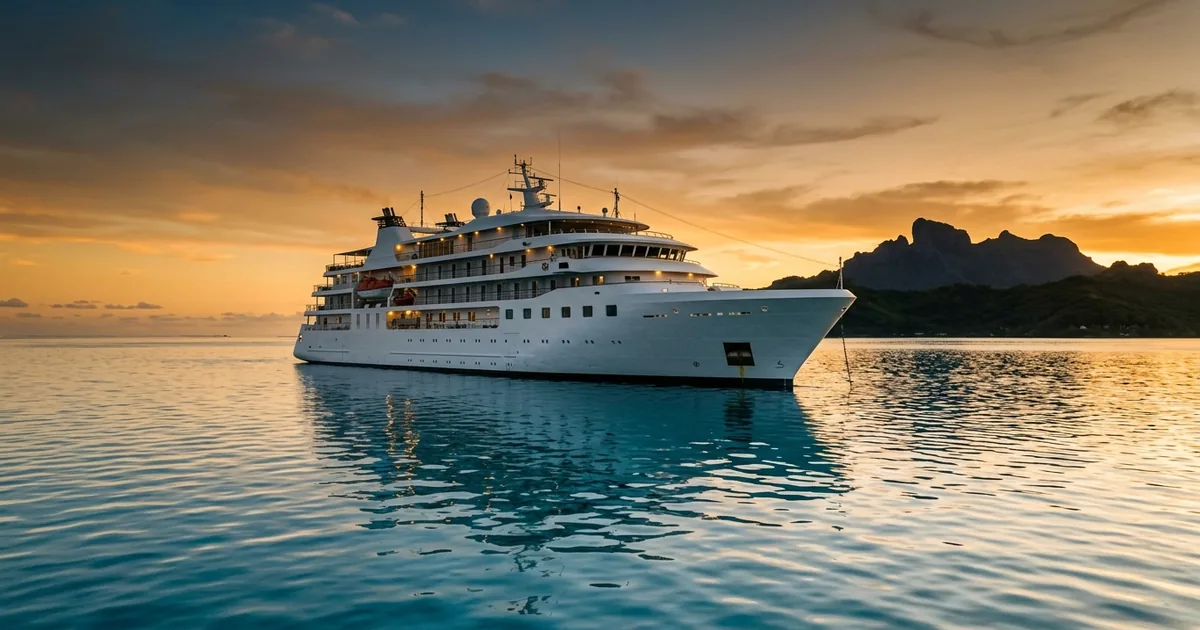
Three passengers are dead and 149 people sit anchored off Cape Verde aboard a Dutch expedition ship after a hantavirus outbreak that, per the World Health Organization on May 4, 2026, may have spread person-to-person. The cruise industry has spent five years selling Antarctica and the sub-Antarctic as the new bucket-list product. The MV Hondius is what happens when that pitch outpaces the public-health playbook.
What the WHO actually said
Per the WHO’s May 4 notice, two of the seven cases on board the MV Hondius are laboratory-confirmed for Orthohantavirus andesense, the Andes virus that “is responsible for most cases in South America.” Three are dead, including two Dutch nationals and one German national. One passenger remains critically ill. Three more report mild symptoms. The vessel carried 147 people, 88 passengers and 59 crew, of 23 nationalities. It departed Ushuaia, Argentina on April 1 and ran through Antarctica, South Georgia, Tristan da Cunha and Saint Helena before turning toward Cape Verde.
The eyebrow-raising sentence in the WHO notice is this one: “limited human-to-human transmission of HPS due to Andes virus has been reported in community settings.” Hantavirus, in the standard textbook, jumps from rodents to humans through urine, feces, or saliva. Person-to-person transmission is the exception, not the rule, and it is largely associated with the Andes strain in clustered settings. A 100-meter expedition ship is, definitionally, a clustered setting.
The expedition-cruise pitch and what it skipped
Expedition cruising used to be a niche. Operators like Oceanwide Expeditions, Lindblad, Quark, Hurtigruten, and Ponant ran small ships into polar and sub-polar waters for travelers who would pay $10,000 to $40,000 per cabin for the privilege. After the COVID-19 trough, the segment grew. Cruise Lines International Association reported that expedition capacity, measured by berths, more than doubled between 2020 and 2025. Travel agents began listing Antarctica and South Georgia in mainstream catalogs alongside Caribbean island-hopping.
What scaled with that growth, less obviously, was the pathogen-vector surface. An expedition itinerary now routinely includes shore landings on islands with active rodent populations, scientific stations, and, in some cases, working ports with their own zoonotic risk profiles. Tristan da Cunha and Saint Helena both have documented rodent populations that have evolved in semi-isolation. The sourcing question for a hantavirus jump on a vessel that visited those islands writes itself. Readers tracking the outbreak in real time can watch ongoing CNN coverage on the LNC live stream as the WHO updates the case count.
The industry’s biosecurity playbook, by contrast, has barely moved. The International Maritime Organization’s guidance still leans on quarantine-flag protocols designed for older respiratory and gastrointestinal threats. There is no expedition-cruise-specific biosecurity standard for rodent-borne or vector-borne pathogens with limited human-to-human transmission. Ships entering port are not screened for it because, until now, no one had a reason to ask.
Cape Verde says no
Praia refused the MV Hondius entry. That is the second story on this story.
Maritime sovereignty law, in cases of communicable disease, gives port states wide discretion. Cape Verde is exercising it. From a Cape Verdean public-health perspective the decision is rational. From a Dutch and an EU perspective it is the start of a diplomatic problem that has no clean answer. Where, exactly, does a Dutch-flagged ship of 23 nationalities go when no nearby port wants it? The WHO has been asked to coordinate among Cabo Verde, the Netherlands, Spain, South Africa, and the United Kingdom. Per the May 4 notice, the WHO advises “against the application of any travel or trade restrictions.” That is policy guidance. It is not docking authority.
This is the point where regulators discover that “expedition cruising” was created without a corresponding regulatory architecture for its failure modes. There is a treaty for nuclear emergencies at sea. There is a framework for oil spills. There is no equivalent for a 100-passenger ship carrying a confirmed Category III pathogen with possible human-to-human transmission, parked outside a small-state capital that has every right to keep it there.
What the cruise lines will say next
Expect three messaging beats from the operator and the broader expedition segment over the next two weeks. First: the case count is small and the response was fast. Second: the WHO global risk assessment is “low,” which is true today and is not the relevant question. Third: the segment will quietly tighten its onboard medical screening and shore-landing protocols, and a future booking page will mention “advanced biosecurity protocols” without specifying what they are.
What the segment will not do, on its own, is publish a hantavirus-specific or rodent-borne-disease-specific biosecurity standard with measurable thresholds. That is the kind of thing regulators have to force, and the regulators in question, the IMO and national flag states, are slow.
The customer-facing problem is simpler. The MV Hondius passengers paid for an expedition cruise. Some of their families are reading the WHO notice this week. CLIA’s marketing premise has, for half a decade, depended on the implicit promise that an expedition cruise is a more authentic, more controlled version of the regular cruise product. The premise was always doing more work than the operating reality could support. Per CNN’s May 5 follow-up reporting, the timeline of onset, between April 6 and 28, suggests the index case may have boarded already infected, which changes the duty-of-care argument materially.
What to actually watch
Three things to track over the next 60 days.
The first is where the MV Hondius docks. If Cape Verde holds, the next likely port is in Spain or Morocco, both of which will face their own internal calculation. The longer the ship sits, the more urgent the question of medical evacuation for the critically ill patient becomes.
The second is whether human-to-human transmission gets confirmed beyond the WHO’s current “limited” framing. Confirmation would change US Centers for Disease Control surveillance posture for any future Andes-strain cluster, not just maritime ones.
The third is whether CLIA or its national affiliates publish a hantavirus-specific guidance update before the next Antarctic season opens in November. If they do, this story will read in retrospect as the catalyst. If they do not, the next outbreak on the next expedition ship is already a foregone conclusion. The segment grew, the playbook did not, and 88 paying passengers and 59 crew are anchored off Praia today because the math caught up.
By Scott Coy. Founder, LiveNewsChat. 20+ years in digital media and SEO.
Updated May 5, 2026.