
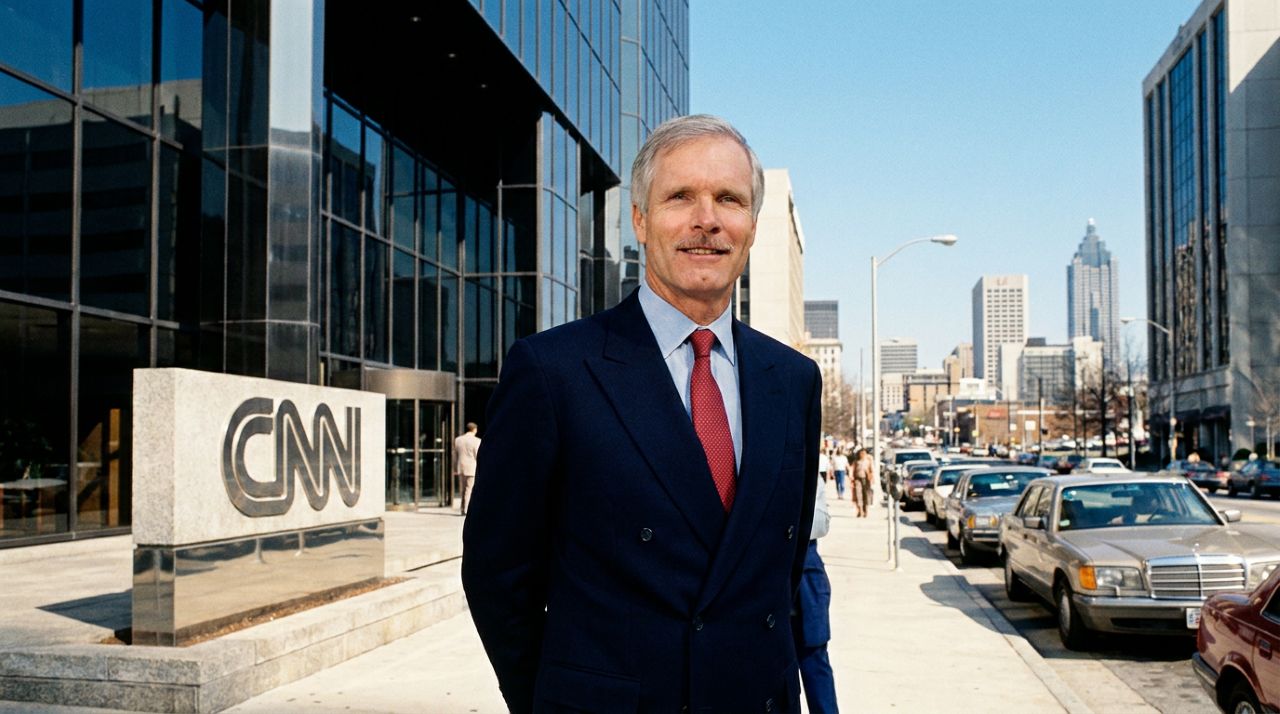
Ted Turner CNN founder, the Atlanta media owner who launched the network in 1980 over the protest of an industry that thought 24-hour news was unworkable, died Wednesday at age 87 from complications of Lewy body dementia. The disease, which he disclosed publicly in 2018 just before his 80th birthday, had pulled him out of the public eye for most of the past five years. The legacy he leaves is harder to retire: a cable architecture, a journalism format, and a philanthropic playbook that other billionaires still copy.
The 24-hour news bet that rewrote television
CNN went on the air on June 1, 1980, with a budget that the major broadcast networks called untenable and a pitch that nobody in 1980 had ever bought before. Cable penetration in the United States was below 22 percent. The Big Three evening newscasts owned the audience for journalism. Turner’s argument was structural: if news ran continuously, every story became a live story, and the audience that Walter Cronkite had to fight for at 6:30 p.m. would self-organize across the day. He bet on the structure, not the specific moment, and the structure won. Within a decade CNN had remade live coverage so completely that the Persian Gulf War of 1991 was watched in real time on cable, and the broadcast networks were the ones playing catch-up.
The post-CNN cable news landscape that followed (Fox News in 1996, MSNBC the same year, then the streaming-news refit of the 2010s) inherited Turner’s premise without paying him for it. The 24-hour wheel format, the live-anchor desk, the rolling chyron, even the assumption that a viewer wants news to be available rather than scheduled, are all his.
The cable bundle was the real invention
The obituaries will lead with CNN, but the more durable Turner accomplishment was the cable bundle itself. WTBS, which he turned from a money-losing Atlanta UHF station into the first cable superstation in 1976, proved that a single channel could distribute nationally via satellite. That insight made the business of basic cable possible. TNT followed in 1988. Cartoon Network in 1992. Each one exploited the same economic idea: a single content asset, distributed through satellite to thousands of cable headends, monetized through a dual revenue stream of advertising and per-subscriber affiliate fees.
That dual revenue model is the financial spine of every cable channel that exists today, and the reason the cable bundle outlasted predictions of its death by twenty years longer than analysts forecast in 2010. The model is finally being unwound by streaming, and Turner lived to see his successors at Warner Bros. Discovery struggle to figure out what to do with CNN inside Max. The architecture survives in muscle memory: the way cable news anchors hand off to one another, the way breaking news graphics look, the way an industry assumes a story is a thing that updates on a wheel rather than a thing that publishes once.
The Atlanta phase: the Braves, the fortune, the philanthropy
The second half of Turner’s career is impossible to compress. He bought the Atlanta Braves in 1976 for under 10 million dollars, ran them as the Braves of TBS so the team’s games would feed the superstation’s national programming, and won a World Series with them in 1995. He sold Turner Broadcasting to Time Warner in 1996 for 7.5 billion dollars, becoming briefly the largest individual shareholder in what was then the world’s largest media company. The merger of Time Warner and AOL in 2000 cost him most of that fortune on paper, an experience he later described as the most expensive education of his life.
The Atlanta period is also when Turner became a different kind of public figure. His philanthropy escalated in 1997 with a one billion dollar pledge to support the United Nations, the largest individual donation to the UN system to that point. The pledge funded the UN Foundation, which he chaired through his decline. The structure he chose, an independent foundation outside the UN bureaucracy that channeled private money into UN programs, became the template that Bill Gates, MacKenzie Scott, and Charles Feeney later adapted for their own giving.
Conservation, bison, and the Captain Planet of it all
Turner was at one point the largest private landowner in the United States, with roughly two million acres across thirteen states. The land was not a trophy. He used it to reintroduce bison to the American West, growing his herd to over fifty thousand head, the largest private bison herd in existence by 2010. He commissioned Captain Planet and the Planeteers in 1990 partly as a children’s animated series and partly as a piece of educational infrastructure that taught American kids the word “biodiversity” through a green-haired superhero. For our broader coverage of the figures who shaped late-twentieth-century media and policy, see LNC’s news media archive.
The contradiction at the center of all of this is the man who founded a 24-hour news network that monetized human attention, then spent the next four decades trying to redirect that attention toward the species and ecosystems being lost while it was being captured. He did not resolve the contradiction. He just lived inside it, and the size of his estate let him fund both sides of the trade at once.
The Mouth of the South in a fragmented news age
Turner was nicknamed “the Mouth of the South” and “Captain Outrageous” for a reason. He once told employees he intended to be the first newsman on the moon. He proposed marriage to Jane Fonda, married her, spent ten years on a horse ranch in Montana with her, and divorced her. He was Time’s Man of the Year in 1991 partly because the magazine could not figure out where else to put a person who had bought MGM’s film library, owned three sports teams, and was lecturing world leaders about nuclear disarmament in the same calendar year.
That figure does not exist anymore in American business. The closest contemporary analog, Elon Musk, is not really comparable: Musk runs a fragmented social platform that diffuses attention rather than concentrating it. Turner’s bet was the opposite, that mass attention could be concentrated and then directed at problems. By 2026 the bet looks dated. The audience he aggregated has been split a thousand ways across YouTube, TikTok, Substack, X, podcast apps, and the AI search experiences that synthesize across them. The 24-hour news wheel he invented is not where the audience is. CNN’s prime-time numbers in 2026 are below where the network started in 1992.
What ends with him
The cable era was already ending in 2024 when Charter and Disney fought publicly over carriage fees and the bundle started to crack on the consumer-facing side. Turner’s death is the symbolic ending, not the operational one. The operational ending will be the next round of cable carriage negotiations and the eventual decision by Warner Bros. Discovery, or whatever Comcast or another buyer rebuilds out of the carcass, about whether CNN belongs as a streaming-first news asset, an attached cable channel, or a legacy property to be milked and shut.
He shaped one of the largest informational realignments of the late twentieth century. He died at the moment that realignment is being undone. Both the founding bet and its dissolution belong to the same man, and that may be the thing the obituaries miss.