
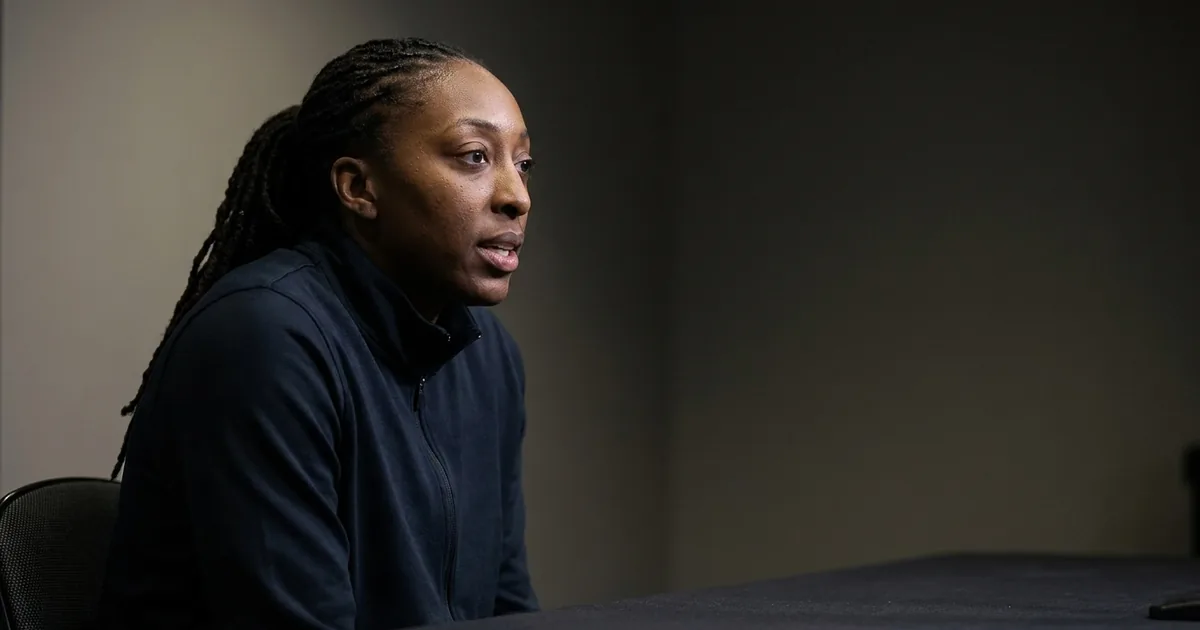
Two months ago the players of the WNBA re-elected Nneka Ogwumike, unopposed, to a fourth three-year term as president of their union. On Wednesday she announced she will retire as a player at the end of this season, which leaves the most consequential labor organization in women’s professional sport being led by someone who will no longer be in a locker room.
The Career Everyone Is Writing About
The obituary-for-a-career version writes itself, and it is genuinely impressive. Drafted first overall by the Los Angeles Sparks in 2012, Ogwumike leaves after 15 seasons as a league champion, the 2016 most valuable player, an eight-time All-WNBA selection and an 11-time All-Star, the second-highest All-Star count in league history. ESPN called her a first-ballot Hall of Famer and nobody has argued.
In the statement the league published, she framed it as a choice rather than a decline: “I’ve learned there’s power in knowing when to walk away.” Commissioner Cathy Engelbert’s line was that Ogwumike leaves the league better than she found it, which is the sort of thing commissioners say, except that in this case there is an audited number attached to it.
The Number Is 364 Percent
While she was doing all that, Ogwumike spent a decade as president of the Women’s National Basketball Players Association, elected in 2016 and returned in 2019, 2022 and again this June. Over that stretch the union negotiated two collective bargaining agreements, and the second one produced a pay increase of 364 percent, the largest in the history of American professional sports, a figure Fortune reported alongside the detail that the players brought in Nobel laureate economist Claudia Goldin to help build the case.
What that raise actually looks like in practice:
- Average player compensation moved into the mid-six figures this season, up from a league where veterans had spent years on five-figure salaries.
- The structure escalates, with the average projected to clear $1 million by 2032.
- Revenue sharing, not just a fixed pot, which is the mechanism that lets player pay track the league’s growth instead of lagging it by a bargaining cycle.
The Canadian Broadcasting Corporation covered the deal as a landmark for women’s sport generally, and that framing is right, but it undersells the organizing problem Ogwumike actually solved. Her membership included players who had spent a decade making less than a public school principal alongside 22-year-olds who arrived with name-image-likeness money already in the bank. Those two groups have different risk tolerances and different definitions of a good deal. Holding them together long enough to extract a 364 percent increase from a league that the NBA substantially owns is the achievement, and it is not a basketball achievement.
Speaking to CNBC in March, Ogwumike put the outcome in the plainest possible terms: the new agreement would show up in players’ bank accounts. Union presidents do not usually get to say that and be right.
She is also, conveniently, her own case study. After two seasons in Seattle she came back to Los Angeles this year on a one-year deal worth $950,000, as Bleacher Report noted in its retirement writeup. A near-million-dollar one-year contract for a 36-year-old forward is not a number the league she was drafted into in 2012 would have recognized.
The Part Nobody Has Answered Yet
Here is the question the retirement coverage has mostly skipped. A players’ union president who is not a player occupies an unusual position, and the WNBPA is about to test it.
The mechanics matter more than they sound. Ogwumike was returned in June to a term running three years, and Minnesota’s Napheesa Collier came in as first vice president, taking over from Kelsey Plum, whose term had expired and who did not run again. Plum’s own move to the Sparks had already reshuffled the union’s leadership bench once this year. ESPN reported, citing a source, that Ogwumike is expected to stay in the role at least into the next election cycle.
There is a real argument for that continuity. Institutional memory is the scarcest asset a players’ union has, because the membership turns over on a five-year cycle while the league’s negotiators stay for decades. That asymmetry is the single biggest structural disadvantage players face in every sport, and a president who sticks around partially closes it.
There is also a real argument against. A union derives its authority from the credible threat that its members will withhold labor, and the person making that threat is more persuasive when she is one of the people who would be withholding it. The WNBPA has spent the past year in running friction with the league over how players are marketed and monetized, including the league’s decision to delete a promotional video pairing player likenesses with betting content during the CBA fight. Those disputes are not settled. They are the next agreement’s opening positions.
What This Actually Tests
The honest read is that Ogwumike built something that now has to prove it does not depend on her. That is the standard test of whether a labor victory was structural or personal, and most of them turn out to be personal.
The WNBA is in the most aggressive expansion phase of its existence, with new franchises, new media money, and a valuation curve that makes the 364 percent look, in hindsight, like the players may have settled early. The next negotiation will be conducted against a much bigger revenue base by a leadership group that includes at least one person with no locker-room standing. Whether that group can hold the same coalition together, veterans and rookies and everyone whose economics changed overnight, is the actual legacy question, and it will not be answered by a jersey retirement ceremony.
Ogwumike gets to leave on her terms, which almost nobody in professional sport does. The harder thing she is leaving behind is a membership that has never had to negotiate without her.