
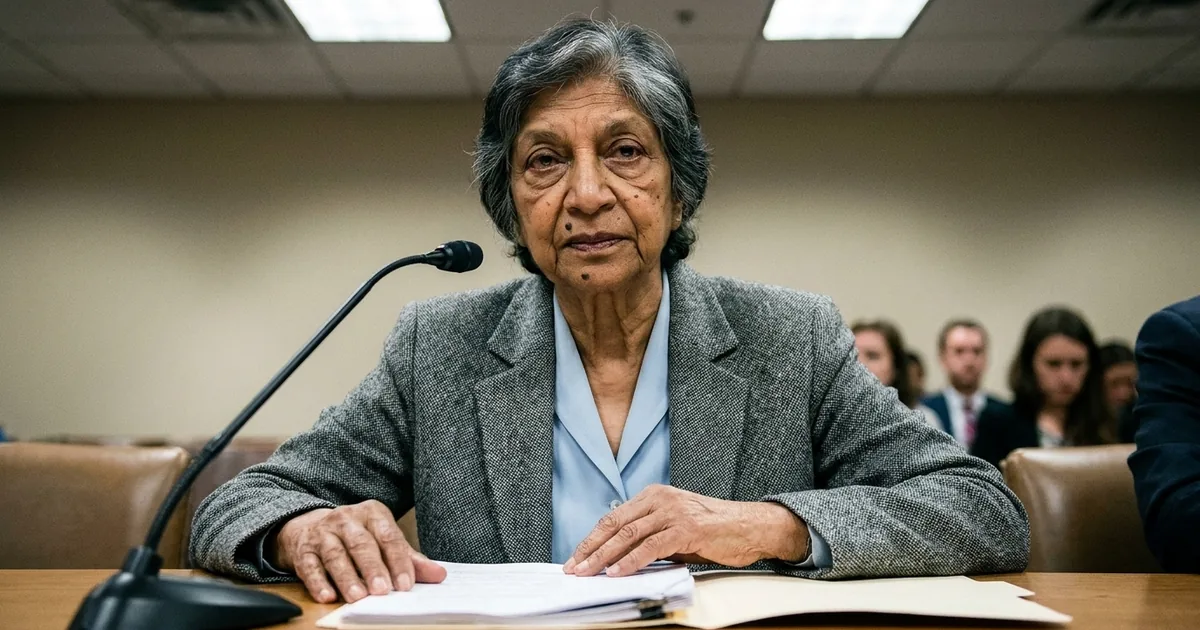
The Norwegian Nobel Committee could not reach Navi Pillay before it told the world she had won the 2026 Nobel Peace Prize, so its chair, Jørgen Watne Frydnes, used Friday’s announcement to leave her a message: “if you see a Norwegian number calling, please pick up.”
Most of the coverage since has been about the man who did not win. That is the smaller story. Near the end of the committee’s own press release sits a sentence written for Washington: “But today, as these same judges are sanctioned, and their institutions are attacked, we need people of courage, vision and determination.” The committee named no government. It did not have to. Pillay sat on the first bench of the International Criminal Court, and since early 2025 the United States has been sanctioning that court’s officials by name, most recently its president.
To see why that sentence lands where it does, start in Durban.
Pillay was born in 1941 into a family of Indian Tamil origin, under a system that sorted South Africans by race and gave a brown girl from a working family almost nowhere to go. She went into law anyway. The committee notes that she defended Nelson Mandela and others who stood against apartheid, and that she later sat on South Africa’s High Court. For a lawyer of her generation and background, that last line alone would have been a career.
It was the opening act. In 1995 the UN General Assembly elected her to the International Criminal Tribunal for Rwanda, set up after roughly 800,000 people were killed in a hundred days. She served eight years there, the last four as its president. In the case of Jean-Paul Akayesu, a town mayor, the tribunal held for the first time that rape and sexual violence could constitute genocide, and the Nobel committee credits Pillay’s influence as “a significant factor.” The same case produced a second first: a defendant charged with inciting genocide purely on the basis of spreading propaganda. Prosecutors who have since gone after broadcasters and politicians for the words that came before a massacre are standing on that ruling.
In 2003 she was among the first judges of the new International Criminal Court in The Hague, and she served on it until 2008. Then came six years as UN High Commissioner for Human Rights, a job that has never made its holder popular with the powerful. Today she sits on the International Court of Justice in the case accusing Myanmar of genocide against the Rohingya.
“If you say nothing and do nothing and think you are being neutral, you are not. You’re being complicit.”
She said that in September 2025, as chair of the UN commission of inquiry on the occupied Palestinian territory, when the panel concluded that Israel was committing genocide in Gaza. Israel rejected the report as “distorted and false.” The committee lists the commission in her résumé without comment, which is its own kind of comment.
Now line her career up against the paper trail coming out of Washington.
On February 6, 2025, Donald Trump signed Executive Order 14203. Its title does not bother with euphemism: “Imposing Sanctions on the International Criminal Court.” The trigger was the court’s arrest warrants for Prime Minister Benjamin Netanyahu and his former defense minister, Yoav Gallant. The order first hit the court’s chief prosecutor, Karim Khan, and then kept going. Judges from Benin, Peru, Slovenia and Uganda followed. By this August, when the State Department added the court’s own president, France counted eleven judges already under American sanctions and called the campaign “an attack on the Court and all the 125 States Parties to the Rome Statute.”
That president is Tomoko Akane of Japan, designated on August 18 along with Abdoulaye Seye, a senior trial lawyer from Senegal. Human Rights Watch called it “just the latest example of the Trump administration’s utter contempt for international law.”
Sanctions of this kind are not symbolic. They block property and bar entry to the United States, and in practice they make banks everywhere nervous about touching the named person’s money. They are the same tools Treasury uses on terrorist financiers and cartel bosses, and they are now aimed at judges whose offense was issuing warrants under a treaty 125 countries have joined.
So when the committee writes about judges being “sanctioned” and institutions “attacked,” and then hands its prize to one of the people who built the institution, the reading is not subtle. The release says “might overtakes right” in so many words.
None of which stopped the president from asking for the prize himself.
On Wednesday, Trump renewed his case, saying he had “settled eight wars” and saved “millions and millions of lives,” a count that some of the parties to those conflicts dispute. He also pre-empted the outcome: “They have a reputation for maybe not giving it to people like me.” He was one of 287 nominees. Last year, when María Corina Machado won, a White House spokesman said the committee had “proved they place politics over peace.” In January, Trump went further and tied his Greenland demands to the snub in a letter.
It is also the second time this week a Nobel has collided with his policy. On Tuesday the physics prize went to a neutrino detector buried in the South Pole ice, a project his budget proposed to cut in half. The Peace Prize is the one he wants, and the committee gave it to someone whose life’s work his administration is actively punishing.
Here is where we land. The committee made the right call, and it put its reasoning in writing where nobody could miss it, if anyone read past the headline. The sanctions on ICC judges are indefensible. A court can be wrong, and the US is free to say so, to stay outside the Rome Statute, and to argue its case in public. What it cannot credibly do is put judges on the Treasury list next to cartel accountants because their rulings inconvenienced an ally, and then complain that a prize for international law went to someone else.
The sanctions should be lifted. Congress has the power to say so and has not used it. Until it does, every American official who talks about the rules-based order is talking past the judges on that list.
There is also a quieter point in the committee’s language. “The greatest powers have often evaded responsibility,” the release concedes, and cases under international law “have produced different results depending on who is the perpetrator and who is the victim.” That is an honest admission from a body not known for them. It is also the strongest argument for courts like the one Pillay helped found. The answer to uneven justice is more of it, applied to everyone, including allies and including us.
Pillay may still be waiting on that phone call. The award ceremony is December 10 in Oslo. Between now and then the sanctions list will either get shorter or it will not, and that, more than any White House statement about this morning’s result, will show what Washington thinks of the prize it keeps asking for.