
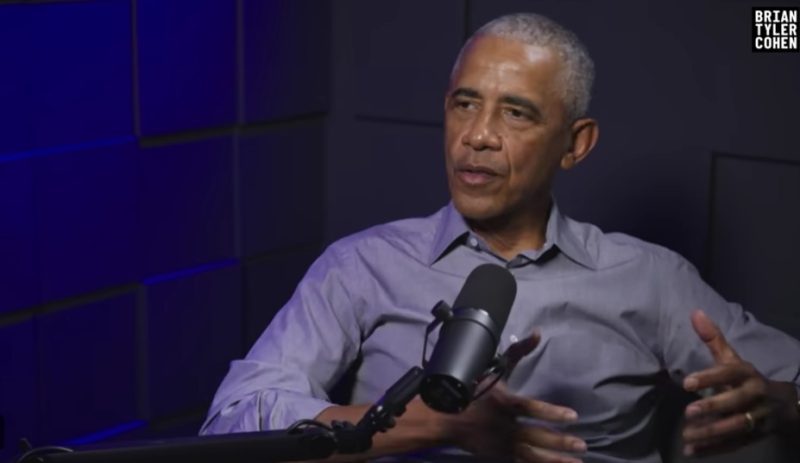
Barack Obama sat down with podcaster Brian Tyler Cohen for what amounted to his most pointed public commentary since Trump’s second term began, covering everything from Trump’s racist AI video depicting the Obamas as apes to the deadly ICE operations in Minneapolis, Democratic Party strategy for 2028.
The 52-minute conversation, published on Cohen’s “No Lie” podcast, marked Obama’s first on-camera remarks since Trump’s Truth Social account posted and then deleted an AI-generated video on February 5 that placed the faces of Barack and Michelle Obama onto the bodies of apes. The video, set to “The Lion Sleeps Tonight,” drew condemnation from both sides of the aisle, with even Republican Senator Tim Scott calling it “the most racist thing” he had seen from the president.
Obama’s response was vintage: measured in tone, devastating in implication.
On the Racist Video: A ‘Clown Show’ Without Shame
Rather than directly naming Trump, Obama chose to frame the viral outrage as symptomatic of something bigger. He acknowledged the video gets “attention” and called it “a distraction,” but quickly pivoted to what he sees as the real story: a fundamental collapse of political norms.
“There doesn’t seem to be any shame about this among people who used to feel like you had to have some sort of decorum and a sense of propriety and respect for the office,” Obama said. “That’s been lost.”
He described the current political environment as “a clown show that’s happening on social media and on television,” drawing a sharp line between what dominates online discourse and what he says he encounters when traveling the country. Americans, he argued, still believe in “decency, courtesy, kindness.” The video, in his framing, reveals more about the people who post it and tolerate it than it does about its targets.
Trump has refused to apologize for the video, blaming a staffer and insisting he never saw the offensive final frames. The White House initially dismissed criticism as “fake outrage” before the post was removed.
On Minneapolis: ‘Rogue Behavior’ Compared to Dictatorships
The sharpest section of the interview came when Obama turned to the ICE operations in Minnesota, where roughly 3,000 federal agents were deployed under “Operation Metro Surge” beginning in December. The operation, which targeted Minneapolis and St. Paul, resulted in the deaths of two American citizens: 37-year-old Renee Nicole Good, a mother of three killed on January 7, and Alex Jeffrey Pretti, a 37-year-old ICU nurse killed later that month.
Obama called the federal agents’ behavior “deeply concerning and dangerous,” describing tactics that included pulling people from their homes, using five-year-old children to bait their parents, and tear-gassing crowds who were simply standing in the street, breaking no laws.
“This is not the America we believe in,” he said, comparing the ICE actions to what “we’ve seen in authoritarian countries” and “in dictatorships, but we have not seen in America.”
But Obama spent just as much time praising the community response. Residents of the Twin Cities organized in subzero temperatures, buying groceries for neighbors, accompanying children to school, staging peaceful protests, and using whistles and car horns to alert communities when ICE agents were nearby.
“That kind of heroic, sustained behavior in subzero weather by ordinary people is what should give us hope,” Obama said.
Border czar Tom Homan announced Thursday that Operation Metro Surge is concluding, with a drawdown of federal immigration officers from the region. The administration also removed border chief Greg Bovino from Minnesota operations amid the growing backlash.
On 2028: Democrats Need a ‘Robust’ Primary and a Younger Candidate
Cohen asked Obama how Democrats can avoid a repeat of the Bernie-Hillary factional warfare that has plagued past election cycles. Obama’s answer was both diplomatic and pointed.
First, he argued the intra-party divisions get exaggerated. “Bernie Sanders believes, just like Nancy Pelosi believes, just like Chuck Schumer believes, just like Hakeem Jeffries believes, just like AOC believes, in equality and non-discrimination,” Obama said. Compared to parliamentary systems with multiple competing parties, he suggested, Democratic disagreements are relatively narrow.
But the more revealing comments came on the question of candidates. Obama called for a “robust” 2028 primary, noting that his own grueling 2008 battle against Hillary Clinton ultimately made him a stronger nominee. He pointedly argued that Democrats perform best with candidates who are “plugged into the moment, to the zeitgeist, to the times.”
“I’m 64 now. I’m pretty healthy, feel great,” Obama said. “But the truth is, half of the references that my daughters make about social media, TikTok, etc., I don’t know who they’re talking about. There is an element of, at some point you age out, you’re not connected directly to the immediate struggles that folks are going through.”
He did not mention Joe Biden by name, but the subtext was impossible to miss. Biden, who was dogged by age concerns before suspending his 2024 campaign, represents precisely the cautionary tale Obama appeared to be outlining. The message to the Democratic bench: step up, and don’t be afraid to fight it out.
On Bad Bunny: The Halftime Show as Political Blueprint
In one of the interview’s more unexpected moments, Obama held up Bad Bunny’s recent Super Bowl halftime performance as a model for how the left should communicate. The contrast with the anger-driven politics of the right was deliberate.
“The other side does the mean, angry, demagoguery, the us-versus-them divisive politics. That’s their home court,” Obama said. “Our court is coming together.”
He praised the halftime show for being effective precisely because it was not preachy. “It wasn’t political. It resonated. It was smart. Because it wasn’t preaching; it was showing,” Obama said. He described the performance, with its intergenerational imagery of grandmothers dancing with children and community scenes from Puerto Rico, as an embodiment of Martin Luther King Jr.’s vision of “the beloved community.”
“There was a sense of, all right, there’s room for everybody here. That, I think, is where we win,” he added.
And Yes, on Aliens: ‘They’re Real’
Because no Obama interview would be complete without at least one viral soundbite, the former president also addressed the question of extraterrestrial life. Asked directly by Cohen whether aliens are real, Obama did not hesitate.
“They’re real, but I haven’t seen them,” he said, adding that they are not being held at Area 51. “There’s no underground facility, unless there’s this enormous conspiracy and they hid it from the president of the United States.”
When Cohen asked what Obama’s first question was upon becoming president, he laughed: “Where are the aliens?”
The comments land at a moment when congressional interest in unidentified anomalous phenomena (UAPs) has intensified, with multiple hearings and government whistleblowers alleging the retrieval of non-human biological matter from unidentified craft.
The Bigger Picture
This interview represents a clear shift for Obama, who deliberately minimized his public profile throughout Biden’s presidency to let the next generation of Democrats find their footing. That restraint appears to be over. Between his January column calling Alex Pretti’s death a “wake-up call” and now this podcast appearance, Obama is stepping back into the public arena with a specific message: the American people, not politicians, will ultimately determine the country’s direction.
Whether that optimism is well-placed remains to be seen. But the 44th president is betting that the protests in Minneapolis, the backlash to the ape video, and the cultural resonance of a Bad Bunny halftime show tell a more accurate story about where this country is headed than anything happening on Truth Social.
“As long as we have folks doing that,” Obama said of ordinary Americans standing up, “I feel like we’re going to get through this.”