
Germany had never lost a World Cup penalty shootout until Paraguay beat them 4-3 in sudden death in the 2026 round of 32. On the same day, Morocco knocked out the Netherlands on penalties, the Dutch side’s third straight World Cup exit from the spot.
Results like these keep alive the idea that shootouts are a lottery. The research tells a more useful story, because the gap between winners and losers is shaped by pressure, timing, preparation and a goalkeeper’s willingness to do nothing.
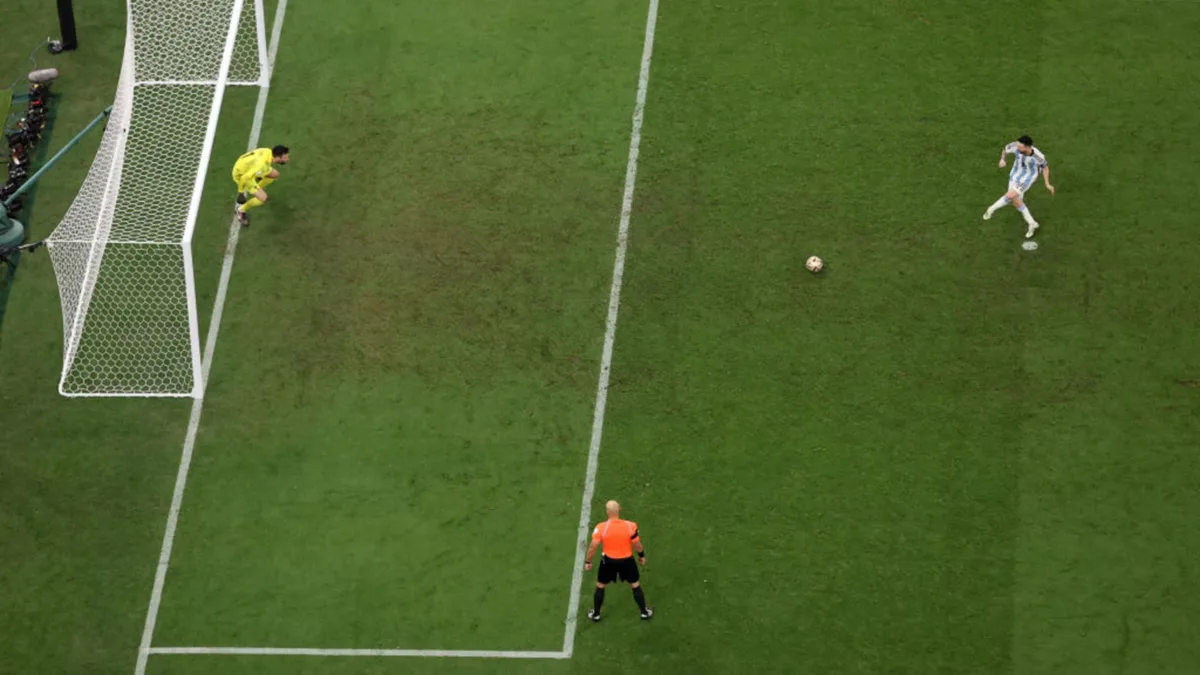
Is a Shootout Really a Lottery?
Penalties are easier to score in open play than in a shootout, which is the first clue that something besides luck is involved. Writer Ben Lyttleton put the World Cup shootout scoring rate at 71%, against about 78% for penalties in professional football overall.
A 2023 study of roughly 50,000 penalties from 11 seasons of European men’s football, about a third of them taken in more than 1,500 shootouts, found the same drop. The authors traced it to worse performance by the kickers, not better goalkeeping, which points squarely at the mental side of the duel.
The 2026 World Cup followed the pattern. In a video review of the tournament’s first 60 penalties, FOX’s Tyler Thrasher counted 25 goals from 40 shootout kicks, a conversion rate close to 62%. Expected-goals models usually value a penalty at around 0.75 to 0.80 goals, so a shootout converting in the low 60s is falling well short of even the cautious end of that range.
Five Factors That Tilt a Shootout
No single factor decides a shootout, but research and recent tournaments keep pointing to the same handful of influences. These are the ones that show up most often in the evidence:
- How the kick is framed: players score far more often when a goal would win the shootout than when a miss would lose it.
- Time taken: takers who rush to the ball after the whistle tend to perform worse than those who settle first.
- Run-up style: stutter run-ups divide opinion, and the evidence on whether they help is mixed.
- Goalkeeper preparation: keepers armed with notes on each taker’s habits can tilt individual kicks.
- Kicking order: early studies suggested going first helped, although larger datasets have challenged that.
Pressure sits behind almost every item on that list. A taker who rushes, abandons a planned run-up or freezes under a keeper’s stare is usually reacting to the moment, not to a lack of technique.
Run-ups show how contested some of these factors are. In Thrasher’s 2026 sample, stutter run-ups scored 7 of 14 shootout kicks against 18 of 26 for traditional approaches, though he called the sample small, while other research cited by ITV put stutter conversion near 80%. Harry Kane’s stuttering kick against Croatia was saved before a retake, because the goalkeeper had left his line early, and he scored the second with a conventional run-up.
How Pressure Changes Every Kick
Norwegian sports psychologist Geir Jordet has studied shootouts for more than two decades, and his work is cited for one of the starkest findings in the field. In major tournaments, players scored about 92% of kicks that would win a shootout outright, but only around 60% of kicks they had to score to avoid defeat.
Behaviour before the kick matters almost as much. Lyttleton reported that English players waited an average of just 0.28 seconds between the whistle and the start of their run-up, faster than any other nation, and were more likely to turn their backs on the goalkeeper. England lost six of seven tournament shootouts between 1990 and 2012.
From 2018, with Jordet consulting on England’s penalty project, the squad began treating the walk, the wait and the run-up as skills to rehearse under realistic pressure, and penalties as a team effort instead of a lonely test.
The same rush that undoes a penalty taker shows up in quick decisions off the pitch. At an online casino, a richard casino no deposit bonus code deserves the opposite approach: checking whether it is entered at sign-up or in the cashier, whether it is open to players in Australia, and whether it can be combined with other offers.
The Goalkeeper’s Side of the Duel
Goalkeepers face the opposite problem from takers, since the pressure falls on the man shooting and a save is a bonus. That freedom lets keepers shape a shootout through preparation and presence, as long as they stay within the laws. Two themes stand out in how they approach it.
Why Keepers Dive Anyway
A 2007 study led by Michael Bar-Eli analysed 286 penalties and found that goalkeepers almost always dive left or right, even though staying in the centre would often be the better strategy. The researchers called it action bias, since conceding while standing still feels worse than conceding after a dive.
The Rule That Reined In the Mind Games
Emiliano Martínez’s antics during Argentina’s 2022 World Cup final shootout win over France became the most debated example of gamesmanship. From 1 July 2023, IFAB’s laws have stated that goalkeepers must not unfairly distract the kicker, including by delaying the kick or touching the posts, crossbar or net. An earlier change in 2019 already required keepers to keep at least part of one foot on, or in line with, the goal line as the kick is taken.
Winners and Losers in the Record Books
National records show how quickly a reputation can change once preparation catches up with pressure. The table below compares four teams with very different shootout histories.
| Team | The record | What changed |
|---|---|---|
| England | Six defeats in seven major-tournament shootouts between 1990 and 2012 | Three wins in four from 2018, after a structured penalty programme and goalkeeper homework |
| Germany | Unbeaten in World Cup shootouts before 2026 | Lost 4-3 to Paraguay in sudden death in the 2026 round of 32 |
| Netherlands | Beaten by Argentina in World Cup shootouts in 2014 and 2022 | Lost to Morocco in 2026, a third straight World Cup exit on penalties |
| Argentina | Beat the Netherlands on penalties in 2014 and 2022 | Won the 2022 final against France in a shootout |
England’s turnaround came after the national team built a penalty project with Jordet as a consultant, and goalkeeper Jordan Pickford’s water bottle, covered in notes on Swiss takers, became a symbol of it at Euro 2024. Argentina’s recent run has leaned heavily on Martínez, who was central to both the 2022 quarter-final shootout against the Netherlands and the final against France. Germany’s 2026 defeat shows that even the best record offers no protection on a bad night.
Does Kicking First Help?
For years, winning the coin toss looked like a real edge. A study by Jose Apesteguia and Ignacio Palacios-Huerta found that teams kicking first won 60.5% of 129 shootouts, a result that fed into IFAB’s 2017 trial of an alternative ABBA order, including at that year’s Community Shield.
Larger samples have since weakened that case considerably. Martin Kocher, Marc Lenz and Matthias Sutter found first-kicking teams won 53.4% of 262 shootouts, which was not statistically significant, and the 2023 study of 50,000 penalties found no advantage for either side in the usual alternating order. IFAB dropped the ABBA experiment, and the traditional sequence remains in place.
Conclusion
Penalty shootouts are not pure luck, even if chance still plays its part on the night. The teams that win tend to manage pressure better, take their time, stick to their plan and back a goalkeeper who has done the homework.
The evidence on kicking order is weaker than the old 60% figure suggested, so preparation remains the edge a team can actually control. Anyone tempted to bet on a shootout’s outcome should set a limit first, and Gambling Help Online offers free, confidential support if those bets start to feel like the real pressure.
FAQ
Is a penalty shootout just luck?
Only partly, since conversion drops under shootout pressure and research links misses to rushed kicks and fear of losing. Routines and goalkeeper homework can shift the odds, even though chance still plays a part.
Does the team that shoots first have an advantage?
One study of 129 shootouts found first-kicking teams won 60.5%, but larger later studies found no significant advantage. The evidence now leans towards the alternating order being fair to both sides.
Why do goalkeepers dive instead of staying in the middle?
Research on 286 penalties suggested staying central would often work better, but keepers almost always dive. Being beaten while standing still feels worse than diving the wrong way, a pattern known as action bias.
What is the success rate of penalties in a shootout?
It varies by sample, but World Cup shootouts have historically converted around 71%, compared with roughly 78% for penalties across professional football as a whole.