
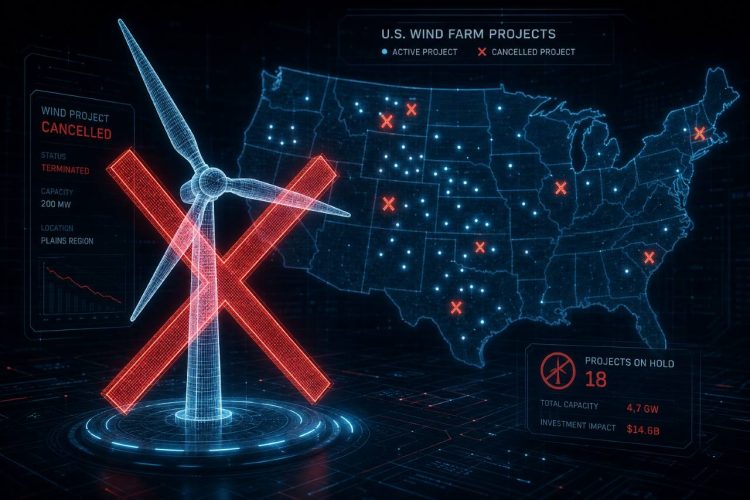
The Trump administration’s war on wind energy is no longer a policy preference. It is an operational shutdown. Approximately 165 onshore wind projects on private land across the United States are frozen because the Pentagon has stopped processing approvals, according to the American Clean Power Association and people close to the affected developments. Simultaneously, the Department of the Interior announced an immediate pause on all large-scale offshore wind leases, citing classified national security reports. The combined effect is the most complete halt of wind energy development in modern American history.
And it happened almost entirely in the dark.
How the Freeze Works
Wind projects near military installations or flight paths require sign-off from the Department of Defense to ensure they do not interfere with radar systems or training operations. This review process has existed for years and has traditionally been routine, a box-checking exercise that rarely delayed projects significantly. Under the current administration, that process has been weaponized.
Since August 2025, developers have faced a cascading series of bureaucratic roadblocks: a lack of expected communication from the Pentagon, canceled meetings with no opportunity to reschedule, and blanket statements that “applications are no longer being processed.” The affected projects include wind farms that were awaiting final sign-off, others in the middle of negotiations, and some that under normal circumstances would not even require Pentagon oversight.
The pattern is not accidental. It is a coordinated administrative freeze designed to kill projects through inaction rather than formal policy. No executive order was signed. No legislation was passed. The wind industry is simply being starved of the approvals it needs to build, and the Pentagon is the chokepoint.
The Offshore Shutdown
The onshore freeze is only half the story. The Department of the Interior announced it is pausing all large-scale offshore wind project leases currently under construction in the United States, effective immediately. The justification: “national security risks identified by the Department of War in recently completed classified reports.”
The use of classified reports as the basis for a public policy decision is a neat trick. It allows the administration to cite national security without providing any evidence that can be publicly scrutinized, challenged, or debated. Congress cannot evaluate what it cannot see. Environmental groups cannot litigate against findings they are not allowed to read. The classification acts as a shield against accountability.
What specific national security threat a wind turbine poses off the coast of New Jersey or Massachusetts has not been explained in any unclassified forum. The administration has offered no public briefing, no declassified summary, and no opportunity for the affected companies to respond to the findings. Billions of dollars in investment and thousands of construction jobs are on hold because of a report that nobody outside the intelligence community is allowed to read.
The Energy Dominance Contradiction
This is where the policy incoherence becomes impossible to ignore. The Trump administration has made “energy dominance” a central pillar of its economic message. The president talks constantly about unleashing American energy production, lowering costs for consumers, and reducing dependence on foreign suppliers. Wind energy, which requires no imported fuel, creates domestic manufacturing jobs, and generates some of the cheapest electricity available, would seem like a natural fit for that agenda.
Instead, the administration is strangling wind at the exact moment when energy price shocks from the Iran war have made the case for diversified domestic energy sources more urgent than ever. Jet fuel prices have doubled. Gasoline is punishing household budgets. An entire airline just went bankrupt because of fossil fuel price volatility. The rational response would be to accelerate every available domestic energy source, wind included. The administration’s response is to shut wind down.
The explanation is not economic. It is political. Wind energy has become a cultural signifier in the same way electric vehicles and solar panels have. Opposition to wind is a tribal marker, a way of signaling alignment with fossil fuel interests and skepticism toward climate policy. The national security framing provides cover for what is fundamentally an ideological project: picking energy winners and losers based on political identity rather than market performance or national interest.
Who Gets Hurt
The people most affected by the wind freeze are not coastal environmentalists. They are rural landowners in Texas, Iowa, Kansas, Oklahoma, and the Great Plains who lease their property for wind turbines and depend on that income. They are construction workers who build the towers. They are the small-town economies that have been revitalized by wind development over the past two decades.
The American Clean Power Association estimates that the frozen projects represent billions in planned investment and tens of thousands of jobs. Many of those jobs are in red states and red districts, in communities that voted overwhelmingly for the president now blocking their economic lifeline. The irony is not subtle, but it is apparently lost on an administration that has decided wind turbines are the enemy.
What Comes Next
Legal challenges are inevitable. The American Clean Power Association and individual developers are evaluating their options, and the use of an administrative freeze rather than a formal policy action creates potential vulnerability. If the Pentagon cannot demonstrate a legitimate national security basis for withholding approvals on projects that have historically been rubber-stamped, courts may force the process to resume.
But litigation takes time, and every month of delay costs developers money and pushes project timelines further into uncertainty. Some projects will die not because they were formally rejected, but because their financing dried up while they waited for approvals that never came. That is the point. The administration does not need to ban wind energy. It just needs to make building it impossible.
The wind industry built its success on market economics: it became cheaper than coal and competitive with natural gas in many regions. The administration’s response to that market success is not competition. It is obstruction. And the Americans who will pay the price are the workers, landowners, and communities who bet on wind as their future, only to discover that their government had other plans.