
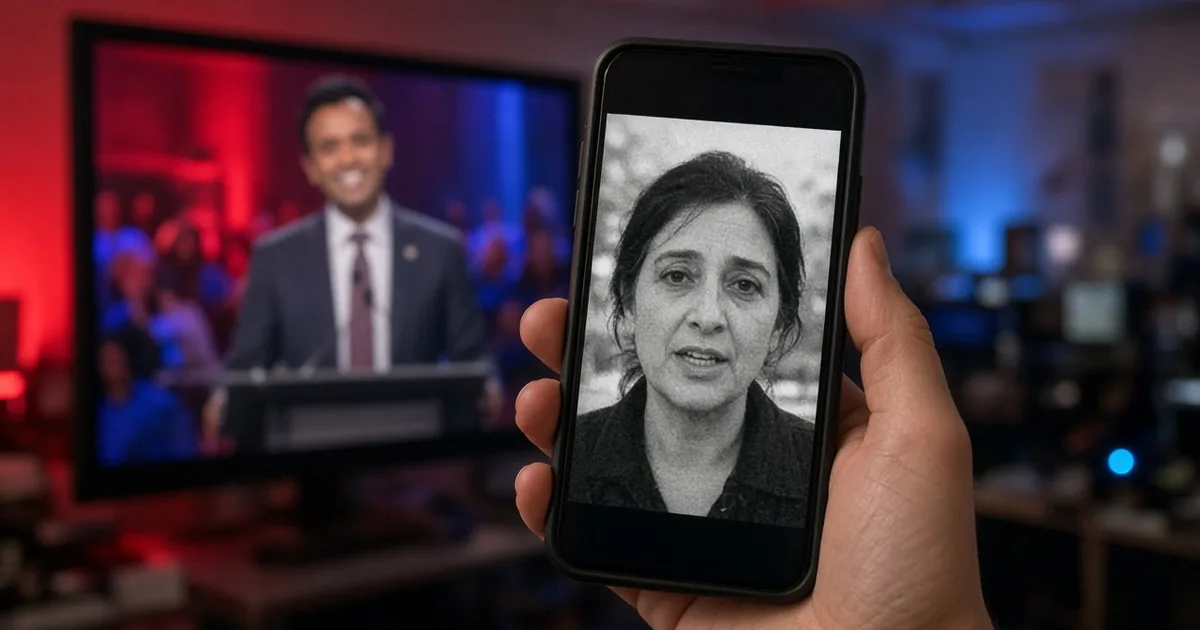
What the ad says. Donna Arthur, Amy Acton’s estranged mother, calls her daughter a liar, suggests she has mental health problems, and says she lied about growing up homeless.
What the record says. In July 1978 Acton’s stepfather was arrested for raping her when she was 12, and a grand jury indicted him that September. He pleaded not guilty, skipped a later hearing, and stayed a fugitive until at least 1981.
Vivek Ramaswamy told reporters Tuesday that the one-minute video of his Democratic opponent’s mother came from his campaign and that he considers it legitimate, and his campaign says it will put $4 million behind it online and on television. What the coverage so far has not done is lay the ad’s claims next to the court record and the calendar, and when you do, the question stops being whether this was in poor taste and becomes what a campaign thinks it buys with a child-abuse case and a statewide ad buy when 676,000 Ohioans have already voted.
What Happened, and What the Campaign Has Not Said
The video surfaced first on a post by Ohio political blogger D.J. Brynes, who writes as The Rooster and told CNN that a voter recorded it while taking a poll. The Ramaswamy campaign’s first statement did not say whether Ramaswamy was responsible for it or knew who made it, and Acton condemned it before the campaign owned it. By late Tuesday the campaign had confirmed it produced the video, and spokesperson Connie Luck said Arthur was not paid and that Acton has “some serious problems with the truth.” The AP reported that the video also lacked the “paid for” disclaimer federal rules require on a television ad, which is the line that tells a viewer who made a spot and who is paying for it. Axios reported Wednesday that Ramaswamy is doubling down despite the backlash.
Two questions are still unanswered, and they matter more than the adjectives. Ramaswamy did not say whether Arthur was coached, and he did not say who wrote the script. A mother speaking in her own words to a camera is one thing. A mother delivering lines assembled by a campaign, in a one-minute spot with a statewide buy behind it, is an opposition-research product, and voters are entitled to know which this was before the money runs.
The Record the Ad Walks Past
Acton has said she was removed from her mother’s custody at 12 because of severe abuse, neglect and sexual abuse, and the paper trail the AP assembled backs the core of it. Her stepfather, Cledith Arthur, was arrested in July 1978 and charged with raping her after her biological father reported him to authorities. The alleged abuse ran from December 1976 to April 1978, about sixteen months. He pleaded not guilty, a grand jury indicted him that September, and he failed to appear at a later hearing and remained a fugitive until at least 1981. He has since died. Acton’s brother, Philip Stearns, said he and his sister were removed from their mother’s custody after the indictment, and that Acton has not seen Arthur since they were in a courtroom together in 1978. The Ohio Capital Journal put the point in its headline: court documents say otherwise.
Precision matters here, because the rebuttal lives in what was charged and not in what was proven. Cledith Arthur was never convicted of anything in this case, since he ran, and nobody should write that he was. But the ad does not ask viewers to weigh a trial verdict. It asks them to believe a woman who says her daughter is lying, about a childhood in which the daughter was taken out of that woman’s home after an indictment of the man in it. The campaign can argue about the tent and the homelessness, which is a dispute between two family members’ memories. It cannot argue its way around the 1978 arrest, the indictment and the courtroom, and the ad needs the viewer never to think about them.
Four Million Dollars, 676,000 Ballots
The arithmetic is the part nobody has printed. Time reported on October 19 that Ramaswamy and his supporters have already run $101 million in ads against Acton, $36 million of it his own money. Four million dollars is about 4 percent of that total, a rounding error for a campaign at this scale and not the kind of sum anyone spends on a mistake. Meanwhile the AP counted more than 676,000 Ohioans who had cast ballots by the time the video appeared. Spread over those votes alone, the buy works out to roughly $5.92 for each ballot that no ad can take back. The campaign is not spending to reach them. It is spending on everyone who has not voted yet, and it chose this video as the message.
That choice tells you what the campaign believes. Polls consistently show an advantage for Acton, according to Time, and an Akron political scientist told the magazine that “all of the polls are trending in the right direction for Acton.” A campaign behind in the polls with a $101 million ad record does not need to guess who its voters are. It looked at its options and decided that the sharpest weapon it had was a mother who has not spoken to her daughter in decades, and then it paid to put her in front of the whole state.
Republicans noticed. Casey Putsch, who lost the Republican primary to Ramaswamy, said he would vote for Acton and called the video “pretty damn low.” Meghan McCain called it “dastardly.” A strategist for Sen. Mike Lee deleted his post sharing it. Sherrod Brown, the Democratic Senate nominee, called it “disgusting” and asked Sen. Jon Husted to condemn it, and Husted’s campaign did not respond to the AP’s request for comment. Donald Trump Jr. and Laura Loomer promoted the video anyway, and that tells you which wing of the party is enjoying this.
Where This Site Stands
We think the ad is indefensible, and that Ramaswamy’s defense, that it is “legitimate,” is a more revealing statement than the video. A candidate can fairly say his opponent has misstated her record, and a campaign is entitled to test it. It is not legitimate to buy statewide airtime for a mother’s accusation against a daughter who was removed from that mother’s home after her stepfather was indicted for raping her, to leave off the disclosure that tells voters who is speaking, and then to decline to say who wrote the lines. Ramaswamy owns it now. He confirmed the video himself, and the $4 million is a decision, not an accident.
The question for the next two weeks is whether the disclaimer failure draws a complaint, whether Husted is made to answer for it, and whether the 676,000 early voters turn out to be the only Ohioans the ad cannot reach. Ramaswamy has made his bet that the rest will not ask what the record says. The record is in the court file, and the file is public.