
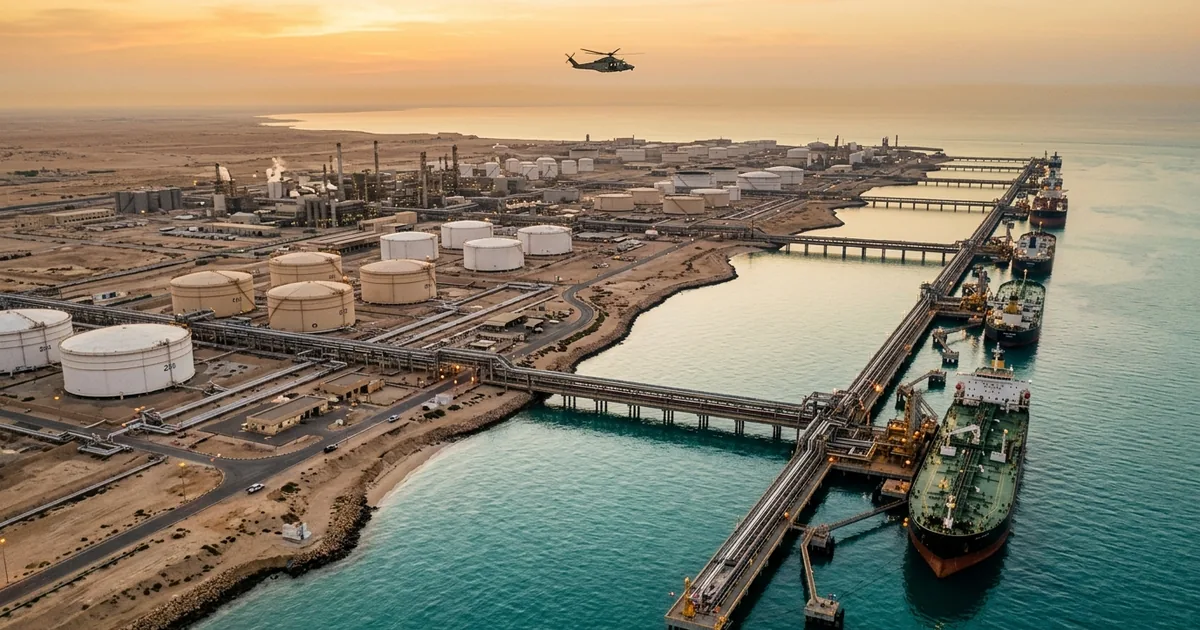
A helicopter belonging to Saudi Aramco crashed Saturday in the kingdom’s most critical oil export hub, killing all 14 Saudi nationals aboard.
The crash at Ras Tanura, confirmed by the Saudi energy ministry through state news agency SPA, comes just days after Aramco resumed crude loadings at the terminal following a nearly four-month suspension tied to regional security disruptions.
What Happened at Ras Tanura
The Aramco helicopter went down at approximately 6 a.m. local time (03:00 GMT) on Saturday, June 28, in or near the Ras Tanura complex on Saudi Arabia’s eastern Gulf coast. Al Jazeera reported that all 14 people on board were killed, with Saudi authorities confirming all victims were Saudi nationals. The Saudi Press Agency cited an unnamed energy ministry official who said a full investigation has been launched to determine the cause.
No immediate details have been released about the helicopter’s model, the purpose of the flight, or the identities or roles of those killed. That gap matters: Ras Tanura is not a passenger hub. Helicopter traffic there is overwhelmingly operational, ferrying crew and engineers to offshore platforms and terminal infrastructure. Whoever was on that aircraft was almost certainly tied to Aramco’s energy operations.
Why Ras Tanura Is Not Just Another Crash Site
Ras Tanura is one of the largest oil export terminals on Earth. At full capacity, it handles roughly 6.5 million barrels per day of crude and refined products, making it a linchpin of the global energy supply chain. The terminal had been partially shuttered since early March, when escalating tensions with Iran and disruptions near the Strait of Hormuz forced Aramco to halt loadings as a precaution.
CNN confirmed that Aramco resumed crude oil loadings at Ras Tanura just this past Friday, the day before the crash. That timeline is significant. A facility spinning back up after months offline runs with heightened operational tempo: equipment being reactivated, crews rotating through accelerated schedules, safety protocols being re-established after an extended pause. Whether the resumption played any role in the crash is unknown, but the proximity will be central to the investigation.
The Broader Safety Question
Saudi Aramco operates one of the world’s largest industrial helicopter fleets, transporting thousands of workers daily across a network of offshore platforms, refineries, and pipeline stations in the Eastern Province and the Persian Gulf. The scale of the operation is staggering, and incidents, while rare, carry outsized consequences given the remote, high-risk environments involved.
Saturday’s crash is the deadliest aviation incident connected to Aramco in recent memory. It also arrives amid a global stretch of fatal air incidents: earlier Saturday, a skydiving plane crashed near Nancy, France, killing all 11 on board, and three U.S. firefighters were killed in a Colorado wildfire burnover. The clustering is coincidence, but the pattern sharpens a point: aviation safety in specialized, high-tempo operations deserves more scrutiny than it typically receives.
What Comes Next
The investigation will be led by Saudi civil aviation authorities, likely in coordination with Aramco’s internal safety division and potentially the helicopter manufacturer’s investigative team. In incidents involving state-owned energy companies in the Gulf, findings are sometimes released months after the event, and not always in full.
For oil markets, the immediate impact is limited. Ras Tanura’s resumption of loadings is not expected to be affected by the crash, and Aramco’s overall production targets remain unchanged. But the human cost is already clear: 14 people left for a routine flight at the heart of the world’s energy infrastructure and did not come back.
The question the investigation needs to answer is whether something about the resumption timeline, the equipment, the conditions, or the procedures at a facility just days back online contributed to the crash, or whether this was a mechanical failure or human error that could have happened on any day. Until that answer comes, the only certainty is 14 families waiting for an explanation that Aramco and the Saudi government owe them.